
Hook Lift Container Guide for Concrete Washout Jobs
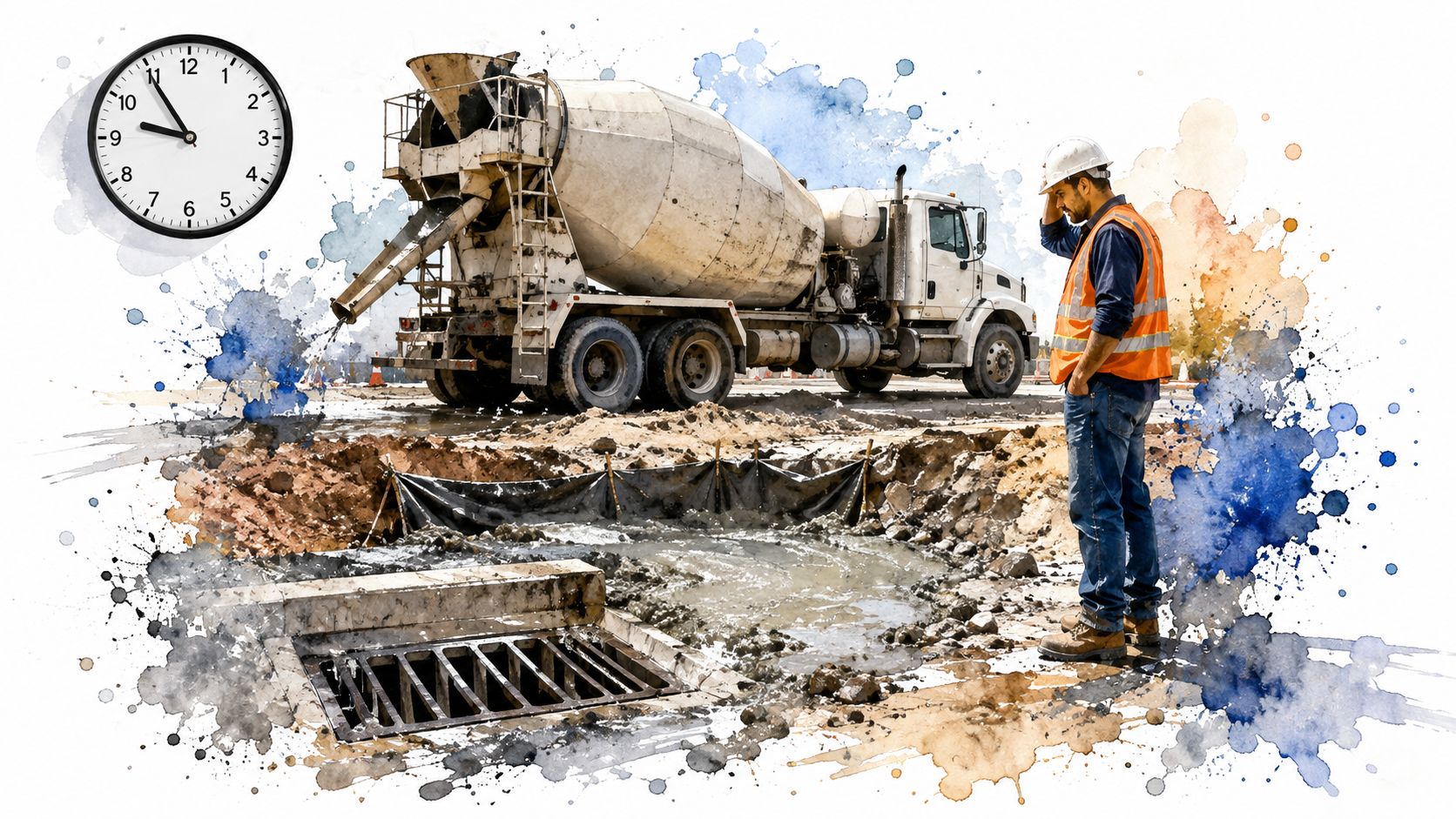
A concrete pour is already moving when someone asks where the washout will go. The mixer is queued, the pump is primed, and the only available spot is an uncovered pit beside a storm drain. That setup may look workable until the first chute rinse spreads cement slurry across the grade, an inspector arrives, or the crew needs to leave the site clean for the next trade.
A hook lift container gives the superintendent a controlled alternative. Delivered before the pour, placed on a stable pad, and used only for concrete washout, it turns cleanup into a planned containment and swap operation. The value isn't just the steel box. It's the reduction in spill exposure, cleanup labor, site disruption, and uncertainty at handoff.
Why Your Next Pour Needs the Right Washout Plan
The washout decision belongs in the pre-pour plan, not in the last ten minutes after the final truck leaves. A designated container keeps chute rinsing, pump discharge, and related slurry inside one defined location instead of sending alkaline material onto soil, pavement, or a drainage path.
Concrete washout is treated as a priority construction pollutant under stormwater compliance programs, and the EPA's construction stormwater guidance is built around preventing contaminated discharges from leaving the work area. The practical question for a crew isn't whether the washout looks messy. It's whether the site has a visible, usable containment method that remains effective through the full pour.
The four problems a container should solve
- Compliance: The washout location is identified, labeled, and included in the project's stormwater controls rather than improvised beside an inlet.
- Capacity: The pan or container can hold the planned rinse water and slurry without relying on a last-minute second pit.
- Swap speed: A full body can be removed and replaced with an empty one, keeping the pour moving on high-volume days.
- Clean handoff: The finishing crew, grading crew, and inspector see a contained work area instead of hardened splatter and tracked slurry.
A container won't rescue poor placement or careless discharge. The chute still has to point into the opening, the pump hose still has to stay inside the containment area, and the crew still needs to monitor the fill level. What it does is make the correct action easy to repeat.
Practical rule: If the washout location hasn't been selected, delivered, and checked before the first truck arrives, the plan isn't finished.
A hook lift setup works especially well when the project has several pours, changing access conditions, or limited room for permanent washout facilities. The operator can remove the full container, deliver it for approved handling, and set an empty body in the same controlled location. That swap-and-go cycle is cleaner than burying washout on site, vacuuming wet slurry by hand, or trying to scrape hardened concrete from an unprotected grade.
What a Hook Lift Container Actually Is
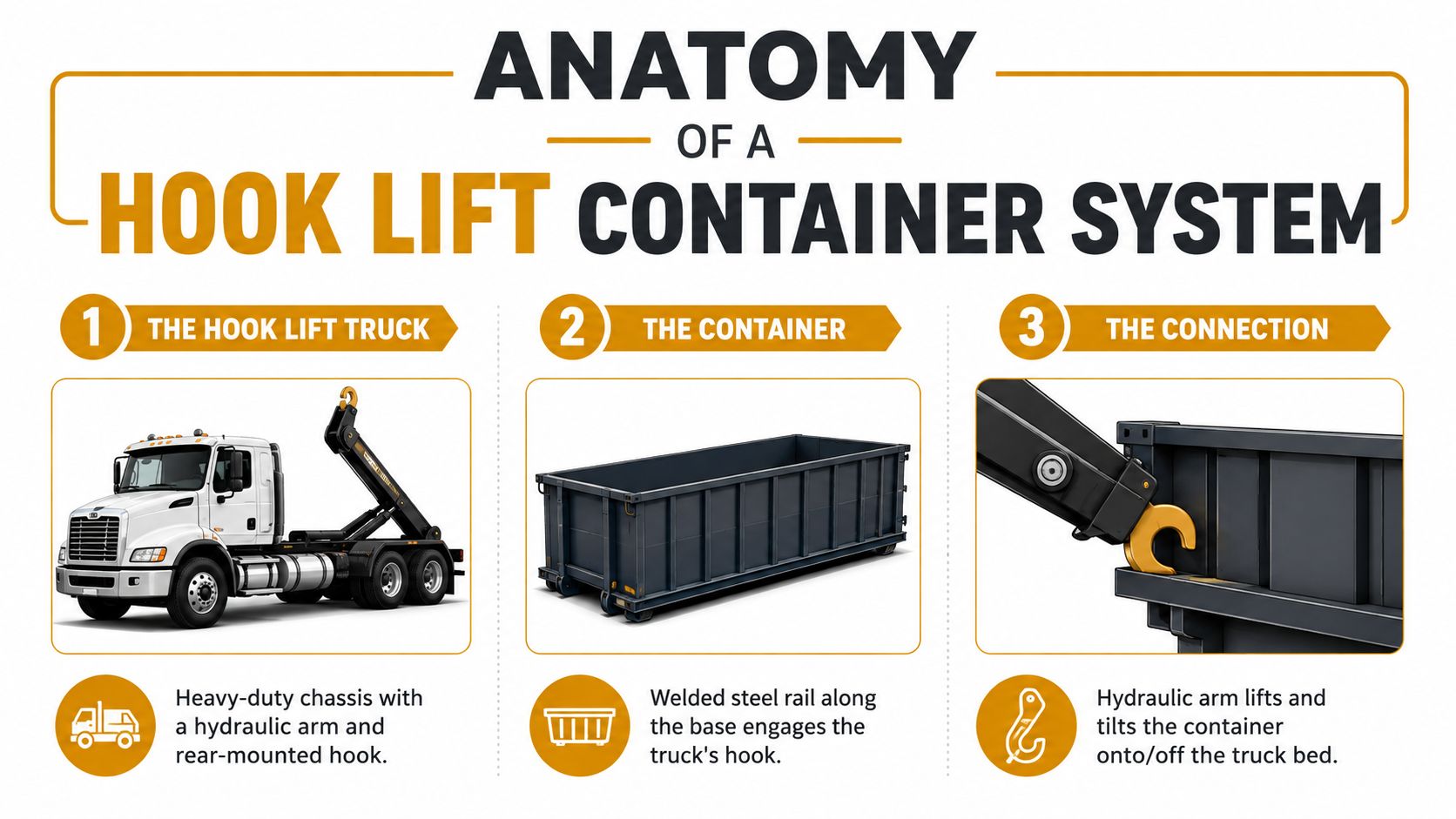
A hook lift container is a steel body designed to be loaded onto and removed from a truck by a hydraulic hook arm. The truck carries the lifting equipment. The container carries the material. The connection between them is a lifting rail or bar positioned to match the truck's hook geometry.
Think of the system like a rail-and-hook pickup. The truck backs straight toward the container, the hydraulic arm reaches to the front rail, and the hook catches it. As the arm retracts, it lifts and draws the body up the truck's rails until the container sits on the chassis. The same mechanism reverses the process when the driver drops the body onto a prepared pad.
The modern commercial history of the system traces to post-war Europe, where manufacturers developed it in the late 1950s and early 1960s for more efficient material handling and waste hauling. Industry history describes wider European adoption in the 1970s and arrival in the United States by the late 1970s to early 1980s, including a 1969 dual-pivot hydraulic design and U.S. introduction around 1980, as documented in the history of the hooklift system.
Know the parts before you order
A washout body usually includes a reinforced steel floor, side walls, a front lifting rail, and a rear opening or access arrangement suited to loading and cleaning. Some bodies use rear doors, while others are configured as open-top pans for direct chute and pump access. The truck's hook, hydraulic cylinder, rails, locks, and safety devices must all match the container.
The term can cause confusion because hook lift, roll-off, lugger, and dumpster may describe bodies that look broadly similar. The decisive difference is the loading interface. A roll-off cable truck pulls a container with a cable, while a hook lift truck engages a purpose-built rail with a hydraulic hook. A lugger body uses a different lifting arrangement again.
For concrete washout, that distinction matters. The container has to tolerate wet cementitious material, repeated loading, transport, and cleaning. It also has to lift without dragging across the ground during the pickup cycle. A properly matched hook lift container offers a defined swap process, which helps the crew remove a full body without turning the surrounding pad into another cleanup problem.
Sizes, Capacities, and What to Match to Your Pour
Container selection starts with the pour, but nominal cubic yardage isn't enough. The superintendent needs to match footprint, wall height, usable volume, payload, access, and truck compatibility. A tall body may hold more material, but a low-profile pan may be safer and easier to use beside a pump truck or under a restricted clearance.
Many hook-lift containers follow DIN 30722-style geometry. One industry guide identifies a 1,570 mm hook height, 1,065 mm rear roller spacing, an external length around 6.50 m, an external width around 2.55 m, and an internal height around 2.20 m for a common configuration, as outlined in this hooklift container dimensions guide. Those measurements aren't decorative. If the hook height or roller spacing doesn't match the hoist, the truck may not safely engage or carry the body.
For washout work, specialized low-sided pans can be more useful than a deep debris box. A 72 by 72 by 24 inch configuration is listed at approximately 18.25 tons and about 441 gallons by the rental provider's product information. A 72 by 72 by 14 inch configuration is listed at about 310 gallons. Those are different operating choices, not large and small versions of the same product.
Match the body to the work area
The deeper 24-inch pan suits a residential or small commercial pour where the truck chute and pump rinse can be directed into a broad opening and the site has room for safe access. The 14-inch low-profile version makes more sense where overhead clearance, pump access, or body height creates a problem. Its lower wall reduces the reach required for discharge, but the crew has less containment depth and must monitor fill more closely.
Standard hook-lift fleets can include smaller bodies around 10 cubic yards and larger containers up through 40 cubic yards, but the right choice depends on the truck and the material, not the label alone. A washout container should be sized for one full day's expected washout, not the project's cumulative concrete volume. If the body must be swapped during the pour, schedule that pickup before the crew reaches an unsafe fill level.
Also separate liquid volume from solid weight. Concrete slurry gets heavier as cement paste and aggregate accumulate, and the container's usable volume can be reached before the truck's rated payload is reached. Confirm both limits with the equipment provider.
Hook Lift Truck Compatibility and Safe Loading
A washout container can fail before the first chute rinse if the truck, hoist, and loaded body do not match. Common configurations include single-axle trucks in the 20,000 to 26,000 pound GVW range, tandem trucks up to 33,000 pounds GVW, and heavier chassis above that range. Those figures describe truck classes, not a safe load for every container. Confirm the truck rating, hoist rating, axle distribution, container tare weight, and wet washout load as one system.
Do not rely on the words “hook lift” in a listing. Two trucks may accept a similar body while differing in hydraulic capacity and fit. Confirm the actual hook height, rail spacing, cylinder rating, container length, rear roller arrangement, and permitted payload with the truck or body manufacturer. For concrete washout, also account for slurry that gains weight as cement paste and aggregate collect.
Load it in a repeatable sequence
- Approach on level ground. Keep the truck straight with the container. Misalignment can place side loads on the hook, rails, rollers, or chassis.
- Engage the front rail. Extend the hydraulic hook only after confirming that it is centered and fully captured.
- Lift and transfer slowly. Raise the body until the rear rollers clear the truck's body rails, then pull it onto the chassis under control.
- Check the seating points. Verify that the body is fully forward, transport locks are engaged, and debris is not preventing proper seating.
- Close and secure the body. Check the rear door latch, tailgate, tarp, cover, warning devices, and lights before entering public traffic.
U.S. federal rules for roll-on/roll-off and hook-lift style containers require the rear of the container to be secured with a compliant mechanism. Permitted methods include a tiedown to both chassis, two lengthwise tiedowns, or two hooks or equivalent devices securing both sides, as described in 49 CFR 393.134. The CVSA inspection bulletin emphasizes using a vehicle designed for these containers.
Unload without creating a second incident
Drop the container on a level, compacted pad with the truck aligned to the body. Lower it slowly while watching the rollers, rear corners, and ground beneath the container. Soft fill or a raised edge can make one corner settle first, twisting the body or sending slurry toward the wrong side.
The drop is not just pickup in reverse. Use a spotter when visibility is limited, and keep workers outside the hook path, roller path, and pinch points. A controlled set-down protects the container, prevents a spill, and leaves the washout area ready for the next pour.
Site Best Practices for Concrete Washout Containment
The container should sit inside the construction footprint, on stable compacted ground, and away from storm drains, curb cuts, catch basins, and waterways. A slight site grade can help only when it directs splash back toward the container. It shouldn't send runoff toward an inlet or across a public path.
The opening needs to face the truck's discharge point. If the mixer chute can't reach the pan, the crew may start rinsing onto grade, which defeats the purpose of the setup. Check truck turning space, pump hose reach, overhead obstructions, pedestrian routes, and the path the hook lift truck will use for pickup.
Give the crew simple pour-day instructions
Post the routine where the mixer and pump operators can see it:
- Rinse into the pan: Direct every chute rinse into the container opening, never onto soil, pavement, or a trench.
- Keep the pump hose contained: Place the discharge end inside the body before releasing residual concrete or rinse water.
- Control splash: Use a splash guard or a broad opening that lets operators work without striking the rim.
- Watch the fill level: Request a swap before the body reaches the point where movement, rain, or one more rinse could cause overflow.
- Sweep the edges: At handoff, collect stray concrete from slab edges and return it to the washout area where appropriate.
The container should hold concrete washout only. Paint, form oil, solvents, curing compounds, fuel residue, and unrelated site waste create a different handling problem and can move the material into a hazardous-waste disposal chain. Keep those streams separate from the start.
A liner can simplify removal and reduce hardened buildup on the steel, provided the liner is compatible with the body and doesn't interfere with lifting or securement. Cover the container when the pour ends, especially before rain, and use clear signage so a new laborer knows exactly what belongs inside. Daily checks should look for tears, settled material, blocked access, displaced covers, and any path toward drainage.
Compliance, Environmental Rules, and Road-Legal Reality
A washout container controls two risks at once: polluted runoff on the site and an unsecured, overweight load on the road. A clean work area does not compensate for a poorly maintained body, and a properly secured truck does not excuse slurry entering a drain or being left without a disposal record.
Projects disturbing one acre or more commonly require a stormwater pollution prevention plan, or SWPPP, that identifies concrete washout controls. The permit and local program set the exact obligation, so confirm requirements with the applicable regulator, engineer, or SWPPP specialist. State transportation departments and local MS4 programs may add conditions, including for smaller sites when another stormwater trigger applies.
Inspectors look for a working control they can verify. Keep the container labeled, use an intact liner where specified, prevent visible overflow or sheen, and maintain separation from inlets. Disposal records should show the approved receiving facility or service path. Leaving hardened or liquid material in an untracked back lot creates a separate compliance problem.
Keep the road move in the same compliance plan
Before pickup, inspect the body, rails, hooks, locks, doors, lights, tarp, and chains. Confirm that the loaded truck stays within its registered gross vehicle and axle limits, including route restrictions. Wet washout is dense. A body that looks only partly full can still put an axle or the entire vehicle over its permitted weight.
Train drivers and supervisors on the securement method that matches the hook lift truck and container design. Check that the load is seated correctly, all required restraints are engaged, and the tarp or cover will remain in place during travel. If the body, hooks, locks, or chains show damage, hold the pickup until the equipment is repaired or replaced.
In the UK, lifting equipment used by hookloaders falls under LOLER examination requirements, with thorough examination required at least every 12 months, according to UK HSE LOLER guidance. The responsible person should keep examination records available and confirm that the equipment is suitable for the planned lift.
Ownership can suit a contractor with frequent, predictable pours and the staff to maintain, store, transport, clean, and empty the body. Renting usually fits intermittent work, changing sites, or crews that prefer to coordinate those services through a provider. The lower-cost choice is the one that prevents overflow, failed pickups, road citations, and undocumented disposal.
Renting From Reborn Rentals, Pricing, and Booking Flow
For many concrete crews, renting is the practical default because the need is tied to a pour schedule rather than a permanent hauling route. A rental avoids tying capital up in a body that may sit between projects, while a specialized provider can coordinate delivery, pickup, swapping, and disposal logistics.
Published rental information lists daily pricing starting at $25 per day and offers washout options including a 72 by 72 by 24 inch body with approximately 18.25 tons and 441 gallons of listed capacity, plus a 72 by 72 by 14 inch body with about 310 gallons. Confirm the current quote directly because delivery, rough terrain, express orders, washout, mileage, and same-day swap requirements can change the final invoice.
Ask for the right quote
Send the provider more than a date and an address. Include:
- Pour schedule: State the planned pour date, start time, expected duration, and whether several trucks or a pump will work simultaneously.
- Washout estimate: Describe expected rinse activity and whether a swap may be needed before the pour ends.
- Site access: Identify gate width, surface condition, turning space, overhead obstructions, slopes, and whether the truck can approach straight.
- Placement point: Mark the proposed container location and identify nearby drains, curb cuts, waterways, utilities, and pedestrian routes.
- Water and discharge details: Explain where the water source is and how the mixer chutes and pump hose will reach the opening.
- Documentation needs: Request disposal records, pickup confirmation, and any container or service information required for the SWPPP file.
Confirm the delivery window and placement instructions before the truck arrives. For a high-volume pour, arrange the swap before the first body reaches its working limit. A same-day request made after the container is already overflowing is an emergency service problem, not a logistics plan.
Budget for the real job
Use the quoted base rate as the starting point, then ask which charges apply to your site. Check the included tonnage, the overage rate per ton, delivery and mileage treatment, rough-terrain charges, washout fees, express service, and same-day swaps. Build a modest 10 to 15 percent tonnage buffer into your internal estimate, as a planning allowance rather than a guaranteed industry requirement, and confirm local landfill restrictions before the pour.
The final checklist is short:
- Match the body geometry to the truck.
- Match capacity to one day's washout.
- Place it away from drainage and on stable ground.
- Train every discharge operator.
- Schedule pickup before overflow.
- Verify locks and securement before highway travel.
- File disposal documentation with the project records.
Reborn Rentals provides ready-to-deploy concrete washout pans and containers for pours, renovations, and changing construction sites, with delivery coordination and clear rental information. Visit Reborn Rentals to check available washout options, submit your site details, and arrange a container before the next truck arrives.

