
Portable Concrete Washout: Ultimate Guide for 2026
The pour is done, the crew is moving fast, and now everyone wants the same thing at once. The truck chute needs washing. The pump crew wants to rinse out. Finishers are cleaning tools. If you don't have a designated place for that slurry in the next few minutes, the site starts making decisions for you.
That’s when small mistakes turn expensive. Gray water runs toward a curb inlet. A laborer picks the nearest dirt corner. Someone says they’ll “deal with it later,” which usually means after it has spread, hardened, or been seen by the wrong inspector. Concrete washout problems rarely start as a major incident. They start as a rushed cleanup with no plan.
Portable concrete washout solves that problem when it’s treated as part of the pour plan, not an afterthought. The crews that stay clean and out of trouble usually do one thing well. They think through the full lifecycle before the first truck arrives: what unit they need, where it goes, how it’s used, how full it can get, who hauls it, and what the rental costs compared with the risk of winging it.
The Hidden Risk on Every Concrete Pour
On most sites, the risky moment isn’t the pour itself. It’s the cleanup right after.
A slab pour can be organized down to the minute, then fall apart in the last stretch because nobody set a washout location. The truck driver asks where to rinse. The pump operator needs a spot. Tools are covered. The nearest open ground looks convenient until that slurry starts moving across soil, stone, or pavement.

What the mess really costs
Concrete wash water doesn’t behave like harmless rinse water. It leaves residue, hardens where you don’t want it, and creates immediate housekeeping issues for the site team. Worse still, it puts the project manager in a bad spot if runoff reaches stormwater controls, adjoining property, or a public right-of-way.
That’s why portable containment keeps showing up on better-run jobs. The global portable concrete washout bin market was valued at US$ 224 million in 2024 and is projected to reach US$ 276 million by 2031, with a CAGR of 3.1%. That growth is tied to stricter environmental expectations and the fact that contractors need practical containment they can move where the work is happening.
What experienced crews do differently
They don’t rely on “somewhere over there.”
They assign a washout location before concrete arrives. They make sure the unit fits the type of work being done. They brief the truck drivers and pump crew. They monitor it during the job. Then they close the loop with proper pickup or disposal instead of leaving a hardened surprise for the next subcontractor.
Practical rule: If your washout plan starts after the pour ends, you’re already late.
A portable concrete washout is one of those site controls that seems simple until it’s missing. Then it becomes the most important thing on the job for the next half hour.
What Is a Portable Concrete Washout and Why Is It Non-Negotiable
A portable concrete washout is a self-contained unit used to collect concrete wash water, slurry, and solids from chutes, pumps, wheelbarrows, tools, and finishing equipment. It gives the crew one approved place to clean up without sending alkaline waste into soil, drains, or unfinished parts of the site.
That sounds basic, but the difference between controlled washout and casual washout is the difference between containment and contamination.
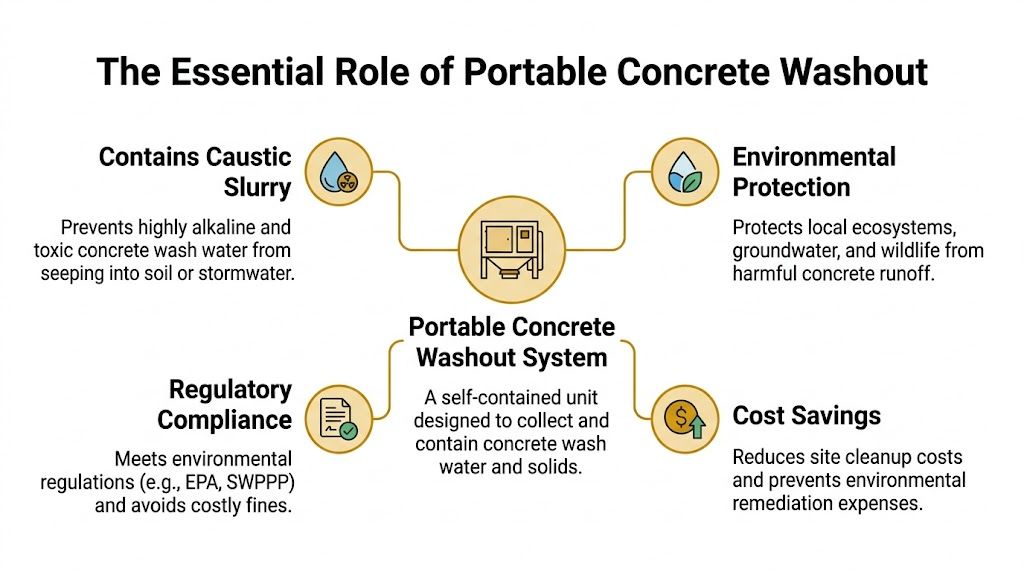
What the unit is actually doing
Think of the washout as a temporary process tank for a dirty part of the concrete operation. It holds water, suspended cement fines, aggregate residue, and hardened solids in one known location so the project team can control cleanup instead of chasing it.
Without that container, the site usually improvises with one of the worst options:
- Bare ground, which lets slurry soak in or spread
- A curb line or gutter edge, which invites runoff problems
- A scrap pit, which often isn’t lined or positioned correctly
- A random dumpster, which creates a disposal mess later
None of those methods gives you clean control. They just move the problem.
Why the waste is taken seriously
Mixer washout uses more water than many people expect. Concrete mixer driver survey results show an average of 225.99 gallons of washout water per truck for end-of-day cleanups, with improper disposal carrying fines of up to $25,000. That number matters because it explains why “just a little rinse water” is one of the most misleading phrases on a concrete job.
When that amount of slurry is unmanaged, the site isn’t dealing with a small housekeeping issue. It’s dealing with a waste stream.
Uncontained washout is basically process wastewater with solids in it. Treating it like ordinary mud is where people get into trouble.
Why old habits don’t hold up anymore
A lot of crews learned on jobs where somebody scraped a shallow pit, tossed in some scrap poly, and called it good. That approach fails for predictable reasons. Pits collapse, overflow in rain, get placed too close to traffic, and turn into a muddy obstacle nobody wants to use. They also don't travel well when the workface moves.
Portable systems are better because they’re designed for controlled use on active sites. You can place them where the trucks and pump crew need them. You can line them properly. You can inspect them quickly. And when the work is done, you can remove them without leaving a crater or hardened residue area behind.
What non-negotiable means on a real site
It means the washout is planned the same way you plan access, traffic flow, and erosion control. It’s not optional because cleanup is not optional. The crew will wash tools and equipment somewhere. Your job is to make sure “somewhere” is a defined, contained location.
Use a portable concrete washout when:
- The project includes any concrete placement at all. Even a small renovation can create messy rinse water.
- The site drains toward streets, inlets, or neighboring property. Most sites do.
- Multiple trades are involved. If pump, finishing, and delivery crews all need cleanup space, you need a dedicated unit.
- The work area is temporary or moving. Portable containment follows the job instead of locking you into one corner.
If a project manager understands that point early, half the washout problems disappear before the first truck backs in.
Mastering Environmental Compliance and SWPPP Integration
Most washout failures aren’t caused by bad equipment. They’re caused by weak documentation and loose field execution.
A portable concrete washout should appear in the project’s stormwater controls as a defined best management practice, not as an informal note. If it isn’t in the plan, marked in the field, and inspected like the rest of your controls, it tends to drift into “we’ll handle it as needed.” That’s where compliance starts slipping.
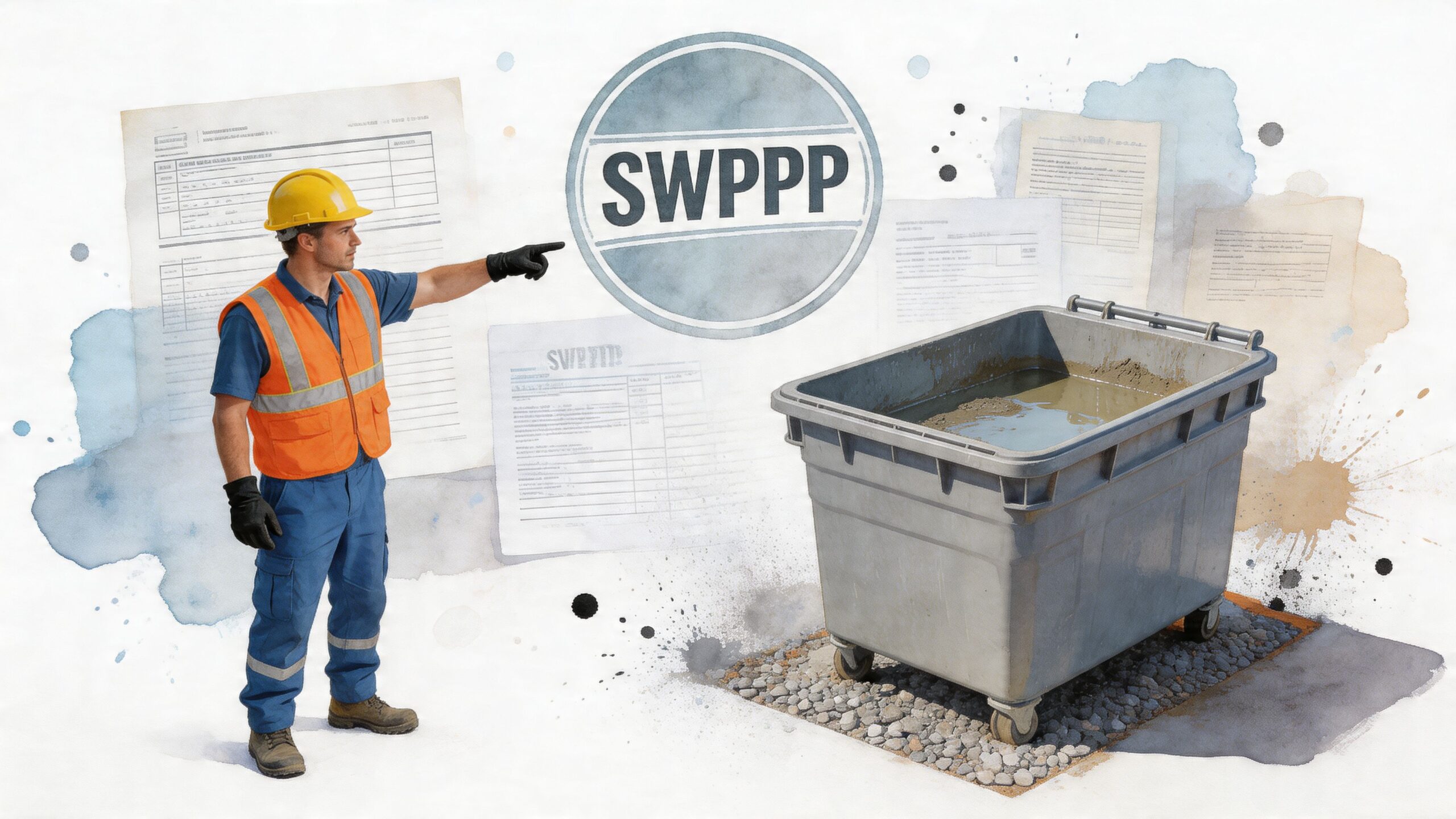
Put the washout in the SWPPP like it matters
If you’re writing or reviewing a SWPPP, the washout area needs more than a label on a map. It needs a description of where the unit sits, what activities are allowed there, how crews are directed to use it, and how the site team verifies containment.
That gap is common. Guidance on washout integration with SWPPPs notes that 68% of queries in consultant forums seek verifiable examples for NPDES permit compliance, and fines for alkaline slurry can exceed $50,000 per violation. That tells you the issue isn’t whether people know washout matters. It’s whether they can prove they managed it correctly.
What inspectors and consultants want to see
They want a washout control that’s easy to verify in the field. That means:
- A defined location that matches the plan documents
- Visible signage so truck drivers and subcontractors don't guess
- Inspection notes showing the unit is intact and not over capacity
- A disposal path that’s clear before the unit fills up
- Records that show the team treated washout as a controlled waste stream
Field note: A washout container becomes a compliance tool when the crew can show where it is, how it’s used, and what happened to the contents afterward.
The records that make life easier
Project managers often overcomplicate this. You don't need a novel. You need a simple, repeatable log that the superintendent, SWPPP consultant, or inspector can follow.
A practical record set usually includes:
| Item | What to record | Why it matters |
|---|---|---|
| Washout location | Planned area and any relocation | Confirms it matches site controls |
| Condition checks | Liner condition, damage, stability | Shows active inspection |
| Fill status | Visual fill level and service timing | Helps prevent overflow |
| User guidance | Crew brief or subcontractor direction | Proves the team communicated requirements |
| Removal or disposal | Pickup date or disposal handoff | Closes the compliance loop |
Where teams get caught out
The weak point is usually handoff between trades. The concrete subcontractor assumes the general contractor has designated washout. The general contractor assumes the supplier has a standard process. The pump crew just wants a safe place to wash out before they leave.
That’s why the washout needs an owner. On a clean job, one person is responsible for placement, monitoring, and service coordination. Everyone else uses the unit, but one person owns the outcome.
If you build that into your SWPPP process, portable concrete washout stops being a scramble item and becomes one of the easiest controls on the site to manage.
Sizing and Selecting the Right Washout Unit for Your Pour
The right unit depends on how much washout activity will happen, where it will happen, and how much room you have to work with. Oversize it too much and you waste money and space. Undersize it and the crew starts looking for backup spots, which defeats the whole purpose.
Selection should start with the work, not the catalog.
Start with the actual washout demand
Ask four questions before you choose a unit:
- How many trucks are expected?
- Will there be a pump truck washout, tool rinsing, or both?
- Is the washout happening in one central area or in multiple work zones?
- Could rain complicate volume management during the rental period?
If the project has several trucks, a central washout area makes sense. If the site is tight, broken into phases, or spread across separate work fronts, one big unit may not solve the practical problem because crews will still use the nearest convenient spot.
For broad planning, some portable rental units are built for substantial on-site containment. Reborn Rentals lists a 72' x 72' x 24' unit at about 441 gallons and a 72' x 72' x 14' unit at about 310 gallons, which gives contractors a useful reference point for medium-duty site cleanup needs.
Match the unit type to the job
Large rigid pans work best when access is good and the cleanup area is predictable. They’re easier to identify, harder to ignore, and better suited to crews washing out repeatedly in the same place.
Smaller containment units make more sense when the work is scattered, access is limited, or only tools and minor rinse operations need capture. Small-format washout containers can provide 15 to 140 gallons of containment for compact jobs, and using them for localized capture can reduce pump-line waste by 70% and cut costs by 60% compared with single-use bags.
That tells you something important. “Right size” doesn’t always mean “biggest available.” Sometimes the better choice is placing smaller containment where the waste is generated.
A quick selection rule
Use a larger pan when trucks and crews can reliably reach one location. Use smaller units when distance, congestion, or sequencing makes central washout unrealistic.
If operators have to go out of their way to use the washout, some of them won’t. Good selection removes that temptation.
Portable Washout Sizing Guide
The table below is a field planning tool, not an engineering formula. It helps with rental conversations and site logistics before final confirmation.
| Number of Trucks (10-yard) | Estimated Washout Volume | Recommended Reborn Rentals Unit |
|---|---|---|
| 1 truck | Light washout activity. Suitable for a compact, controlled cleanup area | Smaller pan or compact containment setup |
| 2 to 3 trucks | Moderate washout activity with shared use by truck and tool cleanup | 72' x 72' x 14' unit |
| 4 or more trucks | Heavier use, more frequent rinsing, greater overflow risk if poorly managed | 72' x 72' x 24' unit |
| Pump plus multiple crews | Distributed washout points may be needed in addition to a main unit | Main pan plus small localized containers |
Site conditions matter as much as volume
Two projects with the same pour size can need different washout setups.
A new-build slab with open access usually favors one clearly marked washout area. A renovation in an occupied facility often needs a tighter footprint and more careful traffic management. A civil site may need the unit placed where haul roads, drainage controls, and active excavation don’t conflict.
Look at these trade-offs before you lock in the rental:
- Access for delivery: Can the unit be placed without creating a later relocation problem?
- Crew behavior: Will the drivers and pump crew naturally use this location?
- Ground conditions: Soft ground and uneven stone can turn a good unit into a bad setup.
- Distance from work: Too close can create congestion. Too far means people improvise.
- End-of-job removal: Can the hauler retrieve it cleanly after the contents set or are serviced?
What works and what doesn’t
What works is simple. One obvious location, easy access, proper size, and enough capacity margin that the crew never feels rushed.
What doesn’t work is trying to force one small unit to serve a busy pour across a large site. It also doesn’t work to place a large unit in a corner nobody can reach once trucks and other equipment are in motion.
Good selection is less about product specs than crew movement. Pick the washout setup your site can use under pressure.
Rental Logistics How to Rent a Portable Concrete Washout
Renting a portable concrete washout should be as routine as ordering fencing or a dumpster. The problem is that many teams wait until the concrete schedule is already tight, then treat the rental like an emergency item. That’s when delivery windows, site access, and pickup timing get messy.
The smoother approach is to treat washout rental as part of pre-pour coordination.

What to confirm before you place the order
Before you book the unit, get these details straight internally:
- Use window: Know when the washout must be on-site, not just the pour date.
- Placement area: Decide where the driver can unload it and whether that location will still work once operations start.
- Access conditions: Tight gates, rough terrain, active traffic paths, and limited staging all affect delivery.
- Pickup plan: Don’t leave this vague. Decide whether pickup happens after use, after curing, or after waste service.
If your team can answer those questions, the rental process gets much easier.
A practical rental workflow
Most reliable suppliers follow the same basic path:
- Choose the unit based on expected washout activity and site access.
- Set dates and location so delivery matches the actual work sequence.
- Review fees and surcharges before checkout, especially if the site has terrain or timing complications.
- Confirm support contacts so the superintendent can solve problems fast on delivery day.
- Document who owns the unit on-site for inspection, use, and pickup coordination.
That’s one reason the best rental experiences come from suppliers that keep the process plain. Reborn Rentals does this well with a straightforward checkout flow, clear daily pricing starting at $25/day for qualifying units, and upfront notes about delivery, rough terrain, and rush conditions. For busy project managers, that kind of clarity matters more than marketing language.
Where contractors lose money in the rental process
Not in the day rate. Usually in preventable coordination mistakes.
A common one is ordering the right unit for the wrong duration. Another is failing to align delivery with site readiness, which leads to rushed relocation or idle rental days. A third is forgetting that the washout needs a clean pickup path after use.
The cheapest rental can become the expensive option if the crew has to move it twice, protect it poorly, or hold it on-site because nobody planned disposal.
What good suppliers make easier
A strong rental partner does more than drop equipment. They help reduce uncertainty. That includes confirming availability, clarifying dimensions and capacity, explaining any service limits, and making it easy to get someone on the phone or message thread when the schedule shifts.
That’s the standard contractors should expect. Portable concrete washout rental isn’t complicated, but it does reward suppliers who communicate clearly and contractors who order before the site gets busy.
On-Site Setup and Maintenance Best Practices
A good rental can still fail if the field setup is sloppy. Most washout problems come from placement, misuse, or neglect during the job rather than from the unit itself.
Set it up like a controlled work area, not like spare equipment parked off to the side.
Place it where crews will actually use it
The washout needs stable, level ground and clear access. It should be close enough that truck drivers, pump operators, and finishers can use it without crossing active hazards or taking long detours. It also needs to stay out of normal traffic where loaders, forklifts, and delivery vehicles can strike it.
For daily site management, these habits work well:
- Mark the area clearly: Make the washout location obvious before concrete arrives.
- Check the liner or containment surface: If the unit relies on a liner, inspect it before use and after heavy activity.
- Keep the approach clean: Muddy ruts and scrap around the pan make operators avoid it.
- Control nearby runoff: Don’t place it where stormwater can wash through the area.
Manage it during the pour, not after
The best superintendent I’ve seen on a concrete day always assigns someone to glance at the washout between tasks. Not full-time. Just enough oversight to catch bad habits early.
Watch for the usual failure points:
| Problem | What it leads to | Better move |
|---|---|---|
| Unit placed too far away | Crews rinse elsewhere | Move containment closer to the work path |
| Overfilling | Splashing, overflow, dirty surroundings | Stop use early and coordinate service |
| Rain entering the unit | Lost capacity and messy handling | Cover or manage exposure when feasible |
| Mixed waste in the washout | Harder disposal and cleanup | Keep trash and unrelated debris out |
The fill level rule that prevents trouble
Don’t let the unit reach the brim. Once crews think there’s “probably still room,” sloshing and sloppy use start immediately.
Some field guidance for small containment systems recommends an 80% max fill level. That’s a good practical rule across the board because it preserves a safety margin for splatter, rain, and one last rinse cycle that arrives sooner than expected.
Keep one person responsible for saying, “This unit is full enough.” Shared responsibility usually means no responsibility.
Daily checks worth doing
If the rental stays on-site for more than a single operation, run a brief daily check:
- Is the unit still stable and undamaged?
- Is the washout area clean around the perimeter?
- Is the crew still using the designated location?
- Is service or pickup needed before the next concrete activity?
Those checks take minutes and save hours of cleanup later. A portable concrete washout works best when the site treats it like active infrastructure, not passive equipment.
Calculating the ROI of Portable Washout Rentals
Project managers sometimes look at washout rental as a line item to minimize. That’s the wrong lens. The appropriate comparison isn’t rental cost versus no cost. It’s rental cost versus the full price of poor containment.
The economics get clearer when you tie the washout to the amount of waste handled and the administrative burden it removes.
Rent versus buy for short-term work
For many contractors, buying only looks cheaper until you count transport, storage, maintenance, cleaning, and depreciation. Portable washout cost analysis shows renting averages $0.15 per gallon processed versus $0.28 for purchasing after depreciation. The same analysis notes that contractors can reduce insurance premiums by up to 12% when rental providers handle transport and liability with documented compliance tracking.
That matters most on short-duration work, phased renovations, and jobs where concrete activity is intermittent. If the unit won’t stay busy across enough projects, ownership becomes a management task instead of an advantage.
The hidden savings most people miss
Rental can pay back in places that don’t always show up on the original estimate:
- Less internal handling: No need to assign yard space, hauling equipment, or maintenance time.
- Cleaner scheduling: You bring in containment when you need it and remove it when you don’t.
- Lower exposure: The site has a clearer process for compliance and disposal.
- Better documentation: A professional rental process often supports cleaner records than an improvised in-house setup.
A simple way to think about ROI
Ask three questions:
- What would one cleanup incident cost in labor, schedule disruption, and management time?
- What would one compliance issue cost in stress alone, even before penalties are considered?
- How often does buying equipment sit idle between jobs?
If the answers make you hesitate, renting is probably the more efficient move.
Bottom line: A washout rental is one of the few site controls that protects budget, schedule, and compliance at the same time.
That’s why experienced teams don’t argue about whether to have one. They focus on getting the right unit for the right duration and making sure the rental lifecycle is clean from delivery to final pickup.
Contractor's FAQ and Final Checklist
A few questions come up on nearly every job.
Common field questions
What do you do with hardened concrete left in the washout?
Follow the disposal process tied to your rental or hauling arrangement. Don’t assume hardened residue can just be broken out and dumped anywhere. The site should know who is taking it and under what waste handling procedure.
Can you use a portable concrete washout in cold weather?
Yes, but cold weather changes how crews use water and how material sets inside the unit. Plan for slower cleanup, icy approaches, and tougher end-of-job handling.
Who is responsible for final disposal?
That should be decided before the rental begins. If nobody owns disposal, the unit tends to sit on-site longer than planned.
Can one washout serve the whole project?
Sometimes. On spread-out or phased work, one central unit may look efficient on paper but fail in practice because crews won’t walk or drive back to it.
Final pre-pour checklist
Use this before the first truck arrives:
- Unit selected: Size matches the expected work and crew behavior.
- Placement approved: Stable ground, clear access, away from conflict points.
- Crew informed: Drivers, pump crew, and finishers know the washout location.
- Condition checked: Liner, walls, and approach area are ready for use.
- SWPPP aligned: Site documents and field controls match.
- Monitoring assigned: One person owns fill checks and service calls.
- Pickup or disposal planned: End-of-rental handling is already decided.
A portable concrete washout only works when the whole lifecycle is thought through. Selection matters. Placement matters. Service and disposal matter just as much. The contractors who stay out of trouble are usually the ones who treat washout like part of production, not cleanup.
If you need a dependable washout rental for an upcoming pour, Reborn Rentals is a solid place to start. Their setup is built for real jobsite use, with clear daily pricing, practical unit options, and straightforward delivery coordination that helps contractors stay compliant without turning washout planning into another administrative mess.