
Portable Secondary Containment: A Practical Guide for Sites
The pour is moving on schedule until the washout pan stops being a container and becomes a spill path. A chute rinse, a rising slurry level, a damaged liner, or a corner that settles into soft ground can push contaminated water beyond the primary vessel. On a busy site, that overflow can reach a curb inlet before anyone has time to react.
Portable secondary containment gives the crew a second barrier. It doesn't replace a properly selected washout pan, oil berm, or storage container. It catches the release that the primary system cannot hold, provided the backup has enough usable capacity, sits on suitable ground, and remains compatible with the material being contained.
The Moment a Washout Pan Fails
A Tuesday morning bridge-deck pour is moving on schedule. The pump crew watches the line, finishers place concrete, and the superintendent coordinates trucks, traffic control, and inspections. Nearby, a washout pan sits on a compacted base, ready for chute rinsing and tool cleanup.
The failure can begin with one routine rinse. Set slurry has already taken up part of the pan's open volume, so the next discharge sends gray water over the lip. The flow crosses the edge, follows a low spot in the base, and moves toward a curb inlet. Production stops while the crew blocks the drainage path, brings in recovery equipment, and records the release.
The pan itself may have performed as designed. The breakdown came from a system without practical backup or a clear response trigger. A full pan, visible seepage, a damaged liner, or water approaching the sidewall should tell the crew to stop adding material and begin recovery.
Field rule: Treat the washout pan as the primary container and plan a second barrier around the failure points.
Portable secondary containment provides that surrounding barrier. It may be a larger lined pan, flexible berm, containment tray, or another relocatable system chosen for the material and likely release. Its floor must remain liquid-tight, while its sidewalls need enough strength and height to hold the material until recovery. Placement also matters. A barrier on soft, sloping, or poorly compacted ground can lose usable volume when one corner settles.
Concrete washout has two basic controls. The system must retain washwater and cementitious solids, keeping caustic material away from soil and preventing migration to surface water or groundwater. It must also allow the crew to recover or recycle the collected material, as described in EPA guidance for concrete washout management.
The same field logic applies to oil, hydraulic fluid, fuel, and other liquids, although the compliance path can differ. SPCC planning addresses oil-storage and spill-control conditions, while concrete washout belongs to stormwater and construction-site controls. Crews need a barrier that works for the actual substance, weather, ground conditions, and response time available.
What Portable Secondary Containment Actually Means
Portable secondary containment is a temporary, relocatable barrier or vessel placed around a primary container or work activity. Its job is to hold material if the primary container leaks, tips, ruptures, or overflows.
The easiest analogy is a bathtub. The primary container is the tub holding the liquid. The portable secondary system is the surrounding floor and raised threshold that keeps water from spreading through the room when the tub drain fails or the tub overflows. The second barrier doesn't make the first barrier unnecessary. It limits the consequences when the first barrier no longer performs as intended.
The terms on a submittal
A superintendent reviewing a containment product usually needs to distinguish four ideas:
- Nominal capacity is the advertised volume under the manufacturer's stated conditions. It describes the theoretical amount the unit can hold.
- Working capacity is the usable volume after allowing for solids, existing liquid, rainfall, access, and the free space needed to prevent overtopping.
- Freeboard is the empty space above the liquid or slurry line. Rainfall and additional washout can consume it quickly, so it isn't wasted capacity.
- An impermeable liner is a liquid-tight membrane or vessel surface that prevents the contained material from passing into the soil. The liner must also be compatible with the material and protected from puncture or abrasion.
The foundational sizing logic for oil containment is capacity based. A system must hold the entire capacity of the largest single container and provide enough additional space for precipitation. That means a unit surrounding a 300-gallon tank must accommodate the tank's full contents before the rainfall allowance is considered, as explained in EPA material on secondary-containment sizing.
Why portability matters
A permanent diked pad works well where tanks stay in one location. Construction crews work differently. Equipment moves between phases, access routes change, and a washout station may need to shift as the site develops. A portable unit can be folded, lifted, cleaned, transported, and redeployed without building a new concrete structure.
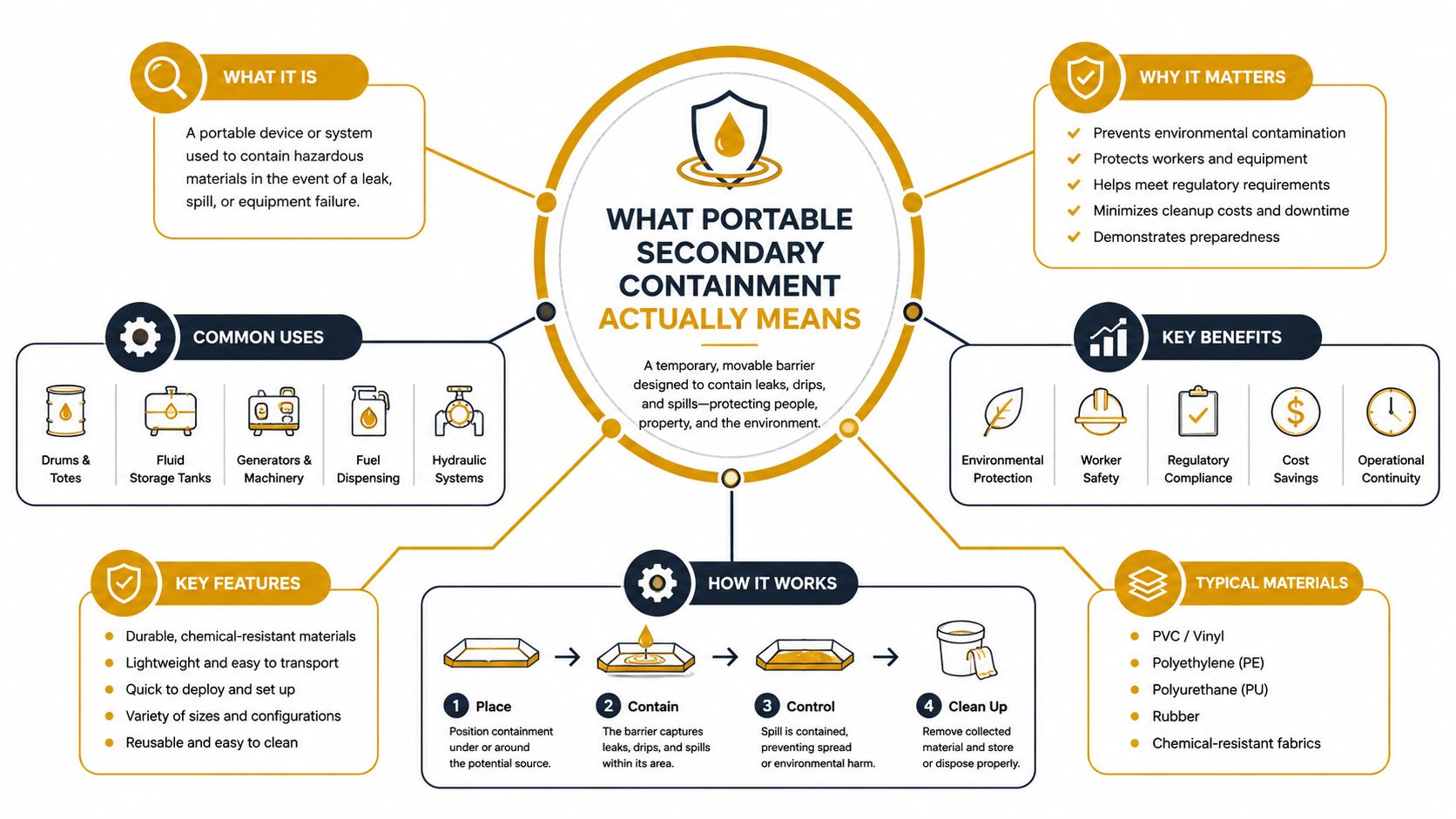
The word “portable” doesn't mean informal or temporary in the careless sense. It describes how the system gets deployed. The containment still needs a defensible capacity, stable placement, intact walls, and an inspection routine.
The Two Regulatory Tracks You Need to Know
Construction teams often use the phrase “spill containment” for two different compliance problems. The first involves oil and oil products under the federal Spill Prevention, Control, and Countermeasure rule. The second involves concrete washout and other pollutants under construction-stormwater requirements.
Under SPCC, portable or mobile oil containers can be part of a regulated facility's containment plan. EPA guidance identifies mobile containers as primary containment whose failure may require a secondary barrier. For bulk storage, the system must be capable of holding the largest single container and enough freeboard for precipitation, while the walls and floor must prevent a discharge from escaping until cleanup occurs. The EPA SPCC guidance explains this framework and its treatment of passive and active containment.
Concrete washout follows a different operational path. The concern is not only the volume of a liquid container. Crews must control cementitious solids, prevent washwater from entering drainage pathways, keep the vessel leak-proof, inspect it during use, and arrange lawful recovery or disposal. A chute rinse on a concrete pour needs an appropriate washout control even when the activity doesn't resemble bulk oil storage.
| Driver | SPCC, 40 CFR Part 112 | Construction stormwater, CGP or MS4 |
|---|---|---|
| Main material | Oil and oil products | Concrete washwater, slurry, sediment, and related pollutants |
| Primary concern | Prevent oil from escaping a facility and reaching navigable waters or adjoining shorelines | Prevent washwater and solids from reaching soil, storm drains, surface water, or groundwater |
| Containment approach | Sized secondary containment, passive systems, or active response equipment selected for the credible release | Leak-proof washout vessel, protected placement, inspection, recovery, and disposal |
| Field question | Can the system contain the largest credible oil release until cleanup? | Can the station hold repeated washout activity without leaking or overflowing? |
| Typical evidence | SPCC plan, equipment selection, inspections, and response procedures | SWPPP records, inspection logs, washout location, service records, and disposal documentation |
A tote of form oil belongs in the SPCC conversation. A chute rinse belongs in the construction-stormwater conversation. Some sites have both, so one inspector may focus on oil storage while another examines the washout station and drainage controls. A generic spill checklist can miss that distinction.
Typical Designs, Materials, and Capacity Ranges
The right portable secondary containment design depends on what the crew is containing and how the site will use the unit. A washout pan must tolerate slurry, impact, and repeated truck access. A berm under a generator needs a different arrangement. A fuel-transfer area may require material compatibility and a way to recover oily liquid without releasing contaminated stormwater.
Rigid pans
Rigid steel or polyethylene pans are easy to position and inspect. Their solid sides provide a clear visual boundary, and many units can be moved with site equipment. They fit controlled washout activity, small equipment, and areas where the crew wants a defined vessel rather than a flexible perimeter.
Their weakness is exposure to impact. A chute, pump hose, rebar bundle, or bucket can damage the pan or its liner if the unit isn't protected. Rigid pans also lose practical capacity as hardened material and standing water accumulate.
Flexible berms
Flexible foam-wall or fabric berms fold for transport and storage. They can surround generators, pumps, fueling points, totes, and other equipment that doesn't fit a rigid tray. Their low entry height can make equipment access easier, but traffic protection becomes critical. Tires, tracks, forks, and dragged materials can abrade the base or deform the sidewalls.
A flexible berm is not automatically suitable for every liquid. The fabric, coating, seams, and liner must be compatible with the material, and the installation surface must not create sharp contact points.
Lined containers
Lined corrugated containers and roll-off-style units suit higher-volume washout operations. They offer a more substantial receiving vessel and can support a service workflow where a full container is removed and another is delivered. The crew still has to control truck movement, prevent liner damage, and monitor the fill level.
| Type | Typical capacity | Footprint | Material or liner | Best-fit use case |
|---|---|---|---|---|
| Rigid pan | Manufacturer-rated, task-specific volume | Defined rectangular or square footprint | Steel, polyethylene, or a compatible liner | Controlled chute, pump, and tool washout |
| Flexible berm | Manufacturer-rated volume that changes with setup and loading | Adjustable footprint | Coated fabric, foam wall, or compatible membrane | Generators, fueling points, totes, and temporary equipment |
| Lined container | Higher-volume configuration selected for the project | Container or roll-off footprint | Rigid container with a compatible liner | Repeated or high-volume washout activity |
Don't select a unit from its label alone. Confirm the material compatibility, floor loading, sidewall behavior, equipment access, and cleanout method. A system that contains petroleum may not be the right choice for cement slurry, and a washout vessel that works beside a pump may be unsafe in a truck turning area.
Sizing and Placement on a Working Job Site
By midafternoon, a washout pan may already contain set slurry, rinse water, and rain from an exposed work area. A pan labeled for 441 gallons can have less than half that volume available for the next rinse if several inches of solids have settled inside. Size the system for the largest credible release, then reduce that capacity for material already in the pan and reserve space for weather.
For concrete work, the calculation includes expected washout, accumulated slurry, and rainfall that may enter before servicing. For oil under SPCC planning, the starting point may be the full contents of the largest container. The calculation changes with the material, but the field question is the same: how much liquid could reach the containment area before the crew can respond?
Usable working capacity = containment volume minus existing solids and liquid, with freeboard reserved for rainfall and additional activity.
EPA identifies precipitation from a 25-year, 24-hour storm as a reasonable benchmark for determining freeboard, while the SPCC rule does not prescribe that exact storm standard as a universal requirement. Use local project requirements and the applicable permit to set the rainfall allowance. Nominal capacity is the label on the pan. Working capacity is what remains after solids, standing liquid, and weather allowance are accounted for.
Place the system where the crew can use it
A correctly sized unit still fails its purpose if trucks cannot reach it, traffic can strike it, or runoff can flow directly to a drain. EPA concrete-washout field guidance recommends locating the station at least 50 feet, or 15 meters, from storm drains and watercourses where feasible. It also addresses truck access, traffic protection, stable reasonably level ground, intact liners and sidewalls, and enough footprint for expected washout activity. Review the EPA concrete washout field guidance before finalizing the station.
Run this placement test before the pour:
- Identify the largest credible release and expected rainfall exposure.
- Deduct settled solids and standing liquid from the rated volume.
- Reserve freeboard rather than treating wall height as usable capacity.
- Check that the ground is stable and level enough to prevent tipping.
- Keep the unit clear of vehicle contact and confirm direct truck access.
- Confirm that workers can inspect, pump, remove, or replace it without crossing a drainage path.
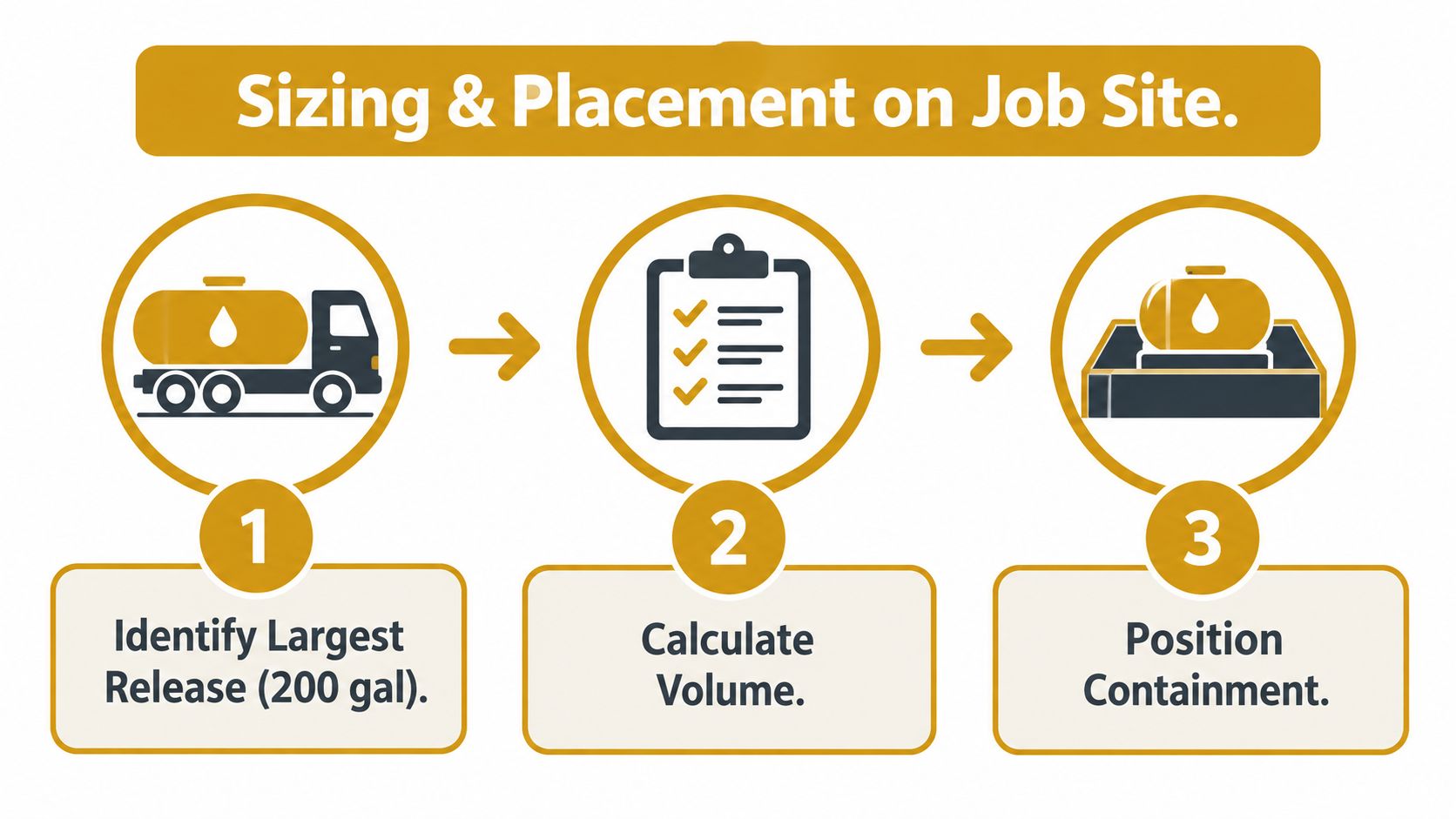
Assign one person to check the level and define the response when the unit approaches its working limit. That service plan connects the oil-spill containment mindset of SPCC with the stormwater controls required around concrete washout. Without ownership and timely removal, even a properly sized pan can become an overflow source.
Renting vs Buying Washout Containment
The rent-or-buy decision depends less on the unit itself than on the way the contractor operates. Buying can make sense when the same crew uses a consistent design across many projects, has a clean place to store equipment, and can inspect, wash, repair, and redeploy the pans. Ownership also means the contractor carries responsibility for condition, transport, and end-of-use handling.
Renting fits a different pattern. It can reduce the need to move dirty equipment between projects, support changing pour volumes, and provide a service path when a pan needs to be exchanged. It also lets a project team select a different configuration when a bridge deck, commercial slab, utility job, or renovation has different access and washout requirements.
Compare the operational burden
| Decision factor | Buying | Renting |
|---|---|---|
| Project duration | More suitable for repeated, predictable use | More suitable for short or changing project needs |
| Storage | Requires a designated clean storage area | Reduces the need to stage equipment between jobs |
| Maintenance | Contractor handles cleaning, inspection, and repairs | Service terms may include cleaning, pickup, or replacement |
| Capacity changes | Limited to owned inventory | Easier to request a different size or configuration |
| Documentation | Contractor keeps its own service and disposal records | Delivery, pickup, and service records may support project files |
| Transportation | Contractor arranges movement | Rental provider may coordinate delivery and removal |
Ask practical questions before signing a rental agreement. Who removes hardened material? Is the liner replaced after damage? Can the provider swap a full unit before the next pour? What documentation arrives with pickup? Are rough access, urgent delivery, or unusual handling conditions treated separately?
A rental only helps compliance when the crew uses it correctly. Confirm the delivery location, ground conditions, access route, inspection responsibility, and pickup window before the first truck arrives. The superintendent should still verify the unit on site, because a delivery ticket doesn't prove that the placement is stable or that the available working capacity matches the day's activity.
Portable washout containment from a provider such as Reborn Rentals can fit this model by giving contractors access to ready-to-deploy pans and containers, scheduled delivery, and service or replacement arrangements. The important selection point is not the brand name. It is whether the rental workflow supports the project's capacity, access, inspection, and recovery requirements.
Why Nominal Capacity Is Not the Same as Safe Capacity
The number printed on a containment pan is a ceiling, not a target. Nominal capacity describes the unit under stated conditions. Safe working capacity is lower whenever solids, rainwater, damaged liners, uneven ground, or access constraints reduce the volume the crew can responsibly use.
Three field failures appear repeatedly.
First, a corner can settle into soft subgrade. The liquid level then rises unevenly, and a sidewall may lose effective height before the pan appears full. Second, rainfall can consume the freeboard that the crew expected to preserve for the next washout. Third, rebar, wire, aggregate, tools, or bucket edges can abrade or puncture a liner when workers place them directly inside the containment area.
Make the rating useful
Start by separating material that must remain in the unit from material that can be recovered. Hardened concrete and settled solids displace liquid volume. Standing rainwater also occupies space, even when it isn't part of the original washout estimate. The crew should measure or visually assess those conditions before each active work period and service the unit before the remaining working capacity becomes marginal.
A practical control plan has three parts:
- Spread the load. Use a rigid grate, grate board, or other approved protective layer where equipment or materials could damage the floor.
- Stabilize the base. Place the unit on compacted, reasonably level ground and keep vehicle wheels, tracks, and forks away from the sidewalls.
- Set an intervention point. Treat the labeled volume as the maximum boundary. Arrange pump-out, removal, or replacement while usable space remains for the next credible event and expected rainfall.
The provided EPA-linked SPCC material highlights the importance of systems capable of preventing a discharge until cleanup occurs. That principle applies in the field even when the exact permit track differs. A unit that technically holds a stated volume may still fail its practical purpose if the crew can't reach it, inspect it, recover its contents, or keep additional water from overtopping it. See the EPA SPCC amendments and containment requirements for the broader compliance context.
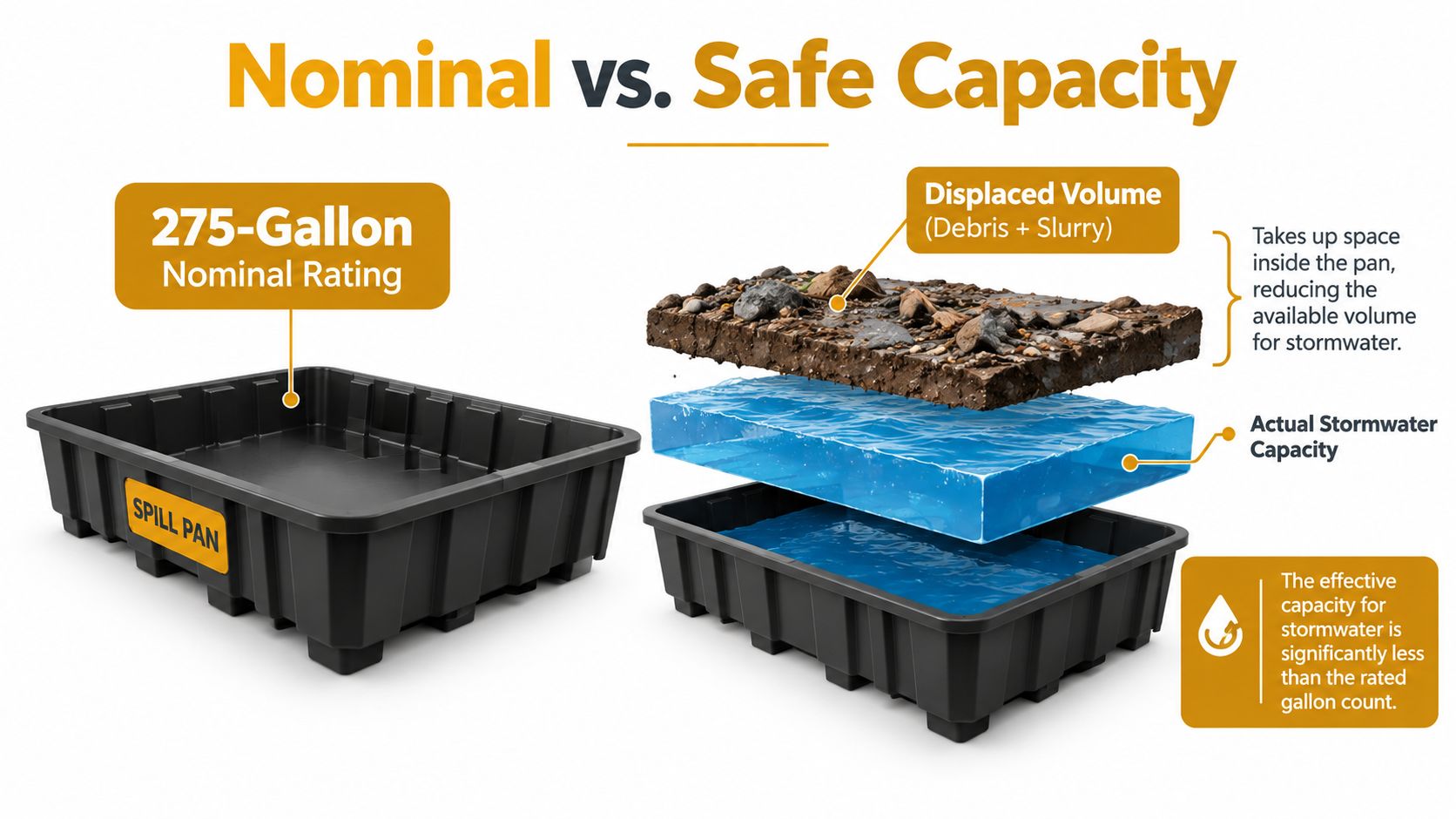
The correction is straightforward: protect the floor, level the installation, reserve freeboard, and service the unit before the next activity forces a rushed response.
Field Checklist Before the Next Concrete Pour
Run this checklist during the pre-pour walk, not after the first truck arrives:
- Confirm the release scenario. Identify the largest credible washout or container failure and select a system with enough usable capacity for that event.
- Check the remaining volume. Account for settled solids, standing liquid, forecast rainfall, and the freeboard needed to prevent overtopping.
- Inspect the ground. Verify that the pan or berm sits on stable, reasonably level compacted ground and won't tip under loading.
- Inspect the liner and walls. Look for punctures, cuts, abrasion, failed seams, distorted sidewalls, and material incompatibility.
- Protect the floor. Stage a rigid grate or approved protective board where chutes, hoses, tools, rebar, or aggregate could damage the containment surface.
- Verify the location. Keep the washout station away from storm drains and watercourses, with the separation required by the applicable guidance and permit.
- Assign one monitor. Name the worker responsible for checking the fill level, recording inspections, and calling for pump-out, removal, or replacement.
- File the records. Keep the delivery ticket, condition check, inspection log, service record, and pickup documentation with the SWPPP or project environmental file.
The morning check should end with one operational question: if the next rinse adds more material or rain begins, who acts and how quickly? Clear ownership protects compliance, keeps the drainage system clean, and prevents a manageable maintenance task from becoming a production stoppage.
Reborn Rentals provides ready-to-deploy concrete washout pans and containers with delivery, replacement, hauling, and disposal options for construction and renovation sites. Review the available containment solutions at Reborn Rentals and confirm the capacity, access, service schedule, and placement requirements before your next pour.