
Professional Service Standards for Equipment Rentals
You're standing on a live site. The pour is scheduled. The crew is lined up. The pump is coming. Then someone asks a simple question that should've been settled days ago: where's the washout going, who's dropping the pan, and are we covered on compliance paperwork if the inspector shows up?
That's where professional service standards stop being office language and start being field reality.
In equipment rental, especially for concrete washout containment, good service isn't about sounding polished on the phone. It's about whether the rental partner helps the job move cleanly or adds another problem for the superintendent to chase. If the pan shows up late, damaged, undersized, or with surprise charges buried in the invoice, that provider isn't just inconvenient. They're a liability.
What Are Professional Service Standards in Equipment Rental
At 6:15 a.m., nobody on site wants a debate about where the washout pan is going, whether the container size is right, or who approved the extra delivery charge. Professional service standards are the set of working rules that keep those avoidable problems off the superintendent's plate.
In equipment rental, especially for concrete washout containment, standards are not a branding exercise. They are the provider's repeatable way of handling scheduling, dispatch, delivery, equipment condition, documentation, pickup, and billing so the field gets the same level of service every time.
For a washout rental, that shows up in details crews notice immediately:
- Order accuracy: The pan or container delivered matches the placement plan, expected concrete volume, and site conditions.
- Delivery discipline: Arrival times are coordinated around access routes, gate procedures, active pours, and crane or pump activity.
- Condition and readiness: The unit is fit for service, with no damage or wear that creates containment, handling, or safety concerns.
- Clear pricing: Delivery, pickup, relocation, overage, and rush charges are explained before work starts, not after the invoice shows up.
- Documentation: The provider keeps organized records and can answer basic compliance and service questions without delays or guesswork.

What good standards look like on a job site
Good standards are visible in the handoff.
The dispatcher has the correct address, access notes, and contact. The driver places the washout unit where the site can use it without blocking traffic or backing another trade into a corner. Pickup gets confirmed before the pan becomes leftover clutter in an active work area. If the scope changes, the rental company responds with a clear answer and a documented adjustment.
That is the benchmark. Consistent execution, not sales talk.
A rental provider should be judged the same way any field partner is judged. Did they arrive prepared? Did they place the right equipment in the right spot? Did they leave the site with fewer problems than they found? In washout containment, those questions matter because a small service miss can turn into access issues, cleanup work, compliance exposure, or an argument over charges.
Practical rule: If the rental process creates uncertainty for the superintendent, the provider's standards are weak.
Why formal standards matter even in a field business
Formal standards matter because site work depends on repeatable habits. A company that has a clear process for dispatch, equipment inspection, driver communication, recordkeeping, and billing will usually create fewer surprises than one that handles every order ad hoc.
That does not mean burying the field in paperwork. It means the rental company has already done the work of setting expectations before the truck rolls. Who confirms placement. What condition the pan must be in before delivery. How changes are approved. When pickup is scheduled. What gets documented if conditions on site shift.
For construction equipment rental, professional service standards are simple to define. The provider can deliver the right unit, on time, in usable condition, with clear communication and clean billing, then repeat that performance job after job. In concrete washout containment, that consistency is what separates a reliable rental partner from another source of site risk.
Why These Standards Matter for Your Job Site
The pour is set for 7:00. Trucks are stacking up. The washout pan still is not on site, or it landed where mixers cannot reach it without blocking access. Now the crew is improvising, the superintendent is making calls, and a routine rental item has become an operating problem.
That is what weak service standards look like in the field. The trouble rarely starts with one big failure. It starts with a late delivery, a vague placement note, a driver who did not get the latest site contact, or an invoice that does not match the agreed rental period. On a concrete job, those small misses can spill into housekeeping issues, rework, crew downtime, and environmental exposure.
For washout containment, service standards are not office language. They are field controls.
Washout confusion creates avoidable risk
Concrete washout is easy to underestimate until the site has to deal with slurry, runoff, or a placement problem during active work. A lot of smaller contractors and crews still run into confusion over what setup is acceptable, who is responsible for placement decisions, and how service timing should line up with pours and pickup.
That confusion shows up in predictable ways. The pan is too far from the pump. The access route gets pinched. The unit fills faster than expected and no one is clear on who to call. An inspector sees poor containment and starts asking questions the field team should not be answering on the fly.
A rental provider with clear standards cuts down those decisions before the truck leaves the yard. The site knows what unit is coming, where it will go, what conditions matter, and how service changes get handled.
Weak standards hit four parts of the job
The first hit is schedule control. If washout containment is late or placed wrong, the pour crew works around a preventable problem.
The second hit is compliance exposure. Poor containment setup can lead to runoff, cleanup work, and documented site deficiencies.
The third hit is labor efficiency. Supers, foremen, and operators end up solving rental problems instead of running production.
The fourth hit is site credibility. Owners, consultants, and inspectors notice whether support items are planned and managed well. Washout containment is part of that picture.
A good rental partner reduces field decisions that should have been settled before delivery.
Why this belongs in precon and vendor review
Support rentals often get less scrutiny than major iron. On concrete work, that is a miss, especially where washout containment ties directly to environmental compliance and site flow.
Review these points before the first pour:
- Communication: Do they confirm delivery window, placement contact, and access limits in writing?
- Service scope: Do they explain who handles placement direction, relocation requests, overflow response, and pickup timing?
- Field response: If the pour sequence changes, can they adjust without creating confusion?
- Billing control: Does the invoice line up with the quoted rate, dates, and service record?
If a provider cannot answer those basic operating questions before mobilization, the job site will carry the cost later.
The Five Pillars of Rental Service Excellence
A truck pulls in an hour before the pour. The washout container is the wrong size, the driver does not have placement instructions, and the office cannot confirm what was ordered. That is what poor service standards look like on a construction site. In equipment rental, especially for concrete washout containment, service quality is not an abstract customer service idea. It is a field checklist.
The providers worth keeping usually perform well in five areas. If one pillar is weak, the site pays for it through delay, confusion, rework, or avoidable compliance risk.
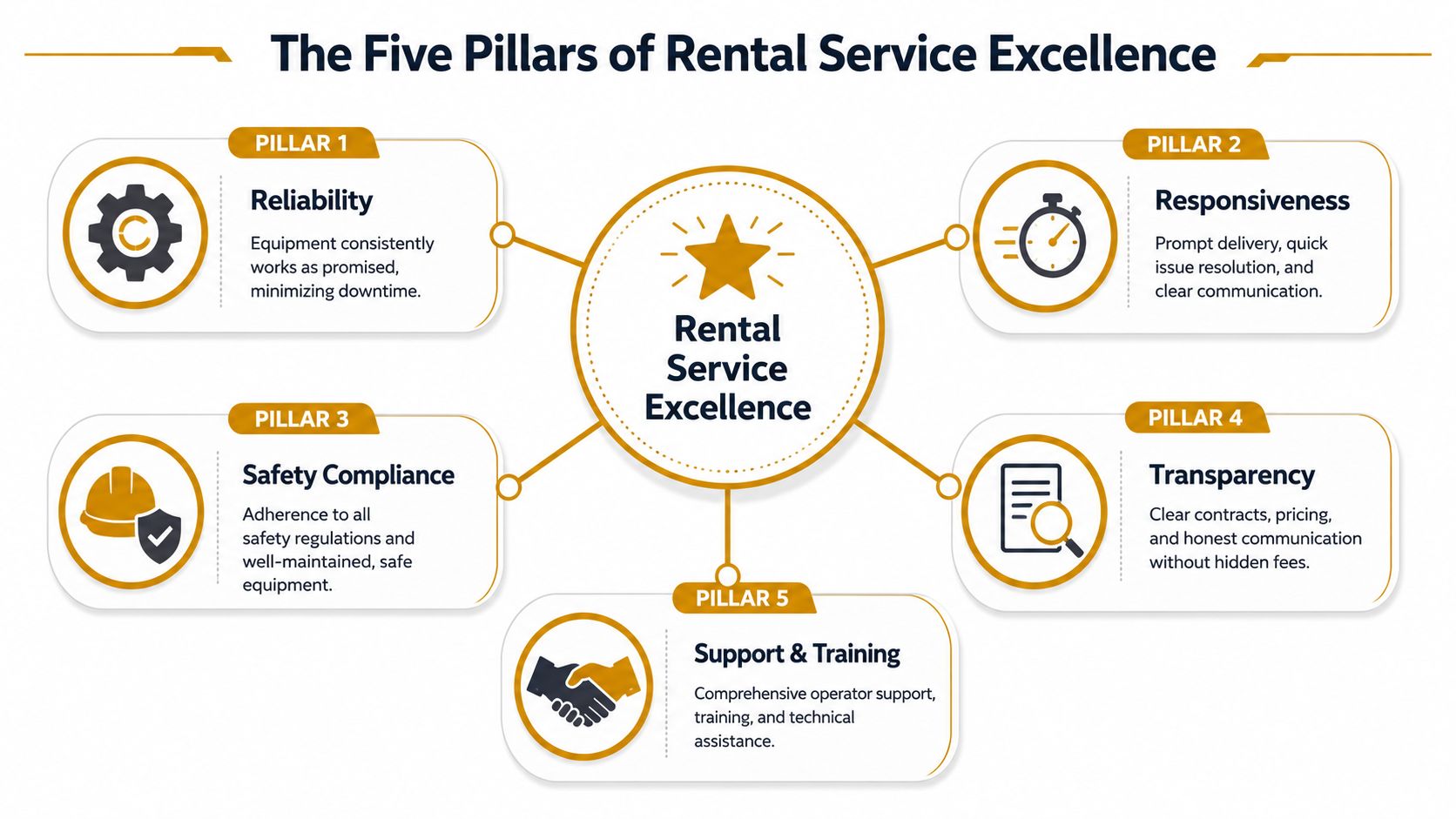
Communication and responsiveness
Good communication starts before the truck is dispatched. The provider should confirm the unit type, delivery window, site contact, access route, and drop location in writing.
Responsiveness matters when the plan changes, which it often does. A reliable rental partner can answer a simple field question quickly, give a straight answer on timing, and document any change so the office, dispatch team, and driver are all working from the same information.
With a weak provider, the office says one thing while dispatch says another. The driver arrives with partial details, and the superintendent ends up sorting it out in real time.
Green flag: They ask for placement details, access limits, and the person who will pick up the phone on delivery day.
Red flag: They treat the street address as enough information.
Delivery and logistics precision
Providers either help the job run cleanly or create a site problem.
For washout containment, delivery precision means more than showing up. It means arriving with the right equipment, at the agreed time, with a driver who understands where the unit can go without blocking haul routes, staging, pedestrian paths, or active work zones. On tight sites, that level of planning saves time for everyone.
A provider with sound field habits checks access width, ground conditions, traffic flow, and any crane or pump activity that affects placement. A weak one leaves those questions unanswered until the truck is already at the gate.
- Good practice: Confirm route, site constraints, and final placement instructions before delivery.
- Bad practice: Leave access, terrain, and timing to the field crew after arrival.
Equipment quality and safety
Condition matters. A washout container should arrive structurally sound, fit for containment use, and ready to place into service without the crew second-guessing it.
That includes the basics. No obvious damage that affects function. No condition issues that make cleanup harder. No uncertainty about whether the unit can handle the planned concrete volume. If the provider sends equipment that looks neglected, that usually points to a bigger service problem behind the scenes, such as poor inspection habits, weak yard controls, or rushed dispatch decisions.
If a crew hesitates to use the unit, the standard was missed.
Pricing transparency
A provider does not need to be the cheapest to be reliable. They do need to be clear.
For rental service, pricing transparency means the quote matches the work, and any extra charges are explained before they hit the invoice. On washout containment, that often includes delivery conditions, relocation requests, swap-outs, extended rental periods, and pickup timing. None of those items should show up as a surprise after the fact.
This is where trust is usually won or lost. Crews can work around a lot in the field, but PMs and accounting teams remember billing problems long after the pour is finished.
Compliance and documentation
On washout containment rentals, this pillar carries more weight than it does with many other support items because the equipment sits close to environmental compliance. If the provider cannot keep records straight, that creates problems fast.
The order should match the delivered unit. Delivery and pickup dates should be easy to verify. Service changes should be documented. If a PM, environmental manager, or inspector asks what was delivered, where it was placed, or when it was removed, the provider should be able to answer without digging through a chain of conflicting emails.
Good documentation keeps disputes short. Poor documentation turns a simple rental into office cleanup.
How to Implement and Audit Service Standards On-Site
The truck shows up during a pour window. The washout pan is the wrong size, the driver has no placement instructions, and nobody on-site knows who approved the order. By the time the mistake gets sorted out, the crew has lost time and the PM has another billing mess to chase. That is what weak service standards look like in the field.
The fix is simple in principle. Put the standard in writing, check it on every rental, and deal with repeat failures before they become normal.
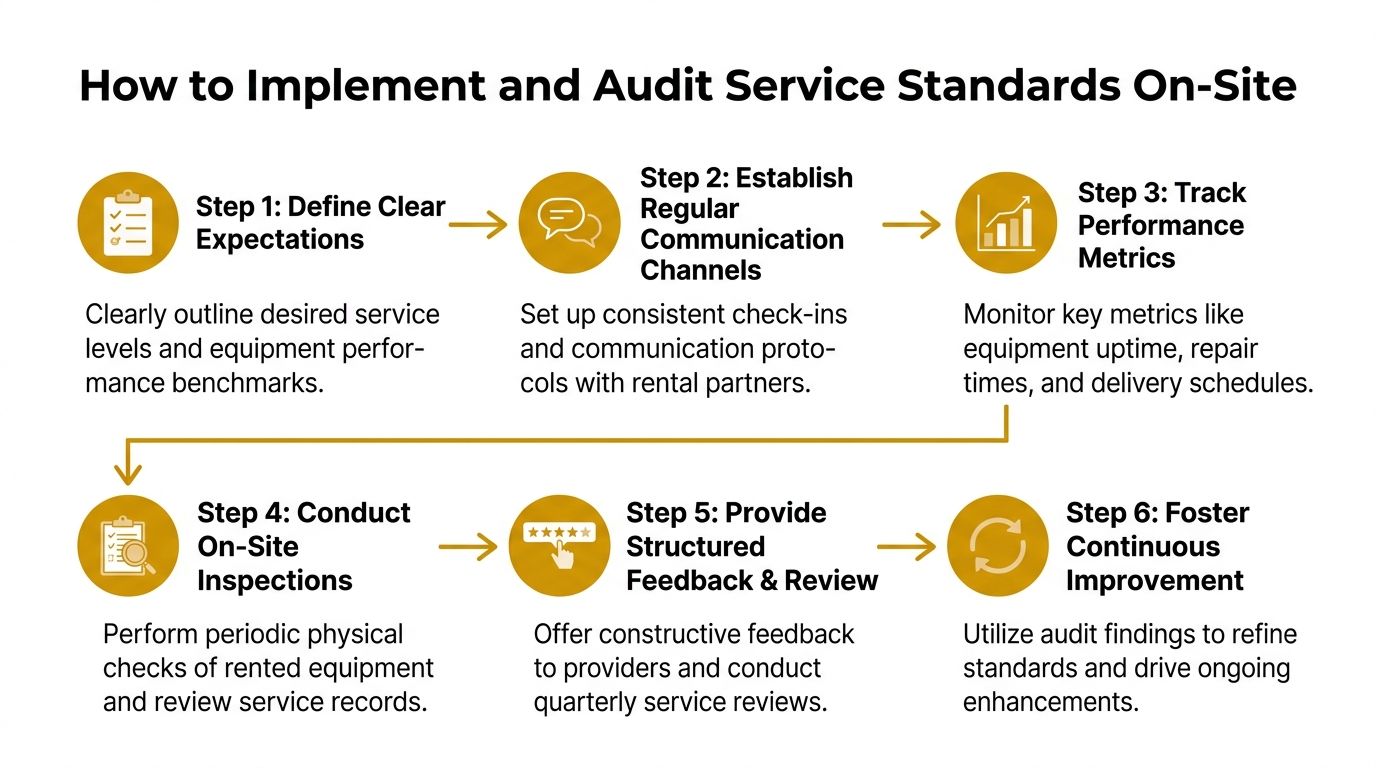
Set the field standard before the first delivery
Start with a one-page service standard that a superintendent or project engineer can use. If it takes ten minutes to read, it will sit in someone's inbox and do nothing.
For concrete washout containment, the standard should spell out the points that create the most site trouble:
- Delivery: Date, time window, site contact, access route, and exact placement area
- Equipment: Correct pan or container size, usable condition, and no leftover material from the last job
- Service changes: Who can approve relocation, swap-out, or extended rental time
- Pickup: Request method, confirmation process, and expected removal window
- Billing and records: Quote reference, approved extras, delivery ticket, and pickup record
Keep it specific. “Deliver washout container” is not a standard. “Deliver 12-yard lined washout pan to east gate staging area, call foreman 30 minutes out, place clear of haul route” is a standard.
Use a short scorecard after every rental
Sites do not need a long vendor review form. They need a fast record of what happened.
A practical scorecard for washout containment rentals can fit on half a page:
| Service Area | What to Check |
|---|---|
| Delivery | Arrived in the agreed window and reached the correct contact |
| Placement | Set in the approved location without blocking traffic or work areas |
| Equipment condition | Clean, usable, correct size, no repair issue that affects service |
| Communication | Dispatcher or coordinator responded clearly when conditions changed |
| Billing | Invoice matched quote and approved changes |
| Documentation | Delivery and pickup records were complete and easy to verify |
Add one line for notes. Keep those notes factual and tied to the job. “Driver needed second placement because dispatch missed access restriction” gives you something to fix. “Bad service” does not.
Audit the pattern, not just the bad day
Any provider can have one rough delivery. What matters is whether the same failure keeps showing up across projects.
Review each rental while the details are still fresh. Then review the provider by quarter or by project phase, especially if you are ordering multiple pans across active sites. Look for repeat misses such as late delivery before scheduled pours, pickups that leave full containers sitting too long, or recurring invoice corrections. Those patterns cost labor, create compliance risk, and usually get worse if nobody addresses them.
As noted earlier, stronger service maturity shows up as more consistent execution. In field terms, crews lose less time when vendors are measured against the same standard every time.
Field advice: Put production risk and compliance risk at the top of the audit. If a service failure can delay concrete work, block access, or create a washout violation, track it first.
Give the site a clear escalation path
Crews should not have to guess who owns the fix. The response path needs to be obvious before the first problem hits.
Use a simple chain:
- Driver or field contact: Fix placement or access issues on arrival if they can be corrected safely.
- Dispatcher or service coordinator: Resolve wrong unit type, missed timing, or pickup scheduling problems the same day.
- Account manager or operations lead: Address repeat service misses, disputed charges, or poor recordkeeping.
- Approved vendor review: Reduce use, place on probation, or replace the provider if the same issues continue.
That structure does two things. It solves small problems faster, and it gives the PM solid documentation when it is time to stop using a provider.
A rental partner earns trust by performing the same way on the fifth order as on the first. If the site has to keep teaching them the job, that is not a standard. It is a recurring problem.
Essential Checklists for Vetting Your Rental Partner
Many teams don't need more vendor theory. They need questions they can use before placing an order.
The easiest way to avoid bad rental relationships is to treat the first conversation like a site walk. Ask direct questions. Listen for clear answers. If the company dances around logistics, fees, or paperwork early, that won't improve after the order is booked.
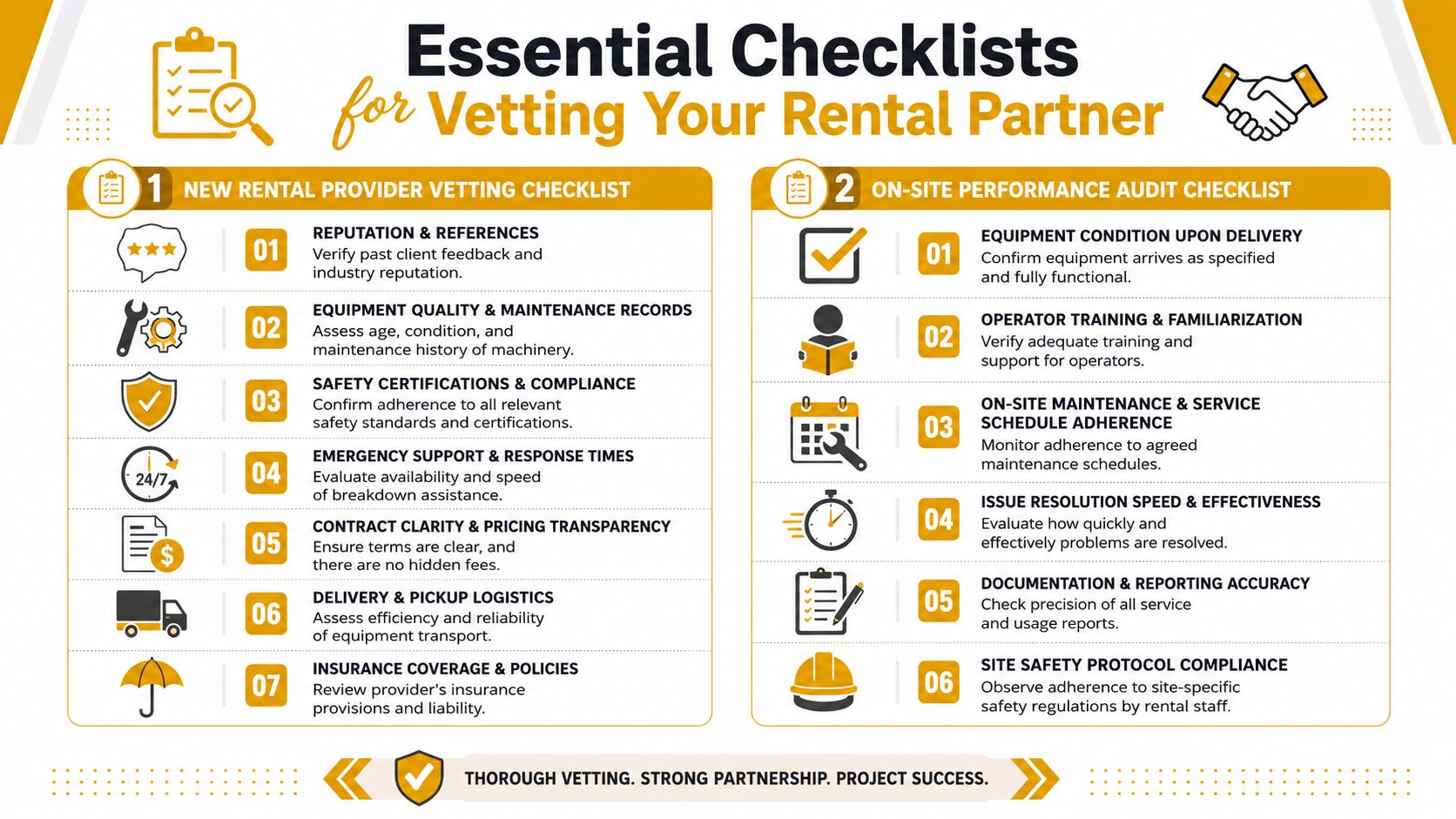
New rental provider vetting checklist
Use this before bringing a new washout containment provider onto a job.
- Scope fit: Do they clearly understand concrete washout containment, not just general equipment rental?
- Equipment clarity: Can they explain which pan or container fits the job conditions without guessing?
- Delivery process: Do they ask about site access, staging area, terrain, and who will receive the unit?
- Pickup process: Can they explain how pickup is requested, confirmed, and documented?
- Pricing transparency: Will they provide a clear fee schedule, including delivery, pickup, rough terrain, and rush conditions if applicable?
- Communication path: Do you get a real dispatch or service contact instead of a generic handoff?
- Documentation support: Can they provide organized service records the PM or consultant can retrieve later?
- Problem handling: What happens if the wrong unit arrives or the site conditions change on short notice?
- Professionalism in the basics: Are confirmations written clearly, or are details buried in loose text and verbal assumptions?
A strong provider answers these without friction. A weak one speaks in generalities.
On-site performance audit checklist
Once the provider is active, check what happens in the field.
- Arrival accuracy: Did the delivered unit match the order?
- Condition on delivery: Was the equipment serviceable and acceptable for use?
- Placement coordination: Did the driver place it where the site needed it, or create rework?
- Crew disruption: Did the rental process create extra calls, waiting, or relocation effort?
- Invoice match: Did billing align with what the team approved?
- Record quality: Can the project team retrieve order confirmations and service dates without digging?
These questions work because they're observable. They don't depend on marketing promises.
Sample rental provider service audit scorecard
Use this as a simple quarterly review tool.
| Service Pillar | Metric/Question | Rating (1-5) | Notes |
|---|---|---|---|
| Communication | Did the provider confirm delivery details clearly and respond when conditions changed? | ||
| Delivery & Logistics | Did the unit arrive on time and get placed correctly for site use? | ||
| Equipment Quality | Did the washout equipment arrive in serviceable condition? | ||
| Pricing Transparency | Did the invoice match the approved quote and disclosed fees? | ||
| Compliance & Documentation | Were delivery, pickup, and supporting records organized and easy to retrieve? |
What a useful scorecard note looks like
Write notes the way you'd write a daily report entry. Short, specific, and tied to an event.
Good note: “Delivery required extra coordination because driver didn't have gate code and wrong contact was listed.”
Bad note: “Communication poor.”
“If I can't explain the service failure in one sentence with a date and a consequence, I don't have a usable audit note yet.”
That discipline matters when operations, purchasing, and project management have to decide whether to keep using the same provider.
Beyond the Checklist What True Partnership Looks Like
A checklist gets you to acceptable. Partnership gets you to useful.
The difference is simple. A transactional rental company waits to be told everything. A real partner sees the site conditions, understands the sequence, and helps prevent problems before they hit the crew. They don't take over the superintendent's job, but they do support it.
In concrete washout containment, that can mean flagging a placement issue before the pan gets dropped where it will interfere with haul routes. It can mean helping the project team think through pickup timing so full containers don't linger longer than necessary. It can mean clean confirmations, accessible records, and fewer loose ends for the office to sort out.
The broader business case for standards is clear. The global professional services market forecast from Credence Research values the market at USD 1,080,002 million in 2024 and projects it will reach USD 2,435,597 million by 2032, growing at a 10.7% CAGR. As service businesses scale, buyers put more weight on reliability, consistency, and accountability. Construction teams do the same thing in the field, even if they describe it in plainer terms.
What works is simple and repeatable. Clear scope. Clean delivery. Honest pricing. Usable documentation. Fast correction when something goes wrong.
What doesn't work is also easy to spot. Vague answers. Last-minute surprises. Missing records. Charges that appear after the fact. Drivers and dispatchers who seem detached from how a real job site runs.
The best rental relationships lower noise. They help the superintendent spend less time policing a support vendor and more time running work. That's what professional service standards are supposed to do.
If you need a rental partner focused specifically on concrete washout containment, Reborn Rentals offers straightforward ordering, clear daily pricing, transparent surcharge notes, and multiple fast contact options so crews can lock in delivery, site details, and compliance-related logistics without the usual back-and-forth.

