
Rapid Roll Off Washout Containers: A Contractor Guide
The pour is on the calendar, the pump truck is staged, and the crew is ready to move. Then somebody asks the question that should've been answered yesterday, where's the washout going? That's where rapid roll off stops sounding like a rental phrase and starts acting like a jobsite constraint.
If the container isn't there, or the wrong container shows up, the whole site feels it. Finisher time gets burned, the truck waits, and someone starts improvising a berm or a bucket stack that won't survive an inspection. Good logistics solve that problem before the first yard lands.
The Rush Moment When a Pour Stalls
A stalled pour rarely starts with concrete. It starts with a missing support item that nobody treated like a critical path task. On a live job, that usually means the washout plan was assumed instead of booked.
The foreman sees it first. The pump operator needs a place to clean out, the crew needs a legal containment point, and the only available spot is too far away, too soft, or too tight for the truck to stage safely. Once that happens, speed stops being a marketing word and becomes a question of whether the site can keep moving without creating a mess or a compliance issue.
Practical rule: if the washout location is still being debated after the truck is en route, the job is already behind.
What matters in that moment is not just delivery speed. It's whether the container arrives in the right configuration, gets placed where the truck can access it, and can be exchanged or picked up without disturbing the pour. A fast drop that can't be serviced cleanly doesn't save the day.
The better habit is to treat washout like a material decision, not a cleanup decision. That means sizing, access, and pickup path get solved upstream, before the slab crew, pump crew, or finish crew is on top of each other.
What Rapid Roll Off Containers Actually Are
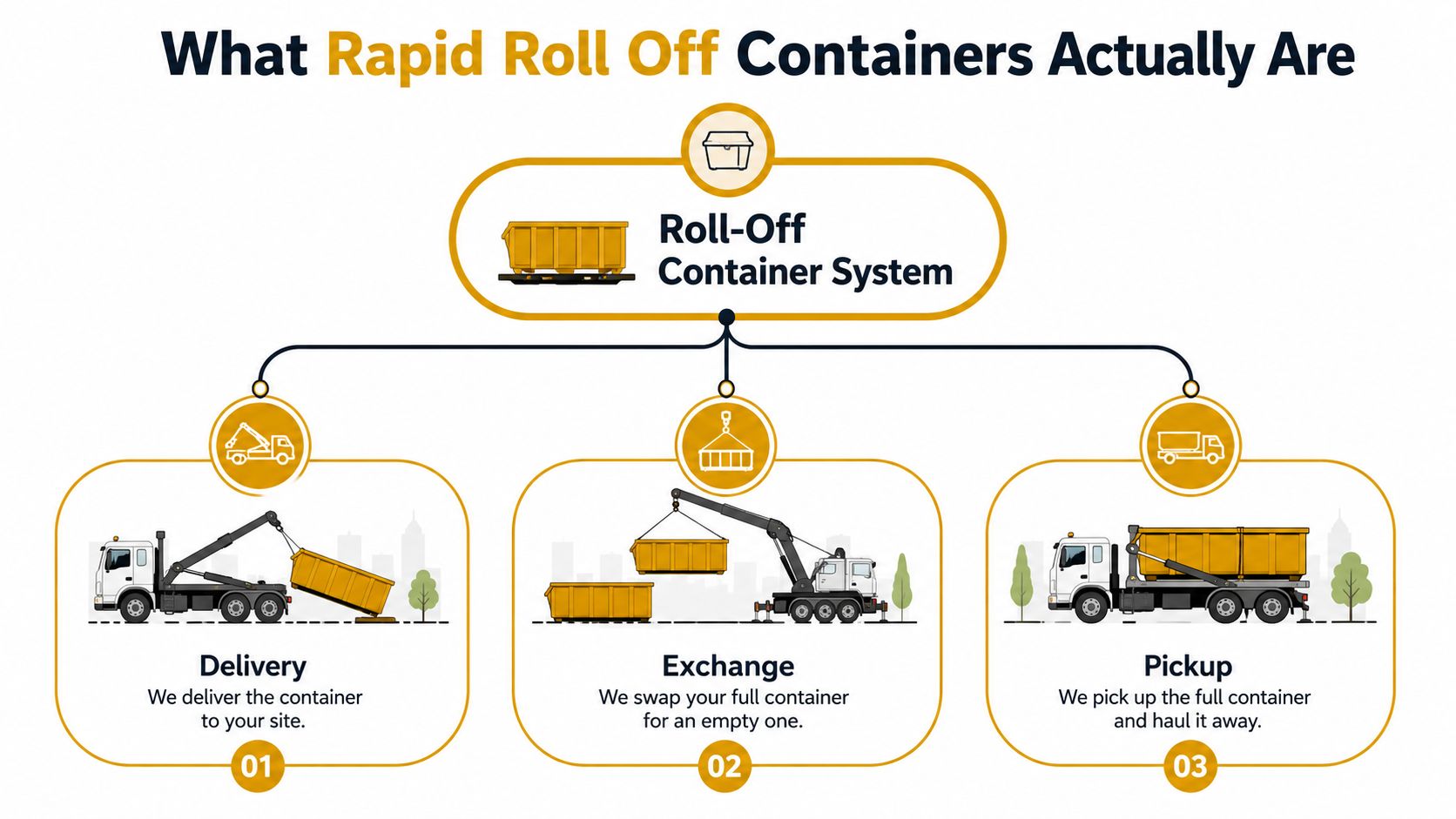
A rapid roll off container is a roll-off unit arranged for quick delivery, placement, and exchange on a live jobsite. The “roll-off” part is the truck-and-bin handling method, while the “rapid” part refers to how quickly the unit can be dropped, swapped, or hauled out once the site is ready.
The term gets confused because roll-off also appears in electrical and signal-processing writing, where it describes attenuation past a cutoff point and is measured in dB/decade or dB/octave. That's a real technical term, but it has nothing to do with concrete washout logistics or jobsite timing. In rental work, the only thing that matters is the truck, the container, and the swap path.
The two limits that govern the container
Every practical container choice comes down to volume and payload. A big-looking pan can still be the wrong pan if it hits legal haul weight before it looks full, especially with dense slurry or heavy mineral waste. The opposite is also true, a light load can fill out volume before it threatens transport limits.
The operative question is simple, which limit gets hit first? If the answer is weight, the crew needs to plan with less fill, staged removal, or an additional unit. If the answer is volume, a larger or deeper container may solve the problem without adding complexity.
Rapid service only helps if the unit can actually be hauled when it's time to leave.
Matching Container Size to Your Pour
The smartest sizing call isn't “largest available.” It's “largest that can be legally moved and still fit the job.” For washout, that usually means matching the container to both the pour rhythm and the density of the material being captured.
Reborn Rentals lists washout options that show the tradeoff clearly, including a 72' x 72' x 24' unit at approximately 18.25 tons and about 441 gallons, plus a 72' x 72' x 14' unit at about 310 gallons. Those specs fit different site patterns. One is better when the job needs more reserve capacity, the other when the pour is smaller or the site needs a lower-profile setup.
| Container Option | Dimensions | Liquid Capacity | Approx. Load Rating | Best Fit |
|---|---|---|---|---|
| Larger washout pan | 72' x 72' x 24' | ~441 gallons | ~18.25 tons | Bigger pours, longer service windows, higher washout demand |
| Smaller washout pan | 72' x 72' x 14' | ~310 gallons | Not listed in verified data | Smaller retrofits, tighter staging, lower washout volume |
The point isn't that the larger unit wins. Dense mineral waste can hit haul limits before the pan is visually full, which is why a heavy cleanup stream often needs a more conservative plan than a bulky, low-density one. That's the same reason contractors sometimes choose a secondary unit or a planned swap instead of pushing one container too far.
A simple field rule
If the job is short and the washout volume stays predictable, a single unit is often enough. If the pour is continuous, the washout stream is heavy, or the site is awkward to access, staged swaps usually beat forcing a single container to carry the whole risk. When weight is the variable, don't chase volume for its own sake.
Site Prep and Placement That Prevents Problems
A fast delivery only stays fast if the pad is ready. The drop zone needs to be flat, stable, and open enough for the roll-off truck to place the container without awkward repositioning. Soft ground, slope, or clutter around the landing area turns a quick deployment into a delay.
The other mistake is putting the washout too close to the wrong thing. It needs to stay clear of storm drains and waterways, and the pump or chute still has to reach it without creating a traffic jam on site. On a live pour, “close enough” is usually the same as “in the way.”
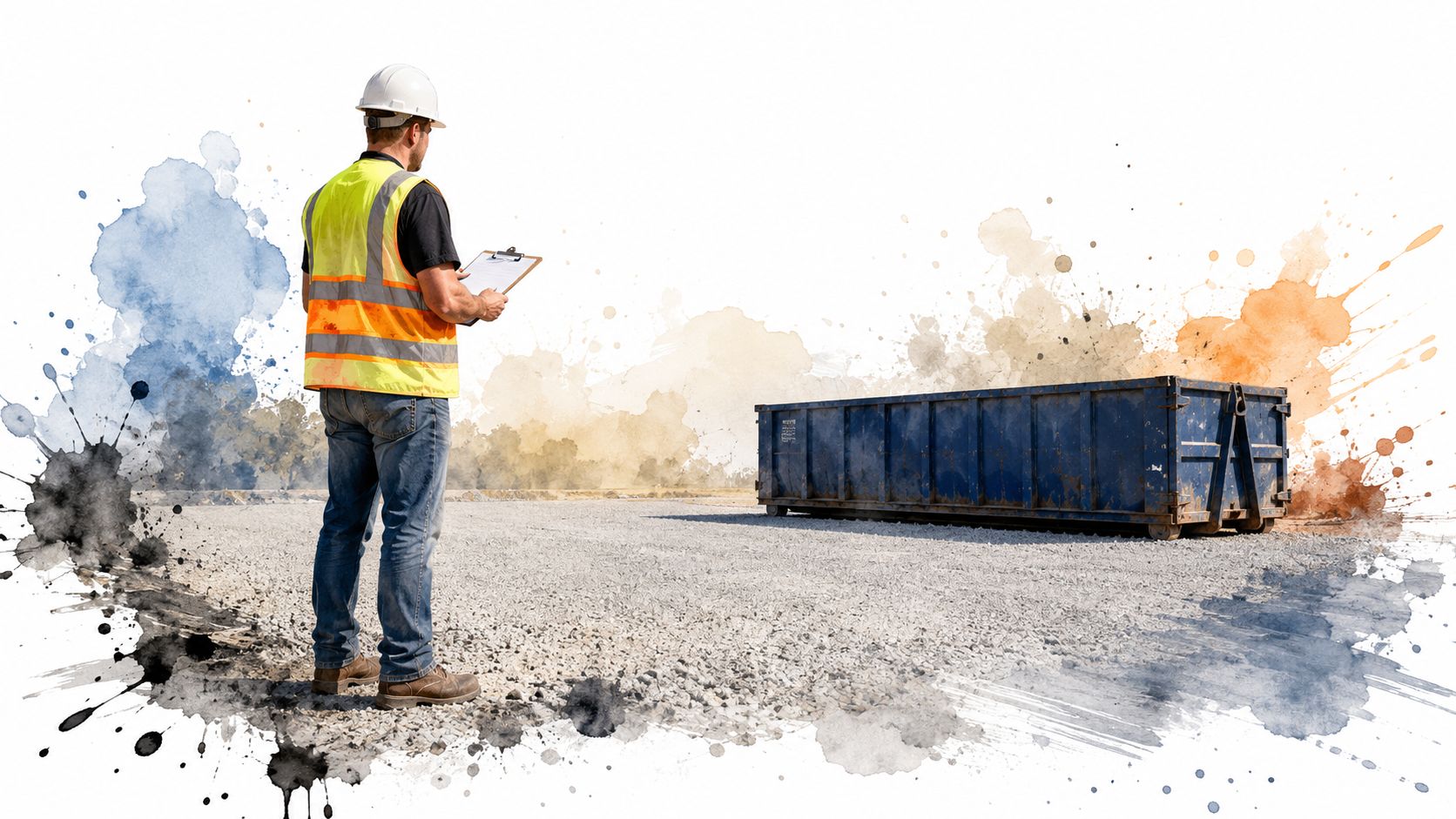
What a clean drop zone looks like
- Flat bearing surface: The container sits level, so slurry doesn't pool unevenly and the truck can set it cleanly.
- Clear approach path: The driver needs room to back in, lower, and leave without clipping other equipment.
- Overhead clearance: Low wires, branches, and temporary structures create preventable slowdowns.
- Space for service: The chute, pump, or washout activity can't block access if a swap is needed.
- Covered idle position: Rainwater and jobsite runoff shouldn't turn a washout into a mess when nobody's using it.
A rough surface or a sloped setup can trigger extra handling complexity, and some providers charge more when the placement isn't straightforward. That's why the access notes matter at checkout. If the site has limitations, flag them before dispatch so the delivery plan matches the ground conditions instead of forcing a last-minute adjustment.
Cover the pan during downtime. That one habit prevents the most common overflow problem, especially when weather or schedule gaps stretch the washout window.
Pricing Structure and Total Cost Scenarios
The invoice usually doesn't surprise people at the daily rate. It surprises them in the add-ons. Transparent pricing starts at $25/day in the Reborn Rentals model, but the total can also include delivery, rough terrain charges, express order fees, and other service-related costs called out in the pricing notes.
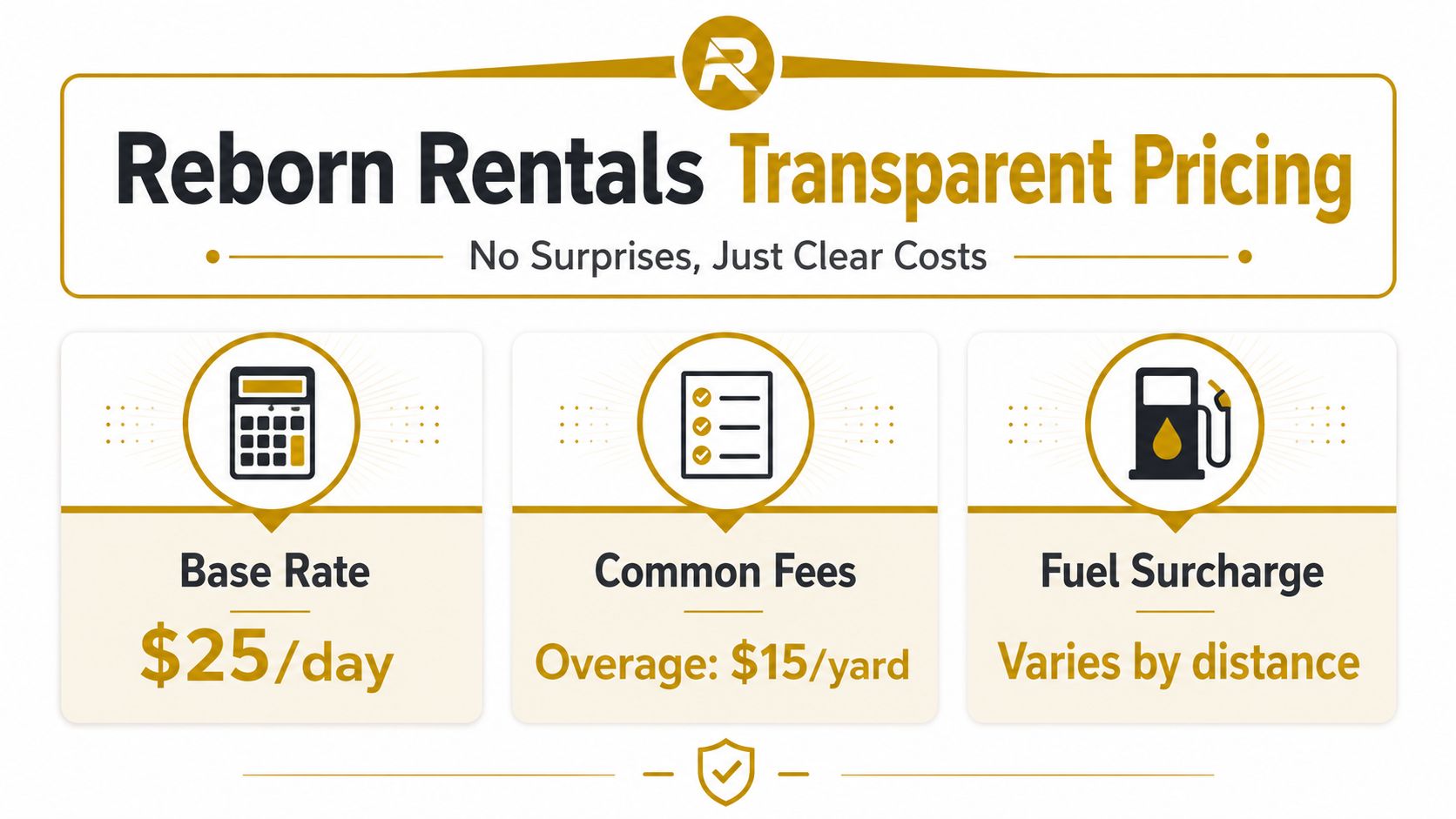
The daily rate is only part of the decision. If a site has difficult access, an express turnaround, or a longer haul path, the total can change enough that a “cheap” container becomes the expensive choice. That's why the project manager should budget for logistics, not just rental time.
Two budgeting patterns that show up on real jobs
For a short retrofit, the cleanest setup is usually one container, one delivery, one pickup. The cost stays simpler when the pour is contained, the site is easy to reach, and there's no need to rush the timeline.
For a multi-week commercial pour, the cost picture changes. A longer rental can involve more service days, more movement on site, and potentially one or more swaps if the washout stream outpaces the first container. In those jobs, express fees only make sense when they protect labor, keep the crew productive, or prevent a shutdown caused by waiting on service.
The cheapest quote is not always the cheapest job if the crew spends half a day working around it.
The practical move is to line up the fee categories before the pour begins. If you know the site is rough, the access is tight, or the turnaround is urgent, price those conditions early. That gives the estimator a real number instead of a guess dressed up as a plan.
SWPPP and EPA Compliance on Active Sites
Concrete washout is a containment problem, not just a housekeeping problem. On active commercial work, the washout area needs to keep slurry out of storm drains, out of waterways, and out of places where it can migrate off-site. The container becomes part of the site's environmental control plan.
What inspectors actually look for
Inspectors and SWPPP consultants want to see containment that's obvious, controlled, and maintained. They want a defined washout location, enough capacity for the expected flow, and evidence that the site isn't letting slurry escape into the drainage system. If the material is being allowed to harden before disposal, that process also needs to stay consistent with the site's handling procedure.
The container helps because it creates a visible boundary. It gives the crew a dedicated place to discharge washout water and solids instead of improvising with berms, scraps, or shallow pits that can fail under wet conditions.
The habits that keep the washout area quiet
- Approved containment: Use a washout setup that clearly holds the slurry in one place.
- Inspection discipline: Keep the area visible and check it before the inspector does.
- Drain protection: Make sure nothing migrates toward storm infrastructure.
- Hardening before disposal: Let the waste reach a safer handling state before removal.
- Paper trail: Keep the documentation the SWPPP consultant expects to see.
The work gets easier when the washout is treated like a formal site control, not a disposable accessory. On many jobs, rented washout containers win over improvised berms because they're easier to explain, easier to inspect, and easier to remove without leaving a compliance headache behind.
Troubleshooting the Three Things That Go Wrong
Most washout failures are predictable. The crew either fills too aggressively, the truck hits a legal haul limit, or the swap-day path gets blocked by debris and nobody can get to the container. None of those problems are exotic, and all of them can be managed before they become a stoppage.
The early warning signs
If the surface inside the pan is building up faster than expected, the container is getting close to its limit. If the material is dense enough that the unit looks only partially used but already feels heavy, transport may be the primary constraint. If hoses, cords, boards, or hardened washout are creeping into the access lane, the swap path is in trouble.
The adjustment that usually fixes it
- Overfilling: Pull back earlier and schedule an extra swap instead of squeezing in one more cycle.
- Legal haul limit: Treat weight as the controlling factor and stop loading before the truck gets pinned.
- Blocked access: Keep the approach lane clean, especially near the pump washout point.
If the problem is already live, the backup plan is straightforward, isolate the unit, clear the path, and call for service before the crew starts making their own fix. A rushed improvisation usually costs more than a planned extra movement.
The right answer isn't always a larger bin. Sometimes the actual fix is a second container, a quicker exchange, or a tighter cleanup routine that keeps the first one serviceable longer.
Booking a Rapid Roll Off Without the Back and Forth
A clean booking starts with three decisions. First, choose the container that matches the pour and the waste density. Second, set the dates and location with the access constraints already spelled out. Third, note whether the job needs an express turnaround or a special handling plan.
The checkout flow should reflect that logic instead of hiding it. The sequence, Cart, Details, Checkout, only works well when the site notes are complete and the crew knows what has to happen on delivery day. That's where a dispatcher or project lead can prevent the back-and-forth that slows the first drop.
If the booking note is vague, the delivery plan usually is too.
The support channels matter because jobs change. Messenger, WhatsApp, email, QR-based contact sharing, and scheduled callbacks all help confirm the key constraints before the pour starts. A quick check on availability, access, and timing beats a long correction after the truck is already rolling.
Quick reference for the booking call
- Container fit: Match the unit to volume and weight, not to guesswork.
- Site access: Confirm the truck can get in, set down, and leave.
- Service timing: Decide whether one drop is enough or a swap should be planned.
- Compliance readiness: Make sure the washout area will pass a site walk without last-minute fixes.
Containment done right is usually the cheapest containment because it keeps labor, schedule, and cleanup from fighting each other. Use the booking process to remove surprises before the crew needs the container.
If you need a washout setup that's ready for a live pour, Reborn Rentals offers a simplified way to reserve the right container, set dates and site details, and keep the logistics clean from the start. Visit Reborn Rentals to line up a compliant washout solution before the next truck backs into your jobsite.