
Roll Offs to Go: Concrete Washout Guide 2026
You're at the end of a pour. The chute's dripping, the pump crew wants to wash out and move, and the cleanest patch of ground on the site is about to become a gray, high-pH mess if nobody calls it fast. That's the moment when a lot of jobs stop looking organized.
Concrete washout isn't a side task. It's a control point. Handle it badly and you create tracking, cleanup labor, schedule friction, arguments with the inspector, and a stain on the site that keeps causing problems after the trucks leave. Handle it well and the crew finishes cleaner, the access route stays usable, and your stormwater controls don't get tested by avoidable slurry runoff.
That's where Roll Offs to Go thinking matters. Not just “get a bin,” but choose and place a washout unit like it's part of the pour plan. The job is matching the container to the slurry load, the truck path, the ground conditions, and the pickup reality.
The Real Cost of a Messy Concrete Washout
A sloppy washout area wastes time before it ever costs money.
The labor hit shows up first. Somebody has to shovel hardened spill, scrape wheels, lay absorbent or stone where they should've had containment, and answer for why the washout ended up too close to a drain or in the wrong travel lane. Then the superintendent gets pulled into a problem that should've been solved during pre-pour planning.
What goes wrong on real sites
Most washout problems start with one of three bad assumptions:
- “Any container will do.” It won't. A debris dumpster and a washout container solve different problems.
- “We'll decide placement when it arrives.” That usually means the truck drops it where access is easiest for the driver, not where operation is safest for the crew.
- “We've got room.” Room on a site plan isn't the same as a usable, level, traffic-safe spot.
Practical rule: If the washout location hasn't been decided before the pour starts, the site has already accepted more risk than it needs to.
Roll-off systems aren't some niche convenience; they're part of core site logistics. Fact.MR estimates the global dumpster and roll-off container rental market at USD 7.44 billion in 2026, with roll-offs representing 60% of the market, and notes 5.8 million tons of C&D debris landfilled in the U.S. in one recent year. That scale tells you something simple. Contractors rely on these systems every day to keep material handling under control.
Why washout deserves its own plan
Concrete washout is different from mixed job debris because it creates a contained liquid-and-solids problem, not just a hauling problem. The cleanup burden gets worse once slurry escapes onto soil, stone, pavement, or into low spots where runoff collects.
A decent washout setup protects four things at once:
- Crew efficiency during truck and pump cleanup
- Surface conditions around active work areas
- SWPPP compliance and runoff control
- Schedule stability by avoiding rework and relocation
The hard truth is that a messy washout rarely stays contained to one corner of the site. Trucks track it. Rain spreads it. Inspectors notice it. Other trades work around it and lose patience fast.
What Exactly Is a Concrete Washout Roll Off
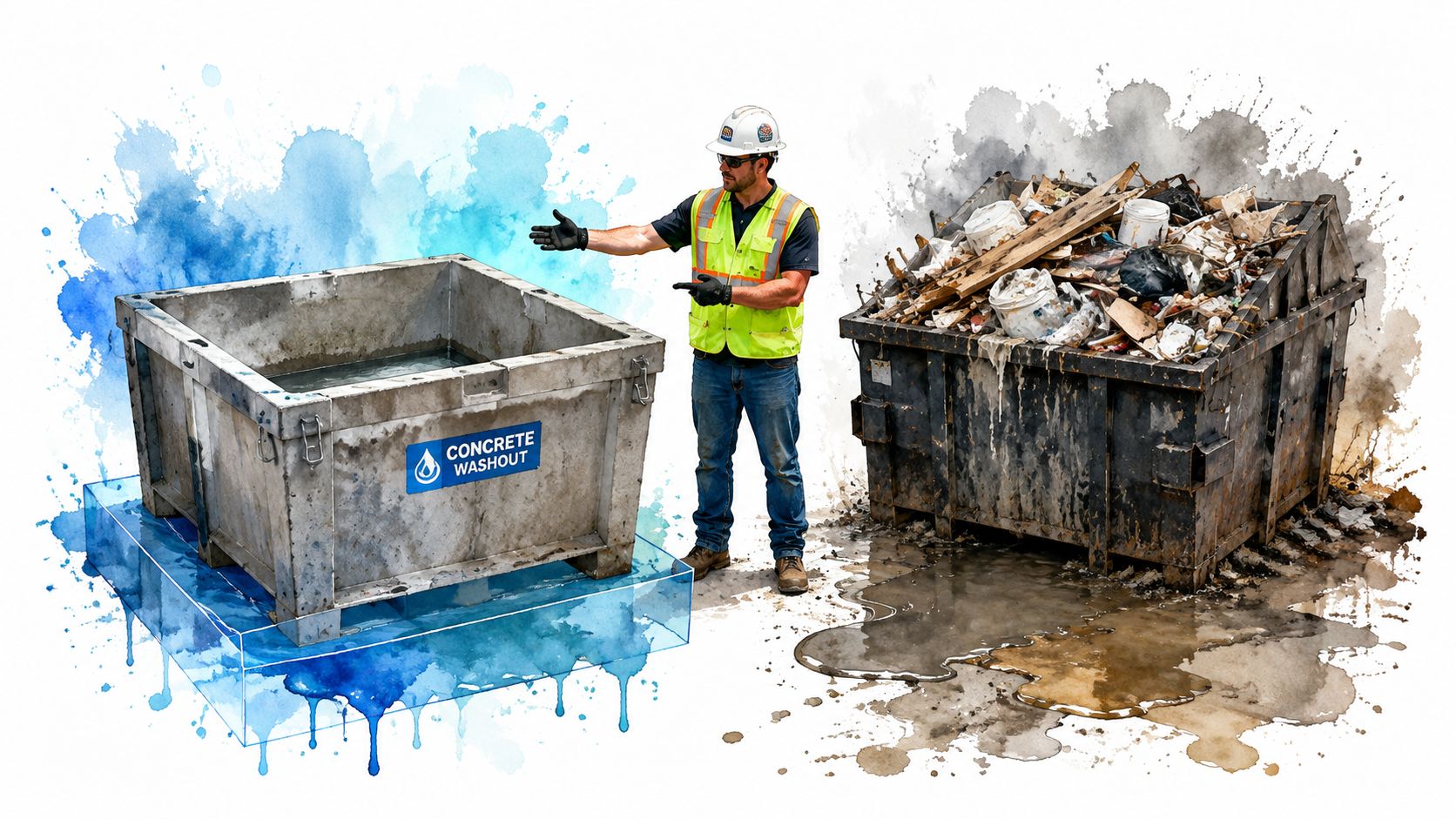
A concrete washout roll off is a purpose-built containment unit for concrete slurry, rinse water, and residual solids from mixers, pumps, chutes, tools, and finishing cleanup. It's closer to an industrial basin than a trash box.
A standard debris dumpster is built to hold solid waste. A washout unit is expected to contain wet, alkaline material without leaking, sloshing out easily, or turning pickup day into a transportation problem.
How it differs from a regular dumpster
The biggest mistake crews make is treating washout like ordinary disposal.
A regular roll-off dumpster is usually selected by cubic-yard capacity. Common commercial sizes include 10, 15, 20, 30, and 40 cubic yards, and those size conventions are standardized around hauling equipment and transport constraints, not slurry containment needs, as summarized in the roll-off dumpster sizing overview on Wikipedia). That's useful for debris planning, but it doesn't answer the washout question.
A washout container is selected for different reasons:
- Containment first so slurry and rinse water stay inside the unit
- Access geometry so chutes, hoses, and hand tools can reach it without awkward, spill-prone movement
- Load behavior because wet concrete residue is dense and shifts differently than dry demolition waste
Why a debris box is a poor substitute
Crews sometimes try to wash out into whatever empty container is on site. That shortcut usually creates new trouble.
A debris box may be too tall for easy chute access. It may already contain incompatible waste. It may not be suitable for wet slurry at all. And once crews start tossing trash, rebar tie wire, scrap wood, cups, and packaging into the same unit, the washout area stops being a controlled process and turns into mixed waste with more handling complications.
A good washout setup is boring on purpose. Trucks reach it, crews use it, nothing leaks, and nobody has to argue about what else got thrown in.
For contractors using Roll Offs to Go as part of site planning, that's the distinction that matters. The unit isn't there to “hold leftovers.” It's there to keep a predictable, messy operation from spreading across the project.
Choosing the Right Washout Unit for Your Pour
Picking the right washout unit starts with one question crews often skip. Are you planning for volume, weight, or both?
For concrete slurry, both matter. Dense material can make a container legally heavy long before it looks full. Acadiana Waste notes that standard DOT weight limits for roll-off debris often should not exceed ten tons, and that dense loads can hit legal limits before the container is full by volume. That's exactly why “bigger is safer” isn't always the right call.
Think in washout activity, not just container size
A useful field approach is to estimate the washout demand from the operation itself:
- Mixer truck rinse-out frequency
- Pump cleanup requirements
- Whether crews will wash tools into the same unit
- How long the container stays on site before haul-off
- Whether rain can add unwanted liquid volume
If the pour is light but the slurry is dense, you may need a smaller unit with stricter fill discipline. If the job runs over multiple days, available capacity can disappear faster than expected because hardened residue steals usable space.
A practical selector for two common pan styles
Below is a simple comparison using the published product details from the publisher information. This isn't a substitute for site review, but it's a good starting point for matching the pan to the work.
| Specification | Standard Pan | High-Capacity Pan |
|---|---|---|
| Footprint | 72' x 72' x 14' | 72' x 72' x 24' |
| Approximate liquid capacity | ~310 gallons | ~441 gallons |
| Published load reference | Not specified in publisher notes | Approximately 18.25 tons |
| Best fit | Smaller pours, lighter rinse-out demand, tighter placement conditions | Larger washout demand, pump cleanup, longer on-site use before service |
What usually works and what doesn't
What works is matching the unit to actual washout behavior. If you know the pump cleanup is going to be substantial, don't size the container as if the crew is only rinsing hand tools. If you know pickups are hard to schedule mid-pour, don't plan on a unit that needs perfect timing to avoid overfill.
What doesn't work is choosing by footprint alone. Two containers can occupy similar site space while creating very different hauling and fill-management outcomes.
One factual example from the market helps show how size and weight expectations diverge in standard roll-offs. An industry sizing summary notes a 25-yard container at about 2.5 tons, a 30-yard at a typical 5-ton limit, and a 40-yard often around 5 to 6 tons or up to 12,000 pounds. Washout planning has the same lesson. Capacity on paper doesn't cancel weight in practice.
If slurry is the load, don't wait for the container to look full. Manage it like a weight-sensitive material from the start.
Job Site Logistics and Proper Placement
Placement decides whether the washout plan holds up under actual site conditions.
A well-chosen container in the wrong spot still fails. If the driver can't place it safely, if the mixer can't reach it cleanly, or if rain carries overflow toward a drain, the equipment choice won't save the operation. Public guidance often misses this point. One sloped-property guide highlights that site-constraint logistics, including slope, narrow access, and soft surfaces, are practical concerns that affect safety, loading, and cost.

The placement check that prevents most problems
Before delivery, walk the location and answer these five questions:
- Can the truck get in and out cleanly? Don't just look at gate width. Check swing room, backing path, overhead conflicts, and whether another trade's laydown area will block pickup later.
- Is the surface stable enough? Soft dirt, recently backfilled edges, muddy subgrade, and uneven stone can shift under a loaded unit.
- Is the area level enough for safe containment? A slight slope can become a real problem once liquid accumulates and the crew keeps washing out to one side.
- Will the crew use it? If the pan is too far from the pour path, people start taking shortcuts.
- What happens in rain? Water always finds the low point. Make sure that low point isn't a storm drain or a route that cuts through active work.
Slopes, soft ground, and tight access
A sloped site is where washout planning gets exposed. The issue isn't just that the container might sit unevenly. The issue is that trucks, hoses, wheelbarrows, and workers all behave differently around a tilted, wet, heavy container.
Soft ground creates a different kind of failure. The pan may look fine on delivery and sink later as the load builds. Then chute alignment gets worse, spillage increases, and pickup becomes harder than placement was.
Tight access causes a third type of headache. Drivers need enough room to place the container safely. Crews need enough room to approach it without crossing live traffic, rework staging, or pedestrian routes.
The best washout location is rarely the nearest empty corner. It's the spot that stays usable from delivery through pickup.
A field checklist worth using
Use this quick pre-delivery review:
- Mark the drop zone before the driver arrives
- Confirm the surface condition after weather changes
- Check truck path twice, especially for pickup day
- Keep clear space around the unit so crews don't crowd it with pallets or scrap
- Separate it from drains and runoff channels even if the route is less convenient
This is the overlooked side of Roll Offs to Go logistics. The container has to fit the site that exists, not the one on the plan sheet.
Booking Your Roll Off and Understanding Costs
Crews usually lose money on washout rentals before the invoice shows up. It happens when the wrong unit gets sent, the driver can't make the drop, or pickup gets delayed because the site changed after booking.
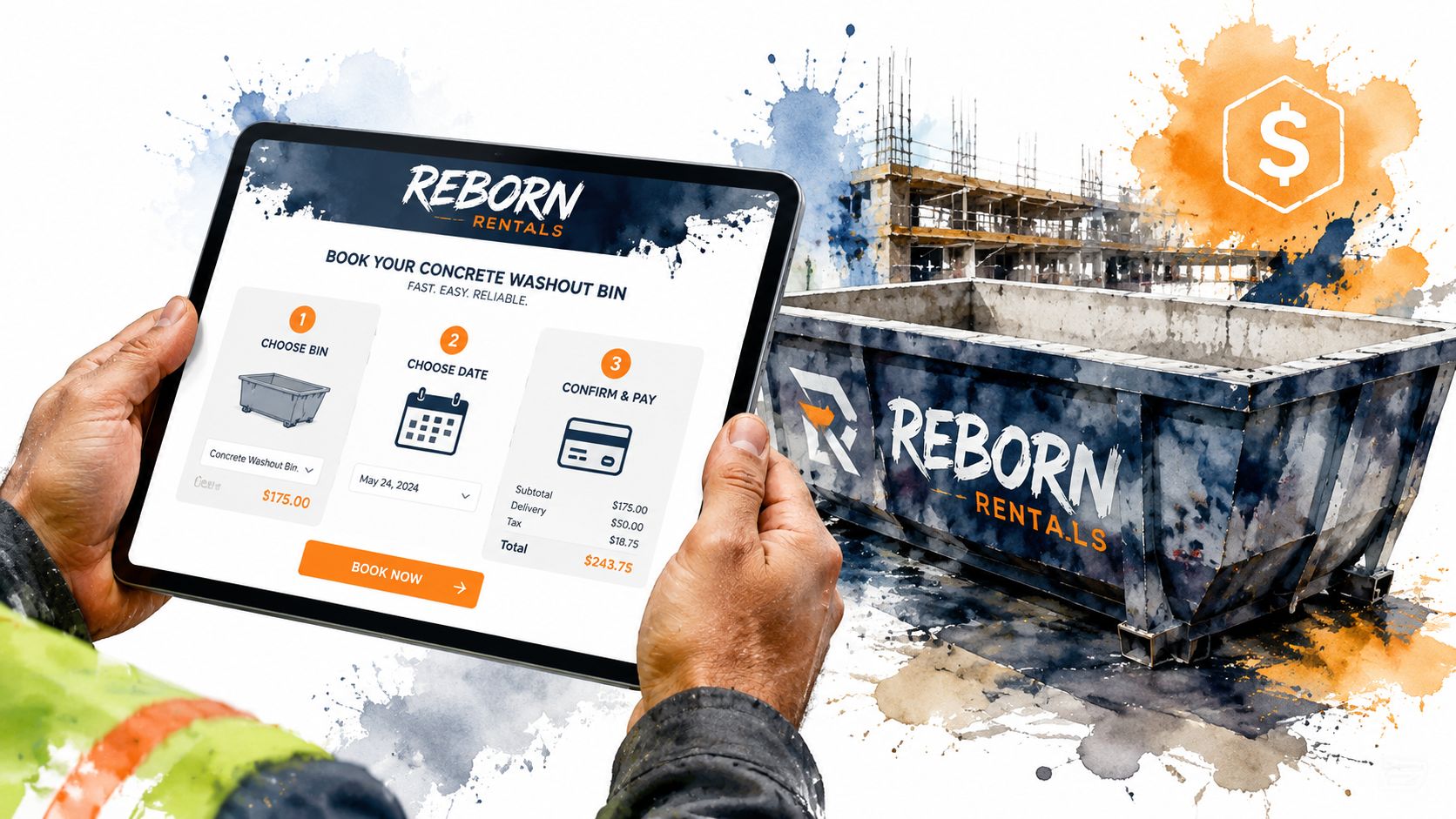
Ordering goes better when the office books from field conditions, not from the site plan alone. The rental company needs the same details a superintendent would ask for before committing a truck: where the washout will sit, what the truck has to drive over to reach it, how soon it needs to be in place before the pour, and whether the container is strictly for concrete washout or at risk of becoming a mixed debris bin.
What to clarify before you place the order
Bad assumptions cost more than clear questions. Give the rental company the facts that affect delivery, use, and haul-off.
- Delivery timing: Give a real delivery window tied to the pour schedule. “Anytime Tuesday” is how units show up after crews are already stacking forms or staging pump lines.
- Actual site access: Report gates, grade changes, soft subgrade, alley width, overhead conflicts, shared drives, and anything else that changes how a truck gets in and out.
- Surface at the drop point: A washout container loaded with slurry gets heavy fast. If the ground is wet, recently backfilled, or prone to rutting, say so before dispatch.
- Intended use: State clearly that the unit is for concrete washout. That matters for equipment selection, handling, and haul-off expectations.
- Pickup conditions: Confirm whether the same access available on delivery will still be open at pickup. I've seen jobs block their own container with fencing, stacked material, and parked lifts within a day.
Reborn Rentals, as noted earlier, lays out a simple checkout flow and notes that pricing can change with delivery conditions, rough terrain, and rush service. That's the right way to look at washout cost. Base rate matters, but site difficulty and schedule pressure are usually what move the number.
Cost control comes from fewer surprises
The cheapest order on paper can turn into the expensive one after one failed delivery or one extra trip.
A few habits keep costs in line:
- Book from current site photos, not old assumptions
- Match rental duration to the actual pour and cleanup schedule
- Flag access problems before dispatch, not after the driver arrives
- Keep the unit dedicated to washout so pickup stays simple
- Update the provider fast if rain, grading, or traffic control changes the plan
Photos help. A single phone picture of the drop area, approach path, and nearest obstruction often answers the questions that drag out scheduling and lead to wrong assumptions.
Good booking is simple in practice. Tell the rental provider what the truck will face, what the crew will need, and what the site will look like on pickup day. That is how you avoid extra charges, missed service windows, and the kind of washout problems that start small and eat half a morning.
On-Site Best Practices and Common Questions
Once the unit is on site, discipline matters more than hardware.
The cleanest jobs usually follow a simple rule. The washout pan is treated like a controlled operation, not a general dumping area. Chutes line up to it, pump cleanup goes to it, tool rinse stays inside it, and nobody casually turns it into the nearest trash receptacle.

Best practices crews should follow every time
- Set it where the chute can reach cleanly. Long, awkward washout movements create splash and miss.
- Watch fill level throughout the day. Don't assume there's room because the top edge is still visible.
- Protect the area during rain. Extra water changes both capacity and overflow risk.
- Keep other debris out. Mixed waste complicates haul-off and cleanup.
- Leave access open for pickup. A washout unit blocked by pallets, fencing, or parked equipment becomes tomorrow's scheduling problem.
Common questions from the field
Keep the washout process simple enough that the last truck of the day can follow it without a speech.
What happens to the washout waste after haul-away?
The provider takes it for proper handling and disposal, and in some cases material may be processed or separated according to local practices and facility rules. The exact path depends on the hauler and the receiving facility.
Can crews throw other construction debris into it?
As a rule, no. A washout container should stay dedicated to concrete-related slurry and residue unless the provider explicitly says otherwise. Mixing in trash, wood, metal, or packaging creates avoidable handling issues.
How far ahead should you book?
As early as the pour schedule is firm enough to support delivery planning. That matters even more on commercial work, because service availability doesn't always mean operational feasibility on a constrained site. Urban access, loading zones, and pickup timing can tighten the window fast.
If your next pour needs cleaner washout control, earlier logistics planning, or a container that fits the site you have, Reborn Rentals is one option to review. Check the unit specs, set the dates and location, and confirm access conditions before delivery so the washout plan works in the field, not just on paper.