
Rollon Roll Off: Roll-Off Containers
You've seen the scene. The pour is done, the crew is tired, and now there's gray slurry spreading where nobody planned for it. A driver rinses a chute onto bare ground, one laborer tries to berm it with scrap mud, and suddenly you've got runoff creeping toward a drain, hardened splash on finished surfaces, and a cleanup problem that costs more than the shortcut saved.
That's usually when someone says, “We need a rollon roll off.”
On a concrete site, that phrase usually means a roll-on/roll-off washout container. It's the big steel unit that gets delivered on a specialized truck, set in place, filled with washout, then hauled away when the job is done. The name sounds like shipping jargon because it is. But the ground-level use is simple. It's a controlled place for concrete washout, and on a busy site, controlled is what keeps a small mess from becoming a compliance issue.
The Real Cost of Uncontrolled Concrete Washout
The expensive part of bad washout management usually isn't the container you didn't rent. It's everything that happens after the crew starts improvising.

A common jobsite pattern goes like this. The pour runs long, trucks stack up, and nobody wants to send a driver across the site looking for a proper washout area. So wash water lands near the work. Then another truck uses the same spot. By the next morning, that “temporary” area has become a slick, crusted pit with tire tracks through it, splatter on sidewalks, and runoff risk if weather turns.
Where the damage shows up first
The first hit is labor. Somebody has to scrape hardened residue, shovel spoiled soil, pressure wash pavement, and explain why the site looks like no one was in charge.
The second hit is schedule. If washout spreads into access routes, staging areas, or around finished work, the crew starts working around the mess instead of through the plan. That slows deliveries, creates slip hazards, and forces rework nobody carried in the estimate.
Then there's the part contractors hate most. Paperwork and liability. Concrete washout isn't just ugly. It's a stormwater and housekeeping issue, and once inspectors or owners see uncontrolled slurry, the conversation shifts fast from production to compliance.
Practical rule: If the crew has to ask where to wash out after the first truck arrives, you're already late.
Why makeshift solutions fail
Plastic kiddie pools, lined holes, and scrap-bin experiments look cheap until they overflow, tear, or get clipped by equipment. They also fail for the simplest reason. Nobody respects a weak setup on a hard-running site. Crews will use what's easy, visible, and built for the abuse.
A proper Roll-On/Roll-Off container fixes that because it gives the washout operation a real home. It contains slurry and solids in one place, stands up to rough use, and can be swapped or removed without turning the end of the job into a hand-cleanup campaign.
If you want clean pours, clean access, and fewer arguments at the trailer, washout needs to be treated like staging or traffic control. Planned early. Marked clearly. Enforced every day.
Decoding Roll On Roll Off Washout Containers
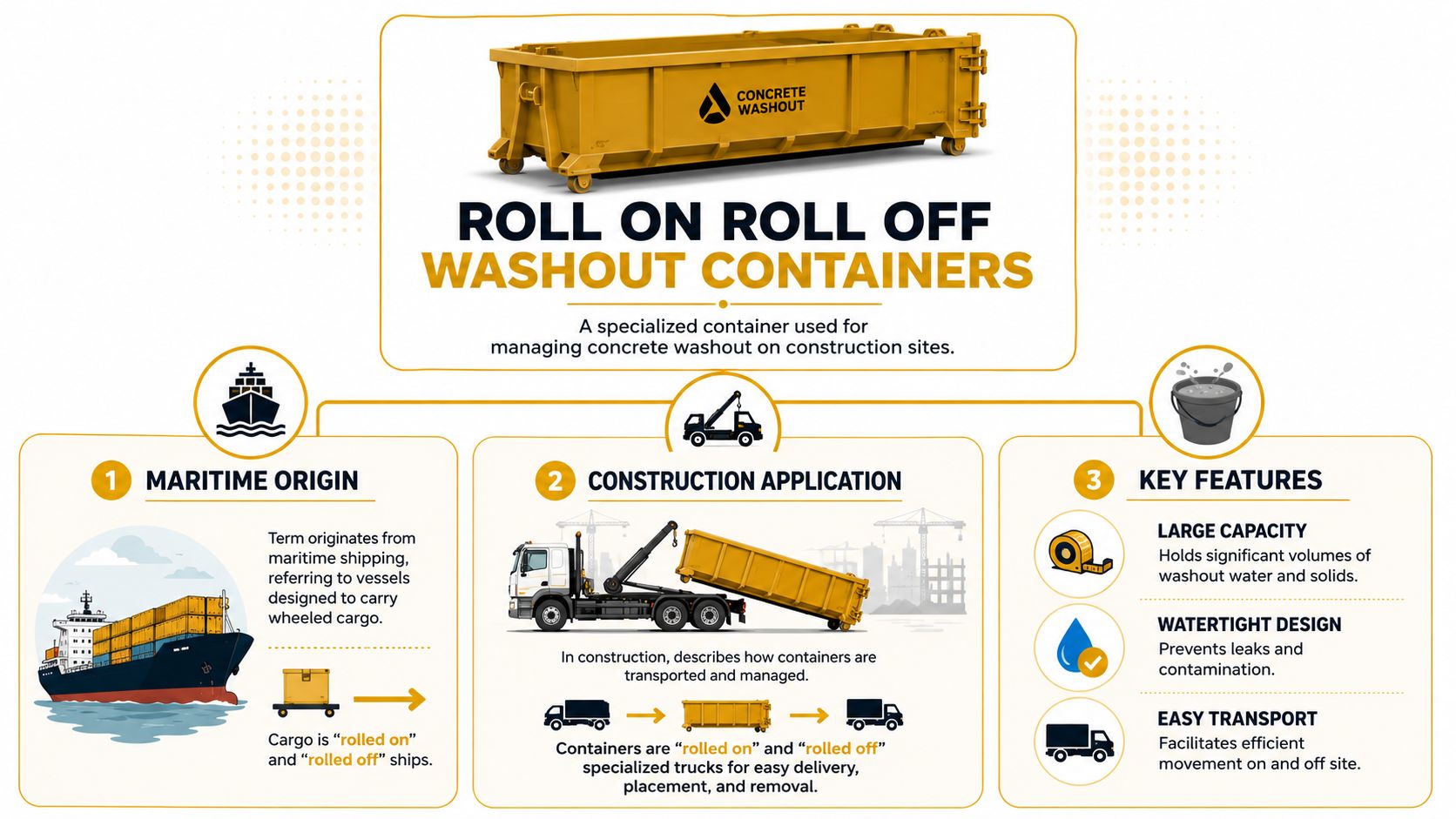
The term Roll-On/Roll-Off, or RoRo, started in shipping. Eurostat defines a Ro-Ro unit as wheeled freight-carrying equipment that can be driven or towed onto a ship, and maritime references describe the method as horizontal transfer using built-in ramps instead of crane lifts in Eurostat's glossary of roll-on/roll-off transport and in the Roll-on/roll-off vessel overview.
On a construction site, the phrase means something more practical. The container is rolled onto the truck for transport and rolled off at your site for use. Same logic. Different setting.
Why the shipping term actually fits
Think of a RoRo ship like a floating parking garage. Wheeled cargo moves across ramps onto internal decks instead of being hoisted by crane. A washout container truck works on that same basic principle. The truck bed and hydraulic system place the unit on the ground without a separate crane operation.
That matters because it changes how you plan the site.
You're not planning for a little pan that two workers can drag around. You're planning for a heavy steel container delivered by a specialized truck that needs approach room, firm ground, and safe clearance to set down and pick up.
Treat the drop area like you'd treat a concrete pump setup. If access is tight, soft, or blocked, the delivery gets harder than it needs to be.
What a washout container is built to do
A real washout container isn't just a big open box. It's built for a specific abuse pattern. Wet slurry. Hardened chunks. Chute washings. Tools getting knocked against the sidewall. Forklifts and labor traffic around it. Weather.
What works well on active sites usually has these traits:
- Leak-resistant construction: The whole point is containment. If wash water escapes, the container isn't solving the problem.
- Heavy steel body: Thin, light-duty gear doesn't survive repeated loading, scraping, and hauling.
- Open top access: Crews need to use it fast without awkward handling.
- Enough volume for both liquid and solids: Washout isn't just water. It's slurry, paste, aggregate residue, and hardened buildup over time.
- Truck-compatible design: The unit has to be handled as transport equipment, not as a static dumpster.
Why small pans and improvised pits hit a limit
Small pans have their place on light work, interior access constraints, or short-duration pours. But once truck volume climbs or the work runs several days, the weak points show up fast.
The pan fills too soon. The crew starts missing the target. Rain reduces freeboard. Somebody dumps where they shouldn't because the “official” washout is full. That's how a manageable process turns into scattered noncompliance.
A rollon roll off container is the better answer when the site needs one washout location that everyone can find, use, and respect.
Choosing the Right Container Size and Capacity
Container selection should be boring. If choosing the unit turns into guesswork, somebody either overpays for empty space or under-orders and creates a mid-job scramble.
The practical way to size a washout container is to match it to pour rhythm, truck frequency, and site duration. Don't size it by optimism. Size it by what the crew will put into it when the job gets busy.
Think in site conditions, not just dimensions
A smaller unit makes sense when you've got a short pour schedule, limited access, or residential work where the washout demand is controlled. A taller or higher-capacity unit makes more sense when multiple trucks will use the same location, the washout window stretches across phases, or the site can't afford a full-container surprise.
If your work tends to generate a lot of rinse water and residual material, err on the side of margin. Under-sizing doesn't save much if you end up paying for disruption.
Reborn Rentals washout container specifications
| Model | Dimensions (L'xW'xH') | Liquid Capacity (approx.) | Load Capacity (approx.) | Ideal Use Case |
|---|---|---|---|---|
| Low-profile unit | 72' x 72' x 14' | ~310 gallons | Qualitatively suited to lighter washout demand | Small pours, residential flatwork, short-duration washout staging |
| High-capacity unit | 72' x 72' x 24' | ~441 gallons | approximately 18.25 tons | Larger pours, commercial work, multi-trade sites, longer use windows |
A simple sizing rule that works on real jobs
Use the lower-profile container when the washout point is mainly serving a small crew and you expect disciplined use. It's easier to place where access is tight, and it's often enough when the scope is limited.
Move up to the higher-capacity unit when any of these are true:
- Multiple truck washouts are expected: More use means less room for guessing.
- The site has no backup washout option: One container has to carry the whole process.
- Rain exposure is a concern: Extra capacity gives you operating margin.
- The job has several concrete activities overlapping: Formwork cleanup, pump washout, chute rinse, and tool washing add up.
If the superintendent says, “We'll probably be fine with the smaller one,” that usually means the larger one is the safer call.
Don't ignore height and access
Capacity matters, but so does crew behavior. A container that's too awkward for the way the pump, trucks, and finishers move through the site won't get used consistently. The best unit is the one that fits the work pattern and keeps washout easy enough that nobody starts freelancing.
That's the actual sizing decision. Not maximum theoretical volume. Daily use without spillover, delay, or excuses.
Meeting SWPPP and Environmental Regulations
Concrete washout management is where clean operations and compliance meet. A sloppy washout area tells inspectors, owners, and consultants that the site is reacting instead of managing.
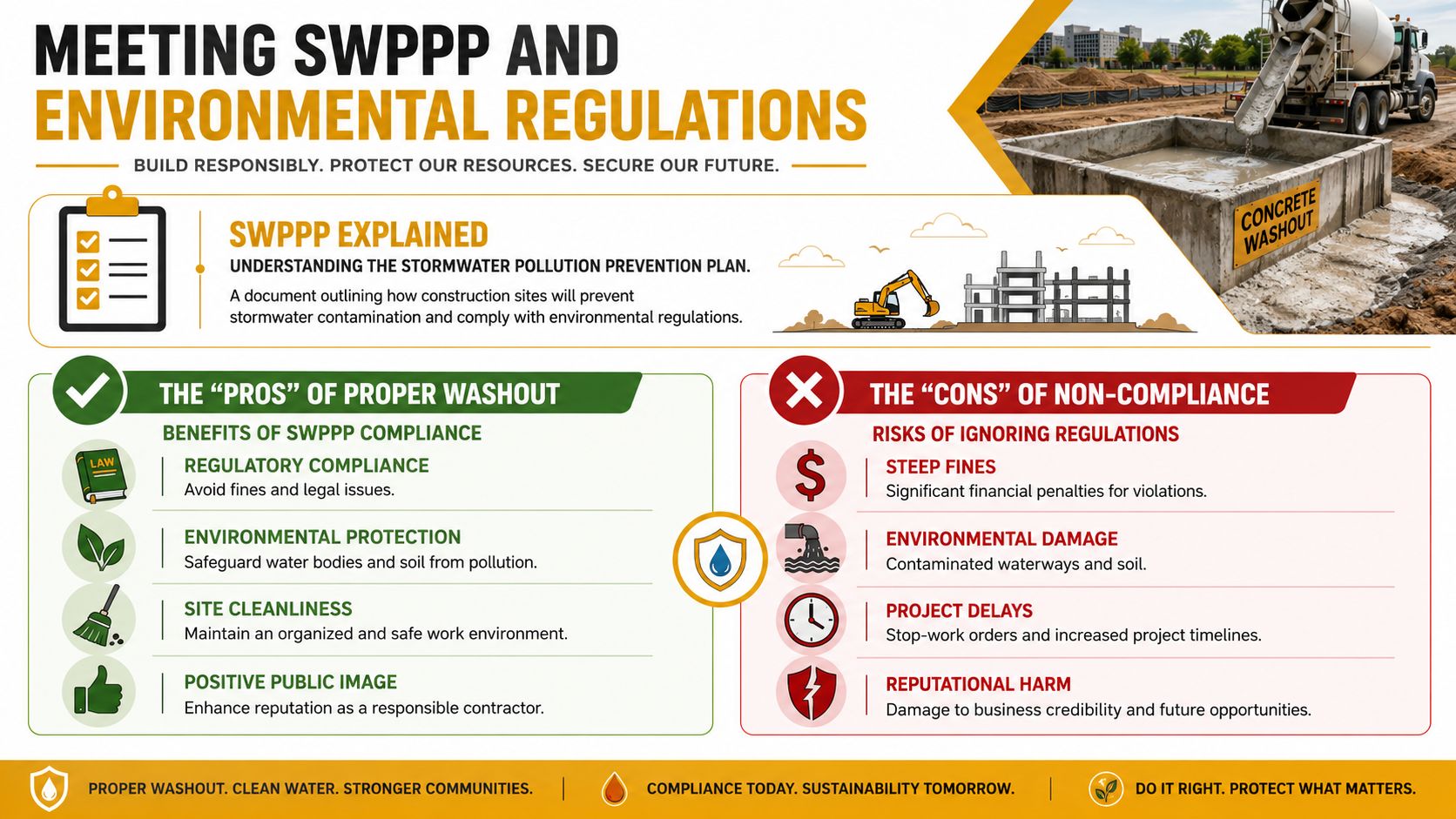
Most crews hear SWPPP and think paperwork. That's a mistake. On the ground, SWPPP is about controlling where dirty water goes, how pollutants are contained, and whether the site has a real plan for predictable messes like concrete washout.
What regulators care about on a washout setup
They care whether washout is designated, contained, maintained, and kept away from paths where runoff can leave the work area. They also care whether the setup looks deliberate. A marked, stable, purpose-built container shows control. A muddy depression behind the trailer shows the opposite.
That's why a rollon roll off container is more than a convenience item. It supports the parts of site compliance that crews can execute every day.
A proper setup helps by:
- Containing slurry in one known location: Crews don't invent backup spots around the site.
- Reducing migration risk: Less spreading means fewer surprises after rain or traffic.
- Improving housekeeping: Clean sites are easier to inspect and easier to manage.
- Supporting documented controls: The physical setup matches what the plan says should happen.
Professional handling matters before the container reaches your site
This equipment also falls under transport handling rules. Under U.S. federal securement guidance for roll-on/roll-off and hook-lift containers, at least two securement devices are required, each with a minimum working load limit of 9,200 lb (4,173 kg), and rear-end securement hardware must be installed no more than 6 ft 7 in (2 m) from the rear of the container.
That's worth paying attention to because it tells you something important. These units are not casual site accessories. They're handled as heavy transport equipment with specific load-control requirements.
Field note: If a container is treated casually in transport or placement, expect problems later in use.
Compliance is cheaper when it's routine
The easiest way to stay compliant is to make the right behavior the easiest behavior. Put the washout where trucks can reach it without crossing half the site. Keep it visible. Keep it usable. Keep crews from having to improvise.
That's what separates a professional operation from a cleanup operation. One plans containment before the pour. The other explains stains and runoff after the fact.
Your Rental Logistics Playbook
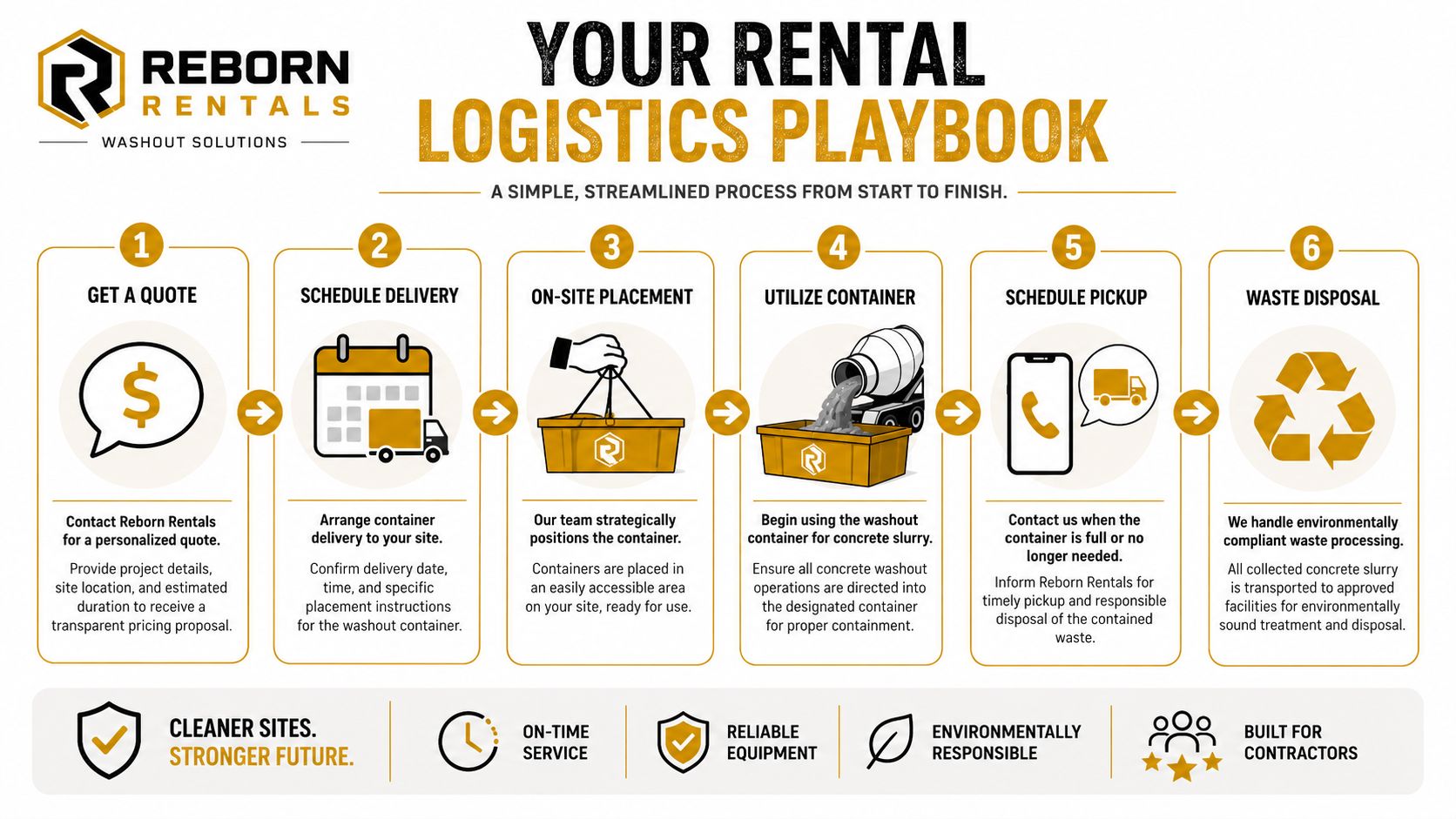
Rental logistics go smoothly when the site team handles three things early. Access, placement, and timing. Miss any one of them and the container may still arrive, but the day gets harder than it needs to be.
Before you schedule delivery
Have the basics settled before you call or book:
- Know the use window. Not exact to the hour, but clear enough that delivery and pickup can be planned around the pour sequence.
- Pick the location. Don't leave this to the truck driver at the gate.
- Check the path in and out. Look for overheads, soft shoulders, fencing pinch points, parked equipment, and muddy grades.
- Choose the right size. Use the decision logic from the sizing section, not a last-minute guess.
If the site is rough, remote, or constrained, say that up front. Difficult terrain and special handling can change how the job should be scheduled.
Placement rules that save headaches
The best spot is close enough to the concrete operation to be convenient, but not so close that it interferes with truck flow, pumps, pedestrian movement, or material staging.
Use this checklist:
- Firm ground: The truck needs stable support during placement and pickup.
- Level position: A bad setup angle invites uneven loading and ugly use.
- Clear swing and backing room: Tight access burns time and increases risk.
- Visible location: If crews can't see it, they'll create a second washout point somewhere else.
During the rental
Once the container is on site, assign ownership. One foreman, superintendent, or lead laborer should watch usage and decide when to request pickup or swap. Shared responsibility usually means no responsibility.
This also keeps billing and scheduling cleaner. If one person tracks fill level, weather impact, and ongoing concrete activity, there's less chance of emergency calls because the container went from manageable to full over one shift.
What to ask about pricing and service
Transparent rental planning usually comes down to a few practical questions:
- Daily rate: Know the base rental cost before the container arrives.
- Delivery conditions: Distance and site access can affect the final number.
- Express service: Rush requests may carry added charges.
- Pickup timing: Don't assume same-day availability if the schedule matters.
The smoother jobs are the ones where the crew treats the rollon roll off container like any other scheduled piece of equipment. Book it early, give it a real location, and manage it like it matters.
On-Site Best Practices for Safe and Efficient Use
Once the container is in place, the job is simple. Keep all washout going into that one controlled point, and don't let daily shortcuts break the system.
Placement and use habits that work
Set the container near the pour activity, but outside the path of backing trucks, lifts, and material drops. A washout unit in the wrong traffic lane won't stay clean for long.
Direct drivers and pump crews to the container before the first rinse. Don't assume they'll figure it out. Mark it, mention it in the pre-pour talk, and have someone point to it when trucks arrive.
A few habits keep the operation tight:
- Control chute angle: A bad angle causes splash and misses the container edge.
- Keep approach space open: If pallets or debris block access, crews improvise elsewhere.
- Watch fill level daily: Slurry volume changes faster than often anticipated.
- Protect freeboard in wet weather: Rain can steal capacity and push overflow risk higher.
Keep the washout area easy to use when people are in a hurry. That's the standard that matters.
What not to do
Don't overfill the container. Don't let hardened buildup reduce usable capacity until fresh washout has nowhere to go. And don't move the unit around the site with whatever machine happens to be nearby unless the rental provider specifically authorizes and plans for that.
Also, don't turn the container into a general trash box. Mixed waste complicates handling and creates avoidable friction at pickup.
When to call for service
Call early if slurry is still active and capacity is getting tight. Waiting until the unit is effectively full leaves no room for the next truck, and then the crew starts creating side problems.
If the contents have hardened and the work is ending, pickup is still a scheduling item, not an afterthought. Build that final removal into closeout so the washout area doesn't become the last ugly thing left on an otherwise finished site.
Common Questions About Renting Washout Containers
What happens to the concrete waste after pickup
A professional provider transports the contents for appropriate processing and disposal rather than leaving the site team to deal with residue, contaminated soil, or hardened waste piles. The key point for the contractor is chain of handling. The waste leaves the site in a contained unit instead of being broken up into a field cleanup problem.
Can I move the container on-site myself
Usually, that's not a smart assumption. These are heavy units handled as transport equipment, and as noted earlier, roll-on/roll-off containers are subject to specific securement requirements during transport. If the location might need to change, decide that before delivery or coordinate the move through the rental provider.
How much notice should I give for pickup
Give as much notice as you can. Busy schedules, route planning, and site access all affect pickup timing. The foreman who calls before the container becomes a problem usually gets a smoother result than the one calling after the crew has already run out of usable space.
What's the real difference between a small washout pan and a rollon roll off container
A pan is a light-duty containment option. A Roll-On/Roll-Off container is a site-scale washout solution. The difference isn't just size. It's how much abuse it can take, how long it can stay functional under repeated use, and how well it supports a single controlled washout point on an active job.
Is a roll-on/roll-off container always the best answer
No. The same way RoRo shipping isn't the right mode for every cargo movement, containerized washout planning should match the job. Industry reporting on RoRo shipping notes that efficiency gains come with route-dependent tradeoffs such as bottlenecks, slot scarcity, congestion, and compliance costs, so the best choice isn't universal in this discussion of RoRo efficiency versus resilience tradeoffs. On a site, the equivalent question is scale and workflow. For a very small task, a large unit may be more than you need. For repeated truck washout, trying to get by with a tiny setup is asking for trouble.
Is the term only used in construction
No. In shipping, RoRo is a major transport method for wheeled cargo. One market estimate projects the global RoRo shipping market at USD 1.81 million in 2026 and USD 2.78 million by 2035, a projected 4.41% CAGR over that period, and the same estimate says vehicle carriers account for more than 500 vessels moving more than 16 million CEUs annually, with over 22 million automobile export units shipped in 2023 in this RoRo shipping market estimate. On your jobsite, though, the practical meaning is simple. The container comes on a specialized truck, rolls off into place, does the dirty work, and leaves with the mess contained.
Why do some crews still underestimate washout planning
Because most of the attention goes to production, not aftermath. That same blind spot shows up in shipping, where public discussion often focuses on damage and rates instead of stability and operational risk. Commentary on RoRo transport points out that safety questions remain relevant because casualty discussions often center on loss-of-control and capsizing-type concerns rather than just cargo condition in this RoRo safety discussion. On site, the version of that mistake is focusing on the pour and forgetting the waste stream. Good crews don't make that separation.
If you need a dependable washout setup without the usual guesswork, Reborn Rentals makes it easy to book the right container, schedule delivery, and keep your site cleaner and more compliant from the first pour to final pickup.