
Stormwater BMP Guide for Construction Site Compliance
The rain doesn't wait for a convenient moment. A site can look clean by day's end, then one hard storm turns loose soil, stockpiles, and fresh concrete work into runoff that heads straight for the nearest inlet. That's where stormwater BMPs matter, because they give you a controlled way to hold, filter, or contain what would otherwise leave the jobsite.
On a construction project, the core problem is rarely one single mistake. It's the chain reaction of poor placement, missed inspections, and a BMP that looked fine on paper but couldn't handle the actual site conditions. Good stormwater planning breaks that chain before it reaches a drain, a creek, or an inspector's report.
Understanding the Key Concepts
A stormwater BMP is the control you put in place before runoff becomes a problem. It holds water, slows it, filters it, or contains it long enough to keep a jobsite organized and keep muddy discharge out of the nearest drain or channel.

Why performance data changed the game
The International Stormwater BMP Database was established in 1996 through a cooperative agreement between ASCE and the EPA to build a shared evidence base for BMP performance. It gave consultants and site managers a common way to compare effluent quality and site conditions, instead of relying on studies that used different methods and were hard to compare EPA BMP database overview.
That shift pushed the field toward a simpler question. What does the BMP do under real site conditions? For a site manager, the answer should account for drainage area, runoff volume, soil type, climate, and maintenance access. A unit that looks right on paper can still fail if crews cannot place it where runoff collects or service it after a storm.
Practical rule: treat a BMP like field equipment, not a brochure feature. If crews cannot install it, inspect it, and keep it working, it will not perform as planned.
What the basic terms mean on site
Effluent quality is the quality of water leaving the BMP. Outflow concentration is the pollutant level in that discharged water. Those terms matter because they describe what exits the system, which is more useful than a simple percentage when incoming runoff changes from one storm to the next.
That distinction helps when teams compare controls across a site. A BMP with a strong performance number may still be the wrong fit if space is tight, soils are unstable, or equipment cannot reach the area for maintenance. A good match starts with the site's risk, then the BMP's capacity, then its placement.
Types of Stormwater BMPs
Stormwater BMPs usually fall into two broad groups, structural and non-structural. Structural BMPs are physical treatment systems, such as bioretention, filtration, infiltration, ponds, wetlands, porous pavement, and green infrastructure. Non-structural practices are the day-to-day controls that keep runoff from becoming a problem in the first place, such as good sequencing, protected flow paths, and stabilized access points.
Structural controls and what the numbers suggest
Monitored systems show that BMP performance varies by practice and pollutant, but the data do support real treatment value. Minnesota's guidance reports median TSS outflow concentrations of about 13 to 26 mg/L across evaluated BMP categories, with median or mean TSS removal ranging from 54% to 88% Minnesota BMP pollutant removal summary.
| BMP Type | TSS Removal | TP Removal | Hydrocarbon Removal |
|---|---|---|---|
| Media filters | about 85% | not provided in the verified data | not provided in the verified data |
| Sand filters | about 85% | about 50% | about 80% |
| Biofiltration and tree-trench or tree-box systems with underdrains | about 80% | about 50% total nitrogen, not TP | about 80% |
Media filters stood out in that summary, with about 10 mg/L TSS outflow and about 85% TSS removal. Sand filters also showed meaningful treatment, and the broader lesson is simple, different BMPs target different pollutants with different levels of success.
Why the same BMP can act differently on different sites
The same practice won't always produce the same result. Influent quality, storm intensity, maintenance, and site conditions all affect how much treatment a BMP delivers. That's why it's smarter to think in terms of fit, not just category.
A BMP is a match between the pollutant you expect and the runoff behavior you can actually manage.
A site with fine sediment problems needs one kind of control. A site with concrete washwater or other high-alkalinity discharge needs another. If you try to use one general-purpose solution for every runoff source, the weak point shows up fast.
How to Choose and Place BMPs
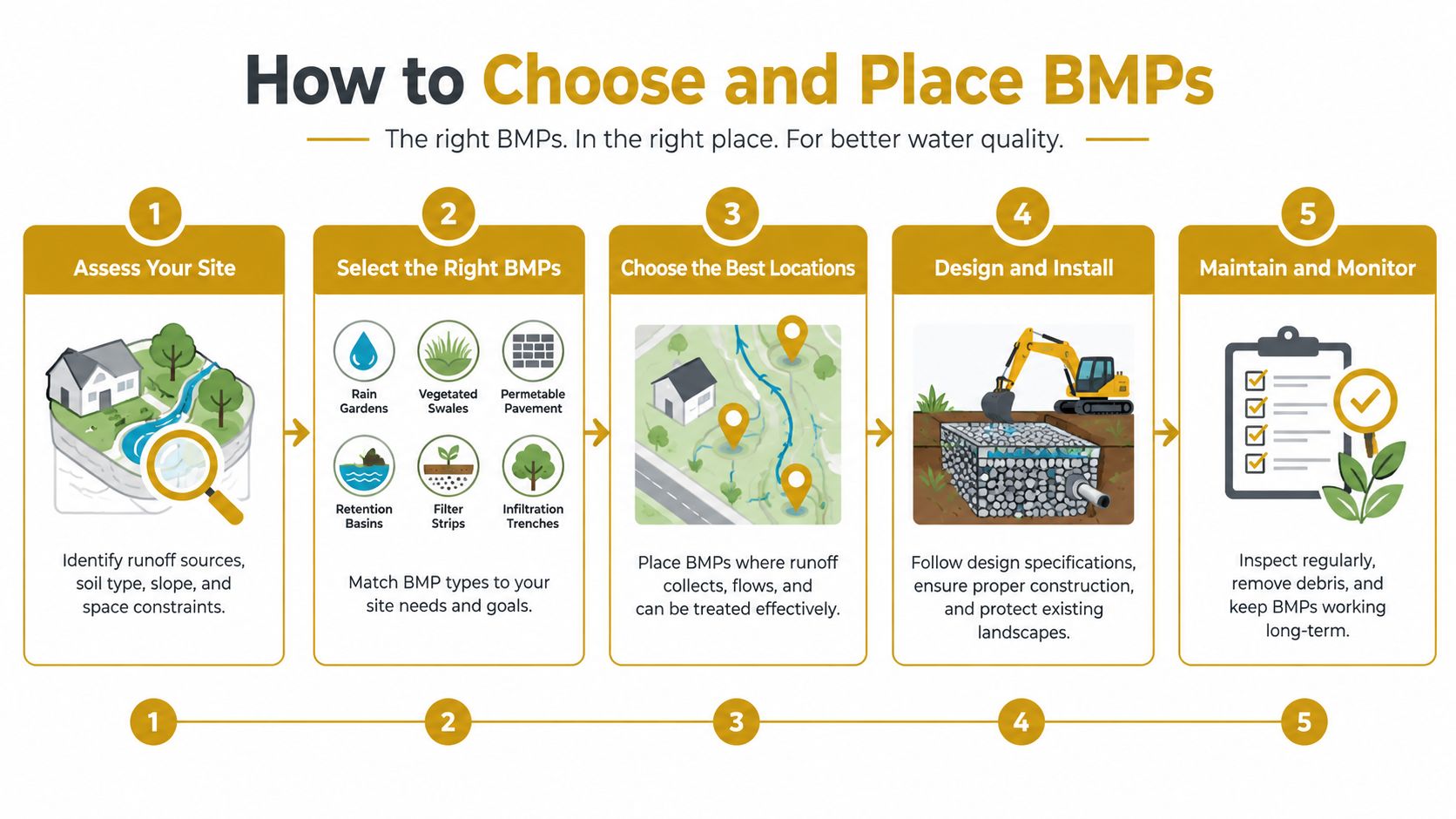
Good placement starts with the site map, not with the product catalog. Walk the drainage paths, note the slope, identify the nearest inlets, and mark where equipment moves during the day. If a BMP sits in the wrong place, it can be technically correct and still fail in practice.
Start with the physical constraints
EPA guidance recommends above-grade washout facilities with minimum dimensions of 10×10 feet, positioned at least 50 feet from storm drains, and lined with at least 10-mil-thick polyethylene to maintain impermeability EPA small commercial SWPPP example. Those details are useful because they force you to think about fit, not just intent.
A practical field layout should answer four questions before the first pour or earthwork push:
- Where does runoff naturally travel? Put the BMP where it intercepts the flow path without blocking traffic.
- Can trucks and crews reach it safely? If access is awkward, maintenance will slip.
- Is the liner or containment surface intact? Impermeability is only real if the barrier has no holes, tears, or weak seams.
- Does the site have room for the full waste stream? Don't size for an ideal day, size for the day with rain, delays, and multiple trucks.
Think about site use, not just site capacity
A BMP can be the right size on paper and still be too exposed in the field. It should sit outside traffic paths, away from drainage outlets, and in a location where a worker can inspect it without climbing over other site obstacles. That matters because a BMP you can't check quickly tends to become a BMP you check too late.
The most common placement error is treating all free space as equal. It isn't. A flat corner beside active travel lanes is not the same as a flat corner with safe access, no utility conflict, and a clean path for pumping or cleanout. The better choice is the one that keeps the control usable on a busy day, not just visible on a plan sheet.
Simple test: if a superintendent can't explain how the BMP gets inspected, emptied, and reset in under a minute, the location probably needs work.
Maintaining Stormwater BMPs
Maintenance turns a BMP from a plan element into a working control. A container that looked ready on install day can slip out of compliance if crews stop watching fill levels, sediment buildup, or damage after a storm.
Build the inspection habit
Start with a fixed routine. EPA recommends inspecting concrete washout containers daily and after heavy rain, then removing contents before capacity exceeds 75% to reduce overflow risk and keep containment dependable EPA concrete washout guidance. That threshold gives crews a clear action point instead of a vague reminder to “check later.”
The routine is simple:
- Inspect at the same time each day. A set time is easier to follow than a loose reminder.
- Check after storms or heavy rain. Weather can shrink usable capacity quickly.
- Record the fill level. The log should make rising volume easy to spot.
- Schedule pumping or solids removal early. Waiting until the container is full turns maintenance into a response to a spill.
Focus on usable capacity, not just container size
Container size alone can be misleading. Sediment takes up room, so the working volume drops before the container looks full. On short pours, or on sites where trucks arrive in waves, that lost margin disappears faster than crews expect.
A washout BMP works best when it is treated like an active control, not a passive bin. Keep watch as the container approaches the trigger point, and act before overflow becomes a discharge path. That is especially important where concrete washout is tied to other stormwater BMPs, because one overloaded control can affect the whole containment setup. Size the BMP for real site conditions, then place it where crews can inspect it, service it, and reset it without delay.
Regulatory Requirements and Compliance
A site can have the right BMP on paper and still fail an inspection if the crew cannot show where it was placed, how it was maintained, and why it fits the site. Compliance is as much about documentation as it is about the control itself.
What compliance looks like in practice
The BMP Database overview above points to a simple principle, real performance should be judged from field conditions, not assumptions. That idea fits permit programs and SWPPPs because inspectors look for records that match what was installed and maintained.
On an active construction site, the compliance checklist usually comes down to a few repeatable items:
- SWPPP alignment: the BMP in the plan should match the BMP in the field.
- Inspection records: the log should show when the control was checked and what was found.
- Corrective action tracking: if a container is near capacity or a liner is damaged, the response should appear in the record.
- Site-specific fit: the control should reflect drainage, soil, climate, access for maintenance, and the discharge point.
Why generic rules aren't enough
A BMP can work on one site and fail on another because the site conditions are different. A contractor on flat ground with easy truck access faces different constraints than a crew working on a tight urban lot or a sloped roadway project.
Compliance gets easier when the BMP decision starts with actual field conditions. If an inspector asks why a washout unit, filter, or containment feature was placed where it was, the answer should connect to runoff flow and maintenance access. That kind of recordkeeping helps a jobsite hold up under review and keeps the control practical for the people maintaining it.
Integrating BMPs with Concrete Washout Containment
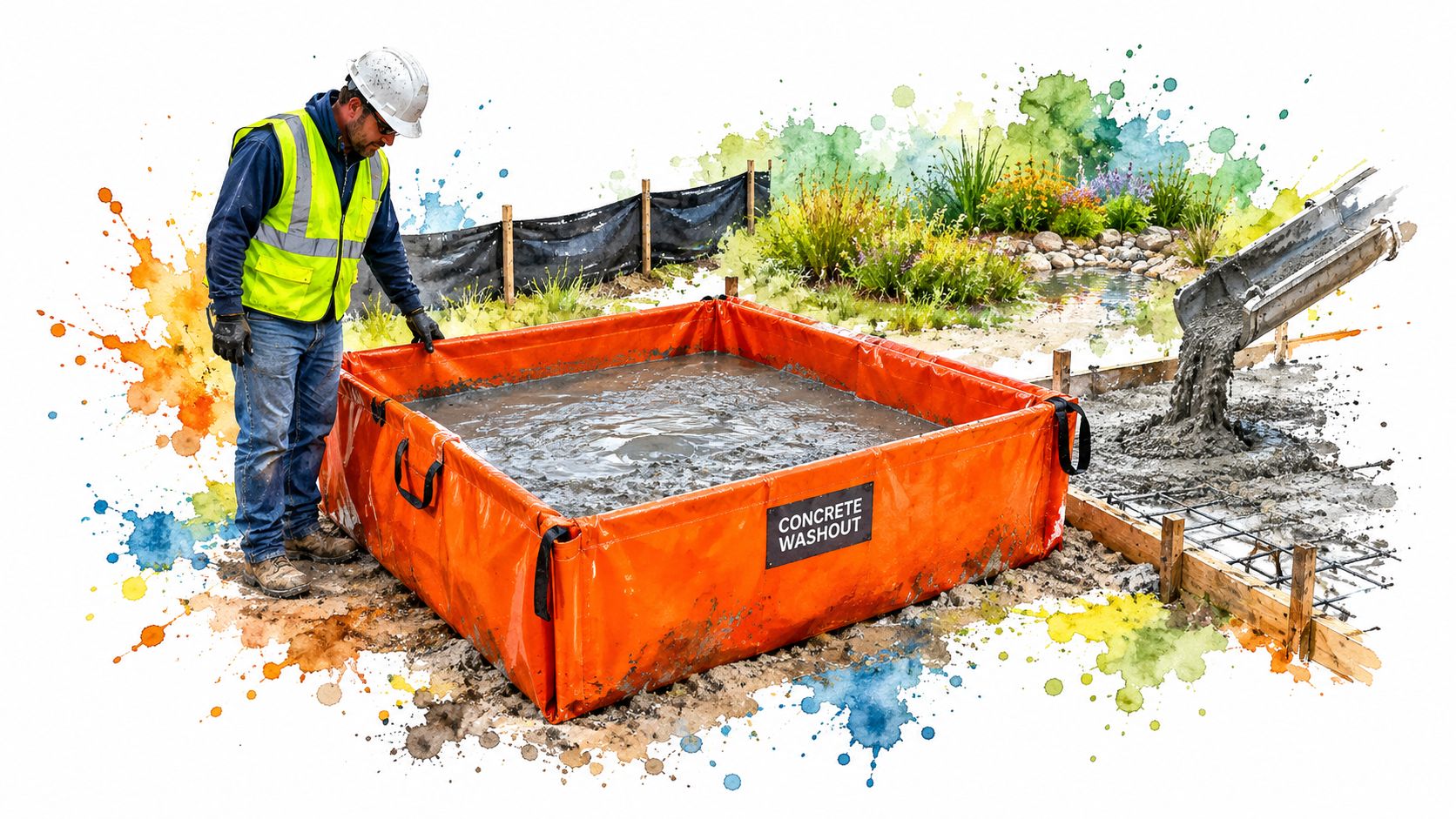
Concrete washout deserves special attention because it is a source-control BMP, not housekeeping. It keeps highly alkaline water and cement solids out of soil, storm drains, and receiving waters. When crews treat it like an afterthought, it becomes one of the easiest ways for a site to create avoidable discharge problems.
Make washout part of the job sequence
As noted earlier, the goal is to collect wash water and cement solids in a leak-proof container and keep the area under routine inspection. The practical point is simple, the washout location should be set before the first pour, not after the truck is already rinsing out.
A good sequence starts with access. Put the unit where drivers can find it quickly, keep it out of traffic paths, and check it before the end of each shift. If rain is coming, lower the liquid level or cover the facility so overflow does not become runoff.
Size it for the peak day, not the average day
Washout needs to handle the full liquid-and-solid waste stream, not just the expected rinse water. That is where dynamic capacity matters. A container that looks fine in dry weather can fall short when rainfall, solids, and multiple truck loads all reach the same facility.
Size the washout for the busiest pour day, including the rinse from every truck and any rain that can collect on the footprint. Leave space for the storm event you can get, not the one you hope for. A practical rule is to place it on high ground and far enough from inlets that rainfall does not use up the freeboard you need to stay in control.
Reborn Rentals offers concrete washout containment units that fit into that workflow as a rental option for crews that need short-term containment on active pours. The value is in the sequence it supports, from setup and inspection to pumping or replacement before the unit becomes a discharge risk.
Keep the washout close enough for crews to use, but far enough from drainage features that a mistake does not become a release.
Conclusion
Stormwater BMPs work when they're chosen for the site, placed with care, and maintained before small problems turn into discharges. The key habits are simple, use real field conditions to guide placement, check capacity before it becomes a problem, and keep washout containment in the same compliance routine as every other control.
The projects that stay cleaner and easier to defend are usually the ones where the BMP plan matches the way the crew works. If you're setting up a pour or tightening your SWPPP controls, consider how rental washout containment can help you stay organized, protect drainage paths, and keep inspections straightforward.
Reborn Rentals provides concrete washout containment units that support SWPPP compliance on active construction sites. If you need a practical way to manage concrete slurry and keep washout where it belongs, visit Reborn Rentals to review your options and line up a solution that fits your jobsite.