
SWPPP Sign Requirements: A Practical Compliance Guide
Tuesday morning, the superintendent is already juggling deliveries, a concrete pour, and a forecast that may turn the access road into mud. Then an inspector parks at the front gate. The foreman meets them with a hard hat, a radio, and a plan binder that's perfectly safe in the trailer, but the sign at the entrance is faded enough that the permit number and contact phone are barely readable.
The inspector's first questions are practical: Where's the SWPPP posted, and who's the on-site contact? While the foreman calls the superintendent, the inspector looks past the gate toward inlet protection, perimeter controls, and the concrete washout. The sign may be the first deficiency, but it often becomes the reason the inspector checks whether the controls and records match what the site claims.
That's the working reality behind SWPPP sign requirements. A sign isn't decoration, and it isn't a substitute for the plan. It's the visible starting point for a compliance review.
The Morning an Inspector Walks Onto Your Site
At a mid-size commercial site, the entrance sign has one job before anyone opens the binder: give the inspector a clear, credible route into the project's stormwater controls. If the sign is missing, rotated toward the wrong traffic lane, or weather-damaged, the inspector has to ask whether the crew is maintaining the rest of the system with the same level of care.
The foreman in this situation eventually finds the plan in the trailer. The operator certification is present in the binder, but the signature on the entrance sign has weathered away. That distinction matters. The binder proves that a SWPPP exists. The sign shows that the project has made its stormwater responsibilities visible at the site.
Practical rule: Treat the sign as the inspector's first field reference, not as a spare copy of the title page.
The inspector walks the perimeter while the foreman searches for answers. They look at whether inlet protection is intact, whether sediment controls remain anchored, and whether the designated washout area is identifiable and contained. A clean sign beside an uncontrolled discharge creates a contradiction. So does a detailed plan that no one on the crew can use to locate the washout.
What the entrance moment reveals
The inspection usually starts with simple observations:
- Visibility: Can someone approaching the property read the sign without entering an active work zone?
- Currency: Does the listed contact still work on this project?
- Consistency: Does the permit information match the SWPPP and permit records?
- Control awareness: Can the crew identify the controls and designated areas described in the plan?
A sign deficiency may be correctable on the spot, but the response still matters. The superintendent should replace damaged material, update incorrect information, photograph the correction, and record the action in the project's compliance file. That response shows control of the issue instead of leaving the inspector to discover whether anyone is monitoring it.
The entrance sign doesn't carry the whole permit. It does determine how confidently an inspector can begin the conversation.
What a SWPPP Sign Actually Is
A SWPPP sign is a publicly readable compliance notice placed at a construction site. It tells workers, subcontractors, inspectors, and members of the public that a Stormwater Pollution Prevention Plan applies to the project, where the plan can be reviewed, and who can answer site questions.
The sign is separate from the SWPPP itself. The plan contains the detailed site description, control measures, inspection procedures, corrective actions, and records. The sign provides a field-facing summary that helps people find the responsible information without searching through a trailer or asking several members of the crew.
Three functions on an active project
First, the sign notifies the workforce. A new subcontractor should be able to see that stormwater controls are part of the job, then receive the project's site-specific instructions during onboarding.
Second, it provides access and accountability. An inspector needs a visible contact and a clear indication of where the plan is kept. A public contact also helps direct questions about sediment tracking, washout activity, or discharge controls.
Third, it supports the project's compliance record. The sign should reflect a project that has completed its required certification and posting process before earth-disturbing work proceeds, subject to the applicable permit and jurisdictional rules.
Don't confuse it with other required postings:
- The OSHA job poster addresses workplace safety and labor notices. It doesn't identify the stormwater plan or BMP contact.
- An EPA permit fact sheet explains regulatory requirements but usually isn't the project's site-specific notice.
- Project identification signage may list the owner, contractor, architect, or permit information without directing anyone to the SWPPP.
- A plan cover sheet belongs in the project file. It isn't automatically an acceptable entrance sign.
Federal guidance establishes the importance of a signed and certified SWPPP. The EPA SWPPP guide states that SWPPPs and related reports generally must be signed by the operator or a duly authorized representative, with authorization documented in the plan. The posted sign is the field artifact that makes that compliance structure visible.
Required Elements, Wording, Size, and Placement
Build the sign in the order an inspector reads it. Put the project name and permit number at the top, then identify the plan, the responsible contact, and the plan location. Keep the language short enough to read from the public access area, but complete enough that the sign doesn't look like a generic environmental notice.
Start with the information an inspector needs
A functional sign should normally include:
- Project name and permit number, matching the current SWPPP and permit records.
- A statement that a SWPPP is on file and available for review.
- The responsible on-site contact, including a working phone number.
- The location of the plan, such as the project trailer, office, or another specified address.
- The applicable certification statement, using the permit's required language or an accepted equivalent.
- A signature and date, when the jurisdiction requires those items on the posted notice.
The exact wording can vary, but paraphrasing shouldn't remove one of those core functions. If a state-issued template exists, use it unless the permitting authority confirms that an alternative format is acceptable.
| Element | Typical Wording | Sizing Guidance |
|---|---|---|
| Project identification | Project name and current permit number | Use the largest type on the sign |
| SWPPP availability | “Stormwater Pollution Prevention Plan available for review at…” | Keep the location prominent |
| Site contact | Name, role, and working phone number | Use type readable from the approach |
| Plan location | Trailer, office, or specified review location | Include enough detail to find it |
| Certification | Required permit certification statement | Don't shorten required legal language |
| Signature and date | Authorized signatory and certification date | Keep the signature visible and legible |
Size follows the inspection viewpoint
There isn't one universal federal sign dimension for every project. A public-sector construction standard, for example, specifies a 4-by-4-foot plywood sign, red letters on a white background, and 10-inch SWPPP lettering for sites of 5 acres or greater. Those specifications appear in the University of Texas temporary stormwater pollution control standard, and they demonstrate why a generic small placard may fail a project-specific requirement.
Use weather-resistant aluminum, coroplast, or properly protected plywood where the permit or owner standard allows it. Mount the sign near the primary entrance at a height that crews and inspectors can read without stepping into traffic. Keep it outside the equipment swing radius, away from dust-producing operations, and clear of parked trailers.
Placement involves trade-offs. A sign beside the gate is visible, but it can be struck by delivery trucks. A sign near the tracking pad may be easy to reach, but tire spray can cover the contact information. A location beside the washout can help crews connect the notice to the control area, but it shouldn't replace the entrance posting if the permit expects entrance visibility.
Certification and Signature Rules on the Sign
The person who signs the SWPPP isn't automatically the person who performs every inspection or manages every subcontractor. Separate the roles before printing anything.
The permittee or operator carries responsibility under the permit. A facility executive or duly authorized representative may sign when that person has the authority and operational control required by the permit. A qualified stormwater professional may prepare, amend, or inspect the plan where state rules assign that work to a licensed or otherwise qualified individual, but preparation authority doesn't automatically equal signatory authority.
The EPA industrial SWPPP guidance describes the final step as having a facility executive or duly authorized representative sign and certify that the SWPPP meets the general permit requirements. EPA construction guidance also points to the permit's signatory provisions and allows certain documents to be signed by the NOI signer or an authorized representative under the applicable regulation.
Use the permit's certification language
The certification statement should sit near the signature line, not in a separate file that leaves the sign ambiguous. Don't replace required language with “I approve this plan” or “The SWPPP is complete.” Those phrases may express intent, but they may not satisfy the permit's certification wording.
| Role | Authority to Sign | Required Language | Re-sign Trigger |
|---|---|---|---|
| Permittee or operator | Signs when identified as the responsible operator | Use the applicable permit certification statement | Operator or permittee changes |
| Authorized representative | Signs when written authorization supports the role | Include the required certification and retain authorization in the SWPPP | Authorization changes or is withdrawn |
| Facility executive | May certify for an industrial facility when authorized by the permit | Certify that the SWPPP meets permit requirements | Facility responsibility changes |
| Qualified professional | May prepare or amend where jurisdictional rules require that qualification | Use the state-required professional certification when applicable | Required amendment or professional responsibility change |
| On-site contact | Provides field coordination unless separately authorized to certify | Contact information alone isn't certification | Contact changes or becomes inactive |
A wet signature can be practical when the sign is installed before mobilization, but it creates a maintenance problem after damage or an operator change. A reprinted sign reduces legibility and tampering concerns, yet crews must make sure the replacement reflects the current authorized signatory. Digital signatures are not accepted everywhere. Nevada's template, for example, expressly rejects them, so never assume an electronic image of a signature will work across jurisdictions.
How State and Local Rules Diverge
A federal template is a starting point, not a universal answer. States and local authorities can add requirements for the sign's design, the people who must sign, and where the notice must be visible.
Florida's approach can require contractors and subcontractors identified in the SWPPP to sign before work starts. That creates a field coordination issue for a general contractor onboarding trades after the initial permit paperwork. The superintendent needs a process that captures those signatures before the subcontractor begins earth-disturbing or stormwater-related work.
Iowa takes a similarly expansive approach for short-term contractors and subcontractors who come on-site, requiring them to sign and become co-permittees under the applicable rule. That means the project team can't treat the signatory process as an owner-only administrative task.
Nevada's template states that digital signatures aren't accepted. A project using electronic document management can still maintain digital records, but the signatory workflow must account for the jurisdiction's refusal to accept a digital signature for the relevant certification.
New York adds another layer. Recent guidance around the state's SPDES program highlights that SWPPP preparation and amended SWPPP resubmissions may require licensed professionals for certain projects, particularly where stormwater management practices are involved. The person responsible for technical plan preparation may therefore differ from the person authorized to certify operation of the project.
| State | Min. Sign Size | Signatory Tier | Placement Rule | Notable Variation |
|---|---|---|---|---|
| Florida | Confirm the current state or local template | Contractors and subcontractors identified in the SWPPP may need to sign | Follow the permit and local authority's posting rule | Trade onboarding can affect signatory completeness |
| Iowa | Confirm the current state or local template | Short-term contractors and subcontractors may sign and become co-permittees | Follow the applicable permit posting rule | On-site contractors can carry co-permittee obligations |
| Nevada | Confirm the current approved template | Use the signatory authorized by the permit | Confirm visibility requirements for each entrance | Digital signatures aren't accepted in the referenced template |
| New York | Confirm the current SPDES or project template | Licensed professionals may be required for certain preparation or amendments | Follow SPDES and local posting directions | Professional involvement can be triggered by project features |
For a superintendent working across borders, the triage rule is simple: print the state or local stock when it exists. Use a federal default only after confirming that the project authority doesn't require a more specific sign, signature method, or placement arrangement.
Inspections, Documentation, and Common Deficiencies
Inspectors don't evaluate a sign from the comfort of the trailer. They approach it from the access route, read the information under current site conditions, and compare what they see with the SWPPP and the person identified as the operator or signatory.
The first check is legibility. Dust, sun, rain, and tire spray can turn a technically complete sign into an unreadable one. Next comes condition. A torn corner, loose fastener, bent panel, or sign rotated away from the entrance tells the inspector that no one has included the posting in routine maintenance.
Field checks that catch problems early
During every routine inspection and before a forecasted storm event, verify:
- Lettering remains readable from the public approach.
- The contact phone works, and the person answering knows the project.
- The permit number and project name are current.
- The sign is firmly mounted and hasn't shifted behind equipment or fencing.
- The certification information matches the SWPPP, including the operator of record.
- Damage has been corrected, rather than noted and left in place.
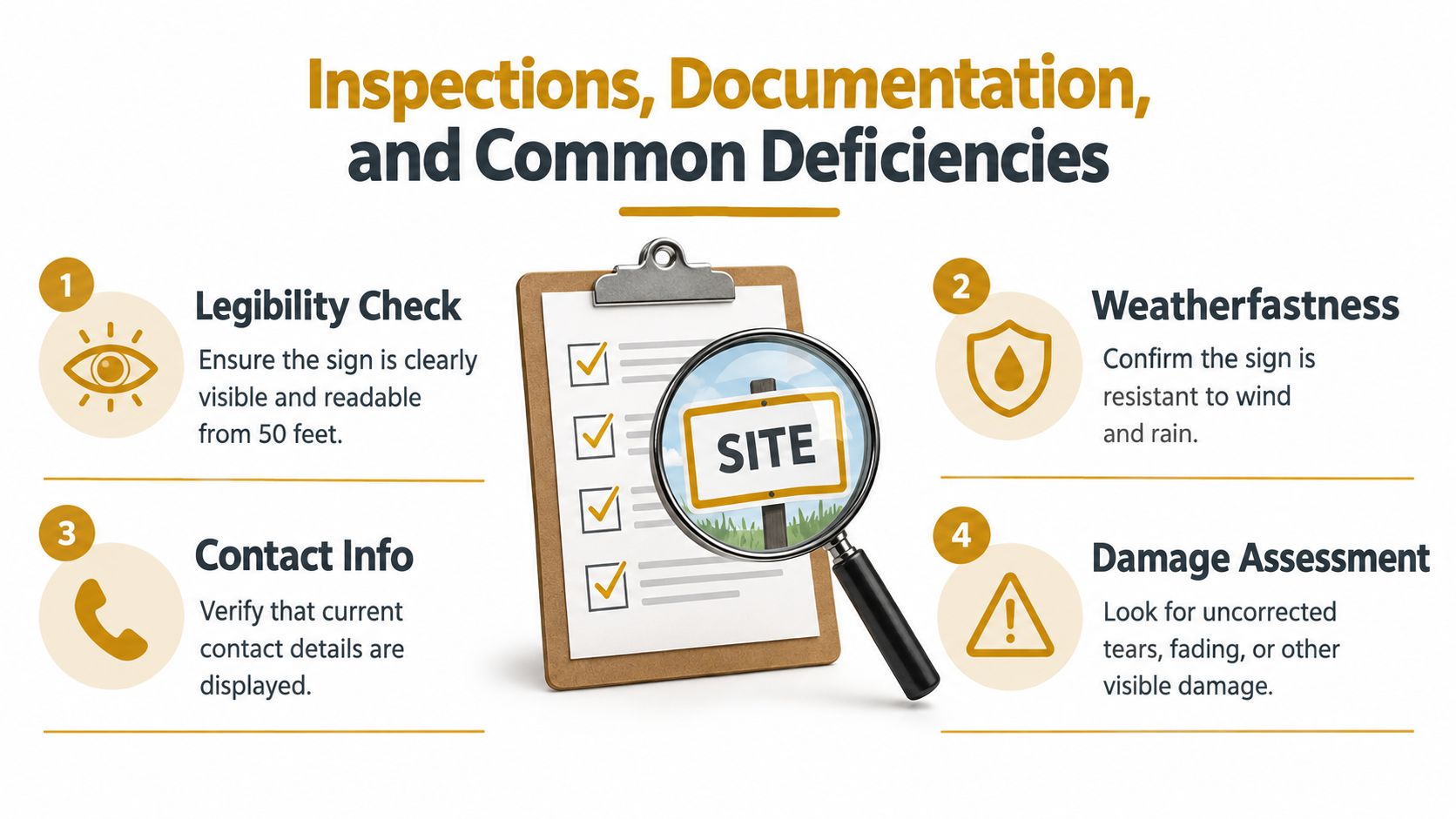
Common deficiencies include faded lettering, an outdated phone number, a missing permit number, a sign facing away from the access road, and a certification signed by someone who isn't listed as the authorized signatory. Each one is preventable if the foreman knows that the sign belongs on the inspection route, not just on the mobilization checklist.
Build a record that proves the correction
Photograph the installed sign after mounting. Include the entrance, the sign face, and enough surrounding context to show its location. A dated photo, a GPS-tagged image where project procedures support it, and an entry in the inspection log create a useful chain of evidence.
If the sign is deficient, record the observation, the corrective action, the responsible person, and the completion date. Replace the panel or update the contact details promptly, then add a follow-up photo. Documentation doesn't excuse a noncompliant sign, but it helps show that the project identified and corrected a field issue instead of ignoring it.
The same inspection discipline should extend to controls connected with the notice. If the sign directs workers to a washout area, the inspector may reasonably expect that area to be identifiable, contained, and maintained.
Linking the Sign to Washout Containment Best Practices
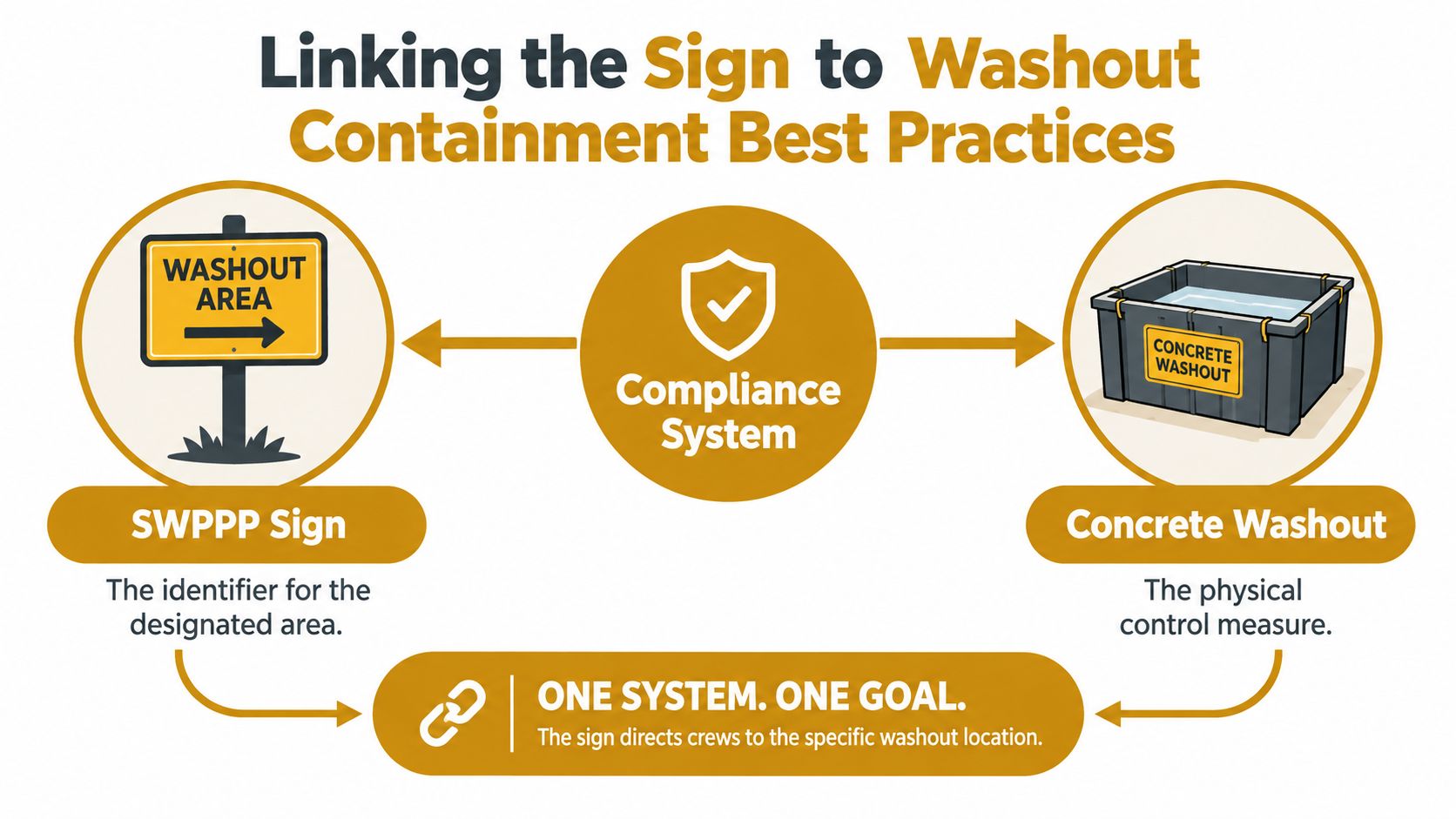
A sign and a concrete washout are often managed as separate checklist items. On a functioning site, they're one compliance system. The sign tells the crew where the SWPPP and designated controls are, while the washout provides the physical containment that keeps cement-laden water away from inlets, soil, and receiving waters.
The connection should be obvious before a concrete truck arrives. The SWPPP map should identify the washout location, the entrance sign should identify the responsible contact and plan location, and the crew should know where to find the site-specific instructions. If the inspector follows that chain and finds the labeled containment area where the plan shows it, the site tells one consistent story.
The physical control has to match the plan
Use a lined bin, pan, or self-contained washout bag appropriate for the expected concrete pump and chute volume. Keep it on a stable surface, away from storm drains and flowing paths, and inspect the liner and surrounding ground for seepage or overflow.
Where the project procedure requires it, manage slurry through pH treatment or off-site hauling. Record disposal or handling activity in the project's environmental records. Inspect the containment routinely, including after deliveries and weather that could compromise the liner or move sediment around the area.
A pristine sign beside an overflowing washout damages credibility faster than either problem alone.
The failure usually begins with a small disconnect. A subcontractor sees the sign but doesn't know which washout is active. The crew uses a temporary area, the container fills, and wash water reaches an inlet. The sign remains technically readable, yet the site's visible instructions no longer match its actual controls.
Make the designated area obvious with durable labeling, maintain clear access, and train each concrete crew before the pour. The sign should direct people to the plan and contact. The plan should direct them to the washout. The washout should demonstrate that the instructions are being followed.
Compliance Checklist and Quick Reference
Run this checklist before an inspection, before a major concrete operation, and after any event that could damage the posting. Assign ownership to a named superintendent or environmental coordinator, not to “the site team” generally.
Pre-installation
- Verify wording: Use the current permit or agency template where available.
- Confirm project data: Match the project name, permit number, operator, and contact details to the active SWPPP.
- Check certification: Confirm that the proposed signatory has the required authority and that supporting authorization is in the plan.
- Select durable material: Use a weather-resistant panel suitable for the site exposure and any owner specifications.
- Confirm size: Check the jurisdiction's minimum dimensions and lettering requirements before fabrication.
Installation
- Choose the entrance: Place the sign where an inspector can read it from the public approach.
- Protect visibility: Keep it clear of parked equipment, fencing, dust sources, and delivery traffic.
- Secure the mounting: Use posts and fasteners that can withstand normal site weather and activity.
- Coordinate the washout: Label the designated washout and make sure its location agrees with the SWPPP map.
- Capture evidence: Take a dated installation photo and file it with the compliance records.
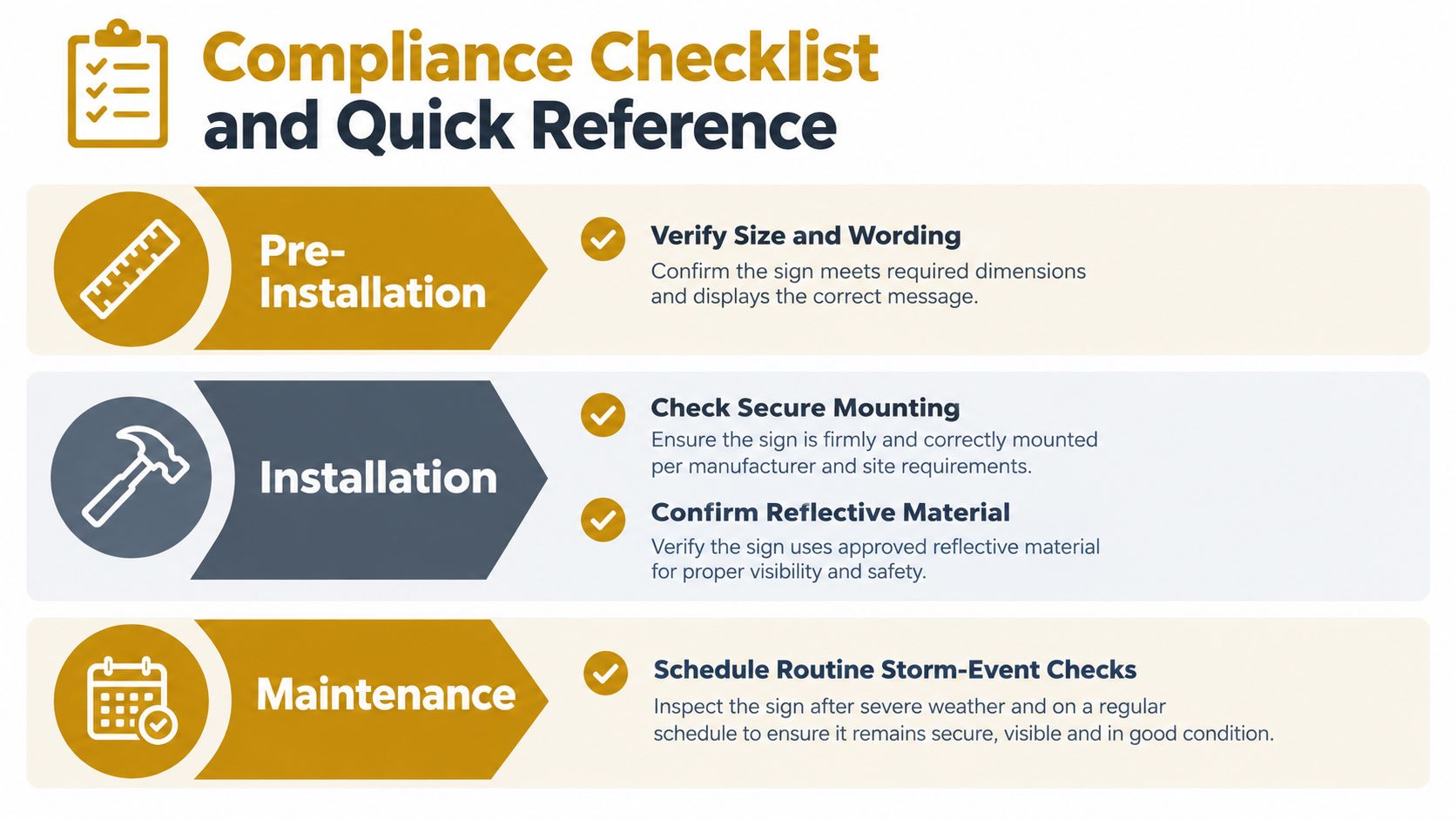
Maintenance
- Inspect legibility: Replace faded, dirty, torn, or distorted panels.
- Test contact details: Call the number and confirm that the listed person still has site knowledge.
- Reconcile records: Check the sign against the SWPPP's current operator and certification pages.
- Review after storms: Look for wind damage, mud spray, displaced posts, and access changes.
- Update promptly: Reprint the sign when the operator, contact, permit information, or certification changes.
Questions crews ask
Does a digital sign satisfy the requirement?
Not automatically. Posting rules vary, and some templates reject digital signatures. Use the jurisdiction's approved format and signature method rather than assuming a PDF or electronic image is enough.
How often should a faded sign be replaced?
Replace it as soon as its required information can't be read clearly. The practical test is whether an inspector approaching the site can identify the project, contact, and plan location without assistance.
Can a subcontractor post its own sign?
A subcontractor may help install or maintain the project sign, but that doesn't make the subcontractor the authorized certifying party. State rules may also require identified contractors and subcontractors to sign or become co-permittees.
When must the sign be posted?
Post it before earth-disturbing activity begins, subject to the timing and wording in the applicable permit. Don't wait for the first inspection to discover that the entrance notice was never installed.
Use this quick-reference card during the gate check:
- Project and permit information: Must survive the inspector's first identification check.
- SWPPP location: Must lead directly to a plan that staff can produce.
- Contact information: Must reach someone who can explain current controls.
- Certification and signature: Must match the authorized records.
- Placement and condition: Must remain visible after traffic, weather, and site changes.
- Washout reference: Must point to a contained, maintained area that matches the plan.
Reborn Rentals provides concrete washout containment equipment for construction and renovation projects, including washout pans and containers that can be arranged through its online rental process. Before your next pour, review the designated washout location against the SWPPP and visit Reborn Rentals to check available containment options and delivery details.