
Temporary Spill Containment: A Practical Field Guide
You've got trucks lined up, the pump's set, and the washout pan was supposed to be the easy part. Then rain hits, the pan's already half full of slurry, and gray water starts moving toward the inlet. That's the moment temporary spill containment stops being a rental line item and becomes the job.
A Day on Site When Containment Goes Wrong
The pan got dropped where the delivery truck could reach it, not where the pour crew needed it. It's close to a storm inlet because that corner was flat and open. Nobody wrote down who checks it, and nobody agreed on when to call for pump-out.
By mid-morning, two mixer washouts and a pump cleanout have filled it past where anyone is comfortable. A shower rolls through. Rain adds volume on top of wash water and solids, the liquid reaches the sidewall, and the crew is now building a sandbag ring around an inlet instead of finishing concrete.
Nothing about that failure is exotic. The pan didn't crack. The crew didn't dump on the ground on purpose. The system failed at four ordinary points that get skipped when containment is treated as a product you order rather than a process you run.
The Four Questions That Decide the Day
- Picking: Does the unit match the waste stream, liquid and solids together, or just the liquid volume on a spec sheet?
- Placing: Can every truck and pump reach it easily, on level ground, away from drains and traffic?
- Operating: Who inspects it, how often, and at what fill level does work stop until it's emptied?
- Removing: How do liquid and hardened material leave the site, and what record proves it happened?
A bigger pan doesn't fix a bad location, a missed inspection, or a pickup that's booked too late.
Get those four answers written down before delivery and washout becomes routine. Skip them and you're improvising next to a drain, with a citation risk and an emergency pump-out competing with the pour schedule. The rest of this guide works through each question in the order you'd face it on site.
What Temporary Spill Containment Actually Means
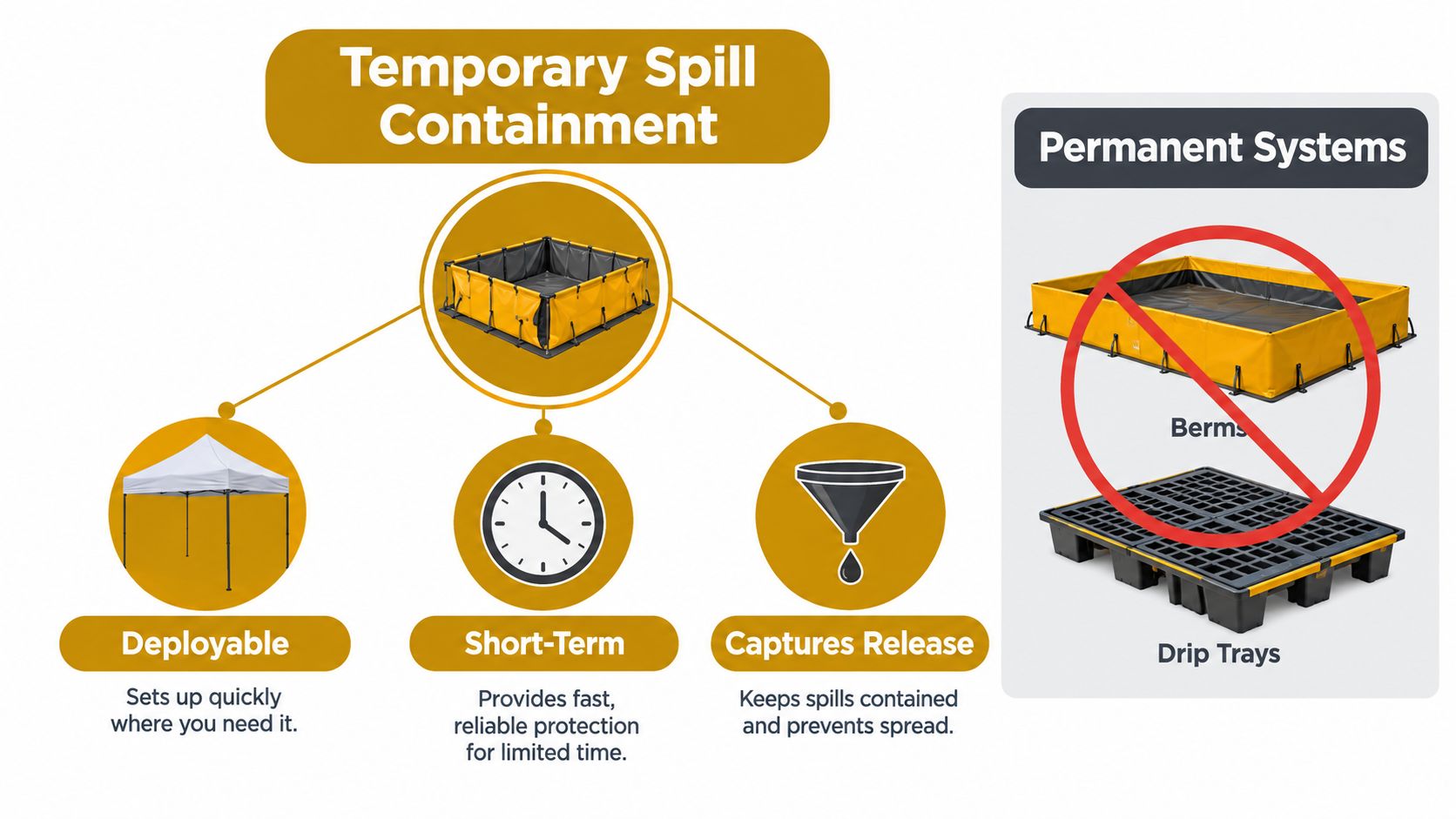
Temporary spill containment is a deployable, short-term system that captures a release or process waste before it reaches soil, a storm drain, or water. It goes in for a defined activity, a pour sequence, a fueling setup, a renovation phase, and it comes out when that activity ends. It's rented, moved, inspected, emptied, and replaced as conditions change.
A permanent berm around a fixed tank is the built-in tub. It never moves because the tank never moves. A rented washout pan is a portable insert. You set it where the work is, you swap or empty it when it fills, and you haul it away at the end. An absorbent kit is a towel. It's right for drips and small leaks, and it's the wrong answer when you need to hold a tub's worth of liquid and solids.
Words Worth Agreeing On Before Delivery
- Primary container: The drum, tote, mixer chute, or equipment holding the material in the first place.
- Secondary containment: The pan, berm, or liner system underneath or around it, there to catch what escapes or gets washed out.
- Usable capacity: What you can safely put in before your stop-work trigger, which is always less than the brim.
- Freeboard: The empty space you deliberately leave at the top for rain, splash, and uneven settling.
Those four terms prevent most ordering mistakes. When a site manager says capacity and means brim volume, and a SWPPP consultant hears usable volume, the crew gets a pan that's effectively full on day one. Say which number you're using, every time.
The other distinction that matters is prevention versus response. Containment placed before the pour is prevention. Absorbents thrown down after slurry reaches pavement are response. Response has its place for fuel drips and hydraulic leaks. It doesn't substitute for a leak-proof container when the waste stream is planned, repeated, and full of solids.
The Regulatory Frame Without the Legalese
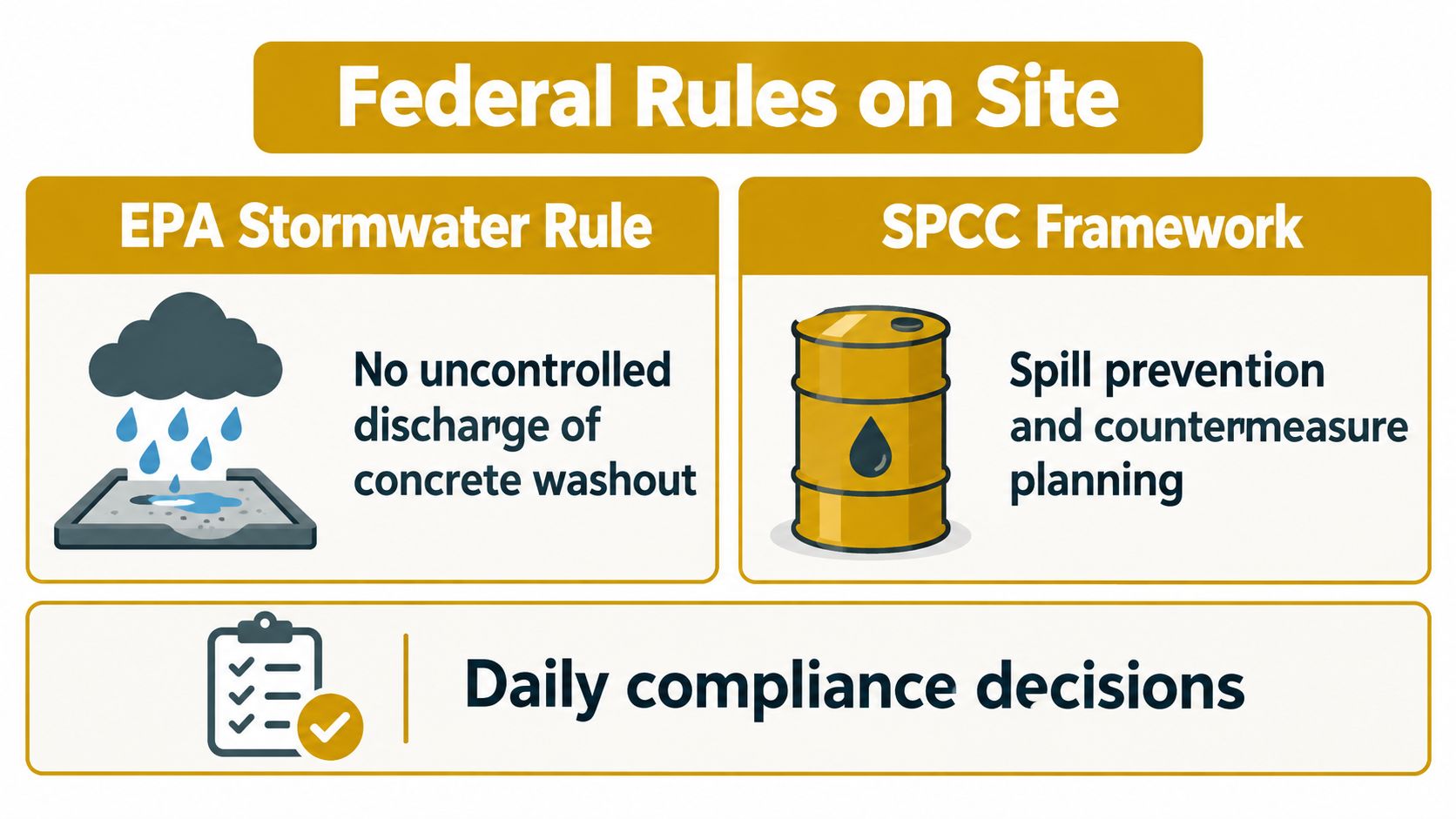
Two federal frameworks drive most daily decisions, and they govern different problems. Mixing them up is how a crew ends up with a spill kit at a washout or a washout pan doing a job it was never meant to do.
Concrete Washout Lives Under Stormwater Rules
Under the EPA's construction stormwater framework, the federal Construction and Development rule prohibits discharging wastewater from concrete washout unless it's managed with appropriate controls, and the same prohibition covers stucco, paint, and form-release oil washout, as set out in the EPA guidance on stormwater discharges from construction activities. Performing washout on site isn't enough. The wastewater can't discharge uncontrolled.
That's because concrete washwater isn't dirty water you can let soak in. It carries highly alkaline cement residue and suspended solids. EPA specifies that washout facilities must retain both the alkaline wash water and the cementitious solids in leak-proof containers so they can't contact soil and migrate to surface water or groundwater, per the EPA concrete washout guidance document. On a washout job, this stormwater obligation is your actual citation risk.
Oil Storage Lives Under SPCC
The Spill Prevention, Control, and Countermeasure program is the older framework. EPA published the original SPCC regulation on December 11, 1973, effective January 10, 1974, and facilities generally need an SPCC plan when aggregate aboveground oil storage exceeds 1,320 gallons or completely buried storage exceeds 42,000 gallons, according to the EPA overview of the SPCC program. EPA estimated in 2009 that approximately 640,000 facilities were subject to SPCC, so this reaches well beyond refineries.
The practical split is simple. Washout questions are stormwater questions about managed discharge, leak prevention, and solids retention. Fuel and oil storage questions are SPCC questions about aggregate volume and a written prevention plan. Local and state permits then layer on top of both, which is why setbacks and inspection duties vary by jurisdiction. Know which rule you're answering before you choose equipment.
Pans, Berms, Totes, and Vacuum Trucks Compared
Each option fails in its own predictable way. Pick based on the waste stream and the access you've got, not on what's sitting in the yard.
Rigid washout pans suit routine pours with predictable volume. They're liquid-tight, they hold solids for later removal, and a crew can see the fill level at a glance. The failure mode is overfilling. Once hardened material builds up, liquid capacity shrinks fast, and the pan that looked generous on Monday is tight by Thursday.
Flexible and drive-over berms work under equipment, drums, and temporary fueling where you need containment that folds, moves, and lets vehicles cross. They're fast to deploy and easy to store. They breach when sidewalls get driven over wrong, when liners tear on rough ground, or when rainwater fills them and nobody drains the accumulated water before a leak happens.
IBC totes and small tanks fit low-volume wash water and dewatering support where liquid needs to be held and hauled. They're compact and forklift-friendly. They don't handle heavy solids well, and a cracked tote or a valve left cracked open turns storage into a release.
Vacuum trucks are the answer when slurry volume outruns static capacity, when a pan needs emergency pump-out, or when liquid has to leave before a storm. Capacity stops being your constraint. Access and timing become it. A truck that can't reach the pan or can't come until tomorrow doesn't solve today's overflow.
Temporary Containment Options at a Glance
| Option | Best For | Watch-outs |
|---|---|---|
| Rigid washout pan | Routine pours, liquid plus solids | Overfill as solids consume volume |
| Flexible berm | Equipment, drums, portable setups | Liner tears, rainwater, sidewall damage |
| IBC tote or tank | Low-volume liquid holding and hauling | Poor solids handling, valve leaks |
| Vacuum truck | High volume, pump-out, storm prep | Access, scheduling delay, cost per call |
Narrow it with two questions. Does the waste include solids that must be recovered, and can the removal method reach the unit on your schedule? If solids matter, you're in pan territory with vacuum support. If it's drips under stored drums, a berm may be enough. Don't let one tool pretend to do the other's job.
Placement and Sizing on the Job Site
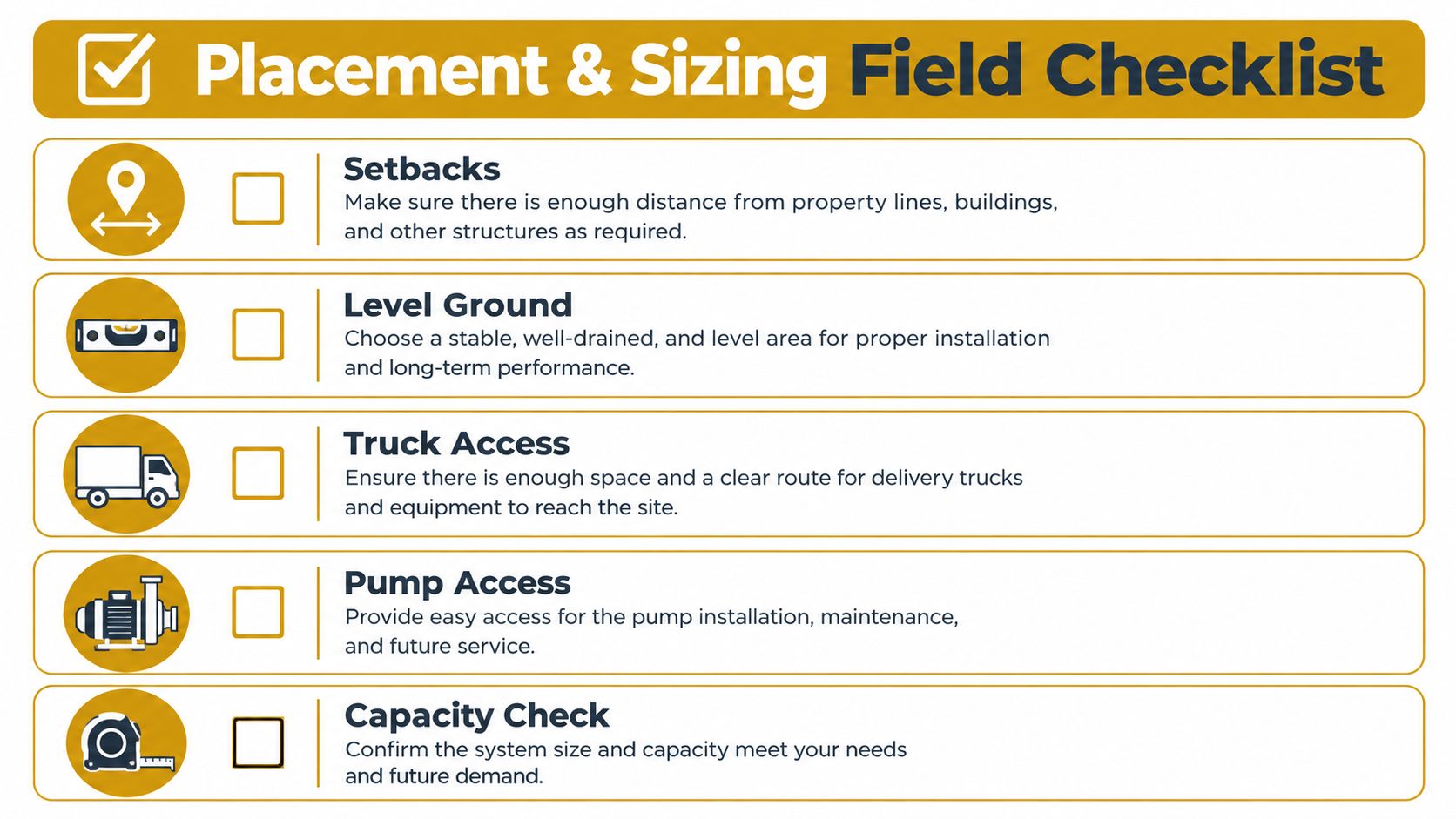
Placement is where containment succeeds or fails, and it's decided in about ten minutes with a tape, a level, and a walk of the site. Run this check before the pan leaves the yard, not while the driver waits.
Federal Highway Administration guidance recommends locating temporary concrete washout facilities at least 50 feet from storm-drain inlets, open drainage channels, and watercourses unless a qualified professional determines separation is infeasible, as detailed in the FHWA construction stormwater guide. Setbacks aren't uniform everywhere. North Carolina guidance uses a 50-foot separation from storm drains and surface waters unless infeasible, while a New York project specification requires 100 feet from wetlands, waterbodies, and drainage structures, a variation noted in the North Carolina NCG01 materials handling guidance. Confirm your number locally and document any exception.
The Pre-Delivery Walk
- Identify the nearest receptor: Find every inlet, ditch, and watercourse, then measure and record the setback you chose.
- Check the ground: Level placement keeps liquid depth even and stops one low corner from becoming the overflow point.
- Walk the truck route: Mixer and pump crews should reach the unit without crossing active work zones, because distance and hassle are what drive improper dumping.
- Keep it out of traffic: Vehicle strikes, tracking, and displaced sandbags turn a control into a release pathway.
- Plan inlet protection and signage: Mark the washout clearly so every operator, including the one who arrives at dusk, uses it.
Why Nominal Gallons Mislead
The number on a spec card is brim capacity. Your working number is smaller. Solids occupy volume that liquid can't. Rainfall adds volume you didn't pour. Freeboard is space you're not allowed to use. Work backward from the 75% full operating cap, size liquid and solids separately against the pour schedule and the forecast, and if the math is tight, plan a second unit or a scheduled pump-out. On larger projects, multiple facilities near pour areas beat one large unit across the site, because crews use what they can reach.
Rental Workflow and What a Daily Rate Covers
A rental goes wrong on logistics more often than on equipment. The pan is right, but it arrives after the first truck, the gate's locked at pickup, or the invoice surprises the project manager. Walk the sequence before you commit dates.
Start with the quote request. Give the rental company the pour schedule, the number of trucks and pumps washing out, the site address and access constraints, and where you want the unit spotted. Confirm dimensions and both liquid and load capacity against that information. A unit that fits the washout volume but can't take the weight of accumulated solids isn't the right unit.
Then lock delivery and pickup windows to the work, not the calendar. Delivery should land before the first washout, with enough time to set, level, line, and sign the facility. Pickup should follow final pump-out and solids removal, not precede it. Confirm who meets the driver, whether the ground can take the delivery vehicle after rain, and what happens if the pour slips a day.

What Changes the All-In Cost
- Delivery distance: The daily rate rarely includes getting the unit to you and back.
- Rough terrain: Soft, steep, or restricted access can add surcharges or require different equipment.
- Express orders: Same-day drops cost more than scheduled ones, and availability isn't guaranteed.
- Liners and damage: Torn liners, lost ballast, and damaged sidewalls can appear as separate charges.
Providers such as Reborn Rentals rent washout pans and containers with delivery and haul-away arranged around the rental period, which is the model to plan against regardless of vendor. Ask what's included, what's metered, and what triggers an extra day. Cost control on containment usually comes from aligning the rental window tightly with pours and inspections, not from shaving the daily rate and paying for idle days, emergency calls, and a second delivery.
Operating the Field During the Rental Period
Once the unit is set, the job becomes a short daily routine. It takes minutes, and skipping it is how a compliant setup becomes a release between inspections.
Assign a named inspector. Not the crew, not whoever's free. One person checks the facility daily and again after heavy rain, looking for leaks, liner or sidewall damage, missing ballast or sandbags, and capacity status. Repairs or replacement happen promptly, and the inspection gets written down. An undocumented inspection is hard to defend when a regulator asks.
The 75% Trigger Runs the Schedule
Treat 75% full as a stop point, not a suggestion. At that level, wash water gets vacuumed out or left to evaporate where that's appropriate, and hardened solids come out for recycling or disposal. Have a cleaned facility or a replacement unit ready at that point so washout never has nowhere legal to go. That single trigger, enforced, prevents most overflows.
Field rule: If rain is forecast and the pan is anywhere near the trigger, lower the liquid level or cover it before the storm, not during it.
Weather protection is part of capacity management. Cover the facility during non-working days and whenever a storm is forecast, and remove accumulated rainwater and spills rather than letting them consume usable volume. Wind protection matters too, since a displaced cover the night before a storm is the same as no cover.
Watch for the four common failures. Overflow traces back to a missed trigger or unplanned rain. A liner tear usually comes from rough ground, tracked equipment, or solids removal done carelessly. Displaced sandbags follow traffic too close to the unit. A blocked or unprotected inlet nearby means the last line of defense was never checked. Each one has a preventive control in the daily walk-around. None of them requires new equipment, just the routine actually happening.
Field Checklist and Common Questions
Save this and run it on every pour. The planner, the superintendent, and the inspector each own a piece.
- Planner: Confirm which rule applies, washout stormwater controls or SPCC oil storage, since Minnesota's requirements distinguish drip pans and absorbents for chemical and fuel handling from full liquid and solids containment for washout, as laid out in the Minnesota construction stormwater permit pollution prevention measures. Verify the local setback, size liquid and solids separately, and book pump-out against the 75% trigger.
- Superintendent: Spot the unit on level ground near the pour, out of traffic, signed, with inlet protection in place and truck access confirmed.
- Inspector: Check daily and after heavy rain for leaks, liner damage, ballast, and fill level. Log it. Record final pumping and solids disposal at pickup.
Questions That Derail Washout Plans
How long can a pan stay on site? As long as it's inspected, maintained, kept below the trigger, and consistent with your permit and rental terms. Time alone isn't the issue. Neglect is.
Rain is forecast mid-pour. Now what? Lower the liquid level, cover the unit when it's not in active use, and check inlet protection before the storm arrives.
Does a washout pan count toward SPCC thresholds? Washout is managed under stormwater controls. SPCC thresholds concern oil storage. Don't merge the two inventories.
How do we document disposal? Keep the inspection log, pump-out records, and solids removal or recycling documentation together with the rental paperwork.
When your next pour is on the calendar, line up containment that fits the schedule instead of scrambling for a pan the morning trucks arrive. Reborn Rentals rents concrete washout pans and containers with delivery and haul-away you can coordinate around your pour, inspection, and pump-out plan. Visit the site, pick your dates and location, and get the unit spotted before the first washout.