
What Is a Stormwater Pollution Prevention Plan
Rain is in tomorrow’s forecast. The grade is still open in two areas. A truck washout spot hasn’t been marked yet. The concrete crew is asking where to rinse tools, and the superintendent just heard the inspector may stop by this week.
That’s usually when stormwater stops feeling like paperwork and starts feeling like jobsite risk.
On most construction projects, stormwater problems don’t start with some dramatic spill. They start with ordinary site activity. Soil gets exposed, runoff finds a low point, wash water gets dumped where it shouldn’t, and a routine rain turns site residue into a discharge problem. Concrete work raises the stakes because slurry and washout water aren’t just messy. They’re highly alkaline, and if you don’t contain them, they can create the kind of violation that gets immediate attention.
A good Stormwater Pollution Prevention Plan, or SWPPP, is what keeps that from happening. It tells your team what the risks are on your specific site, what controls are in place, who’s responsible for inspections, and what has to happen before, during, and after rain events. If you manage concrete work, your SWPPP also needs to deal with washout in a practical way, not as an afterthought buried in a binder.
Your Guide to Construction Site Stormwater Compliance
A lot of site managers first deal with stormwater the hard way. The project starts moving fast, grading is underway, trades are stacking up, and then weather changes everything. What looked fine on a dry afternoon suddenly becomes a runoff pathway the next morning.
That’s why SWPPP compliance matters in real operations. It’s not separate from production. It affects staging, housekeeping, sequencing, crew direction, and where high-risk activities happen. If your controls are weak, the rain exposes it immediately.
Why stormwater gets so much scrutiny
Stormwater is a major pollution pathway because runoff picks up whatever the site leaves exposed. On construction jobs, that usually means sediment, debris, fuels, trash, and concrete-related waste. For concrete crews, the most common weak point is washout. If there isn’t a designated containment area, people improvise. Improvised washout is how good projects end up with preventable violations.
Practical rule: If a crew member has to ask where to wash out, the site is already behind on compliance.
The jobs that stay out of trouble usually have the same habits in place:
- They plan before the first pour: Washout location, drainage flow, access, and cleanup responsibility are decided early.
- They keep controls visible: Silt fence, inlet protection, stabilized access, and containment aren’t hidden in the plan. They’re obvious on the ground.
- They update the site as conditions change: New stockpile, regraded slope, added pour area, or changed traffic route means the stormwater plan has to match reality.
What experienced crews know
A clean site is easier to manage. It’s easier to inspect, easier to explain to a regulator, and easier to keep productive after a storm. The opposite is also true. Sites with loose housekeeping usually have stormwater problems in more than one place.
Stormwater compliance works best when the superintendent, project manager, earthwork team, and concrete subcontractor all treat it as part of execution. Not as a separate environmental issue someone else will handle later.
What Is a SWPPP and When Is It Required
A Stormwater Pollution Prevention Plan is your site’s written playbook for preventing polluted runoff. In plain terms, it identifies where pollution could come from on the job and what controls your team will use to keep those materials out of stormwater.
According to DFM Development’s explanation of SWPPP requirements, a Stormwater Pollution Prevention Plan (SWPPP) is a site-specific, written document mandated under the U.S. Environmental Protection Agency's (EPA) National Pollutant Discharge Elimination System (NPDES) program, which was established through the 1972 Clean Water Act. It is required for construction sites disturbing 1 or more acres to identify pollution sources and outline Best Management Practices (BMPs) for minimizing pollutants in stormwater runoff.
What the requirement means in practice
The key trigger most contractors care about is disturbing 1 or more acres. That doesn’t just mean building on a one-acre pad. It usually includes the full footprint of clearing, grading, excavation, trenching, stockpiling, access work, and other ground disturbance tied to the project.
If you’re asking what is a stormwater pollution prevention plan because you’ve got an active or upcoming build, start with one question: how much land will the project disturb? If it hits that threshold, you’re in SWPPP territory.
Here’s the practical version of the rule:
| Project condition | What it usually means |
|---|---|
| Ground disturbance reaches the threshold | You likely need permit coverage and a SWPPP |
| Disturbed area is active but controls aren’t installed yet | You’re exposed operationally and regulatory-wise |
| Concrete work is starting soon | Washout, slurry, and material staging need to be written into the plan |
A SWPPP isn’t a generic template
Many teams struggle with this aspect. A SWPPP has to be site-specific. A copied document with the wrong drainage notes, wrong control locations, or no mention of concrete washout won’t help much if the inspector walks the job.
A workable SWPPP usually answers practical questions such as:
- Where does runoff go: Offsite, to an inlet, to a ditch, to an MS4, or toward a nearby waterbody.
- What activities create pollutants: Grading, saw cutting, concrete pumping, washout, fueling, storage, and waste handling.
- What BMPs are being used: Silt fence, stabilized entrance, inlet protection, stockpile controls, covered waste areas, and designated washout containment.
- Who is responsible: Named people, assigned inspections, and clear maintenance duties.
The best SWPPP reads like instructions the field can actually use, not like paperwork written for a shelf.
When concrete contractors need to pay attention
Concrete crews often step onto a site after the SWPPP already exists. That doesn’t mean they can ignore it. If your operation introduces slurry, rinse water, cement dust, form-release residue, or chute washout, your work needs to fit the site’s BMPs. If the plan doesn’t address that, it needs to be updated before the work starts.
That’s the practical answer to what is a stormwater pollution prevention plan. It’s the document that turns stormwater compliance from a vague requirement into specific actions on a real site.
The Five Core Components of a Compliant SWPPP
A compliant SWPPP works like a blueprint. Each part supports the others. If one piece is weak, the whole plan becomes harder to defend and harder to use in the field.
EPA’s stormwater program history, summarized in this EPA overview of the storm water program, traces the current framework to the 1987 Water Quality Act amendments and the Phase I and II permit structure. That framework now regulates over 700,000 facilities nationwide, prevents an estimated 2.5 billion pounds of pollutants annually, and compliant sites can reduce total suspended solids discharges by 70-90% compared with uncontrolled runoff.
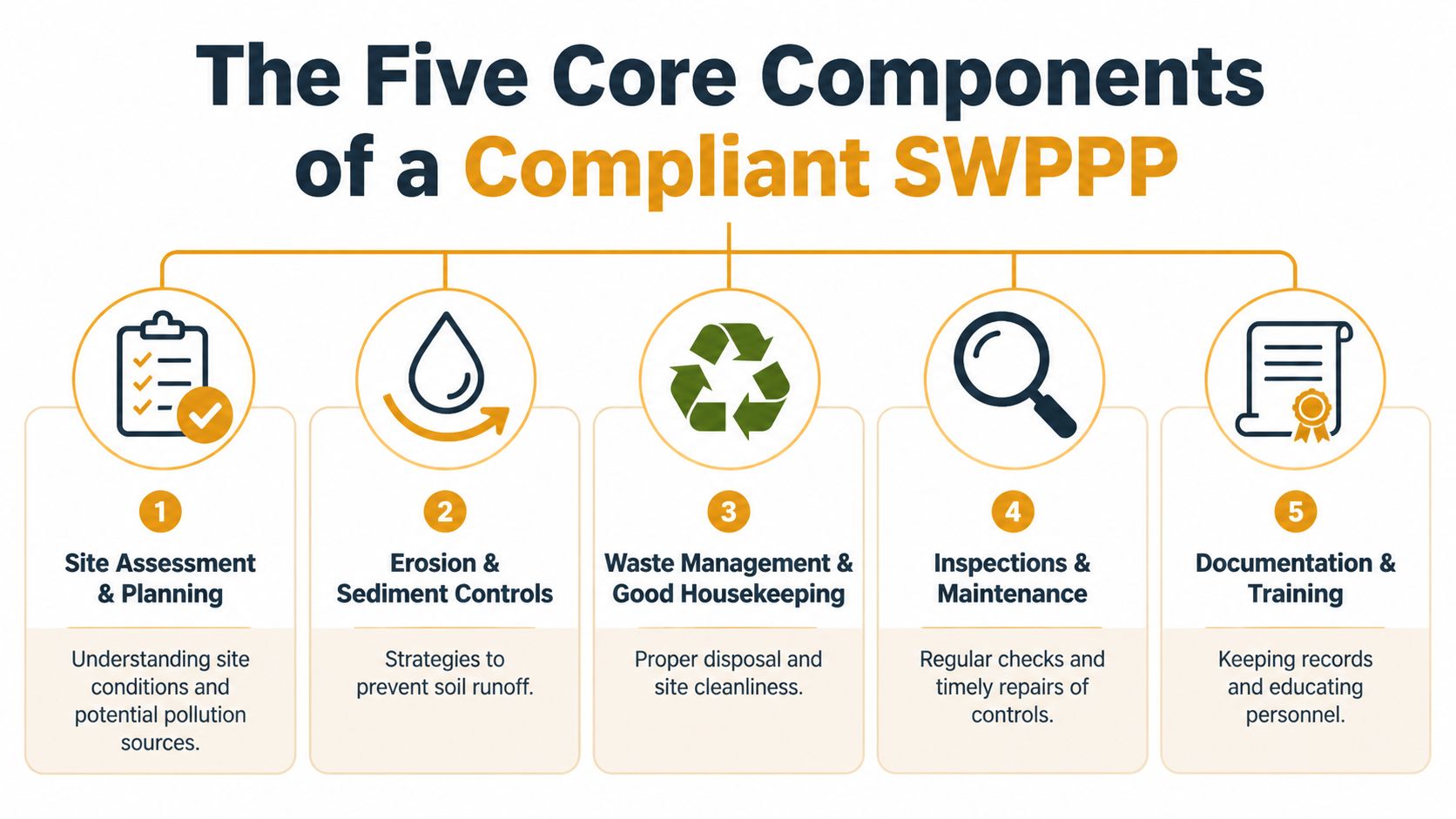
Site description and map
The site map is not filler. It shows how water moves through the project and where controls have to work. If the map is wrong, BMP placement often ends up wrong too.
For construction jobs, the map should reflect actual field conditions, including drainage paths, disturbed areas, discharge points, concrete staging zones, and any designated washout area. A missing washout location is a warning sign because it usually means the plan was written without thinking through concrete operations.
Pollutant sources and BMPs
This part identifies what can leave the site and how you’ll stop it. On many jobs, teams focus heavily on sediment control and give less attention to material-specific pollutants. That’s a mistake.
Concrete work creates a different risk profile than bare soil alone. Your SWPPP should connect the activity to the control. If the site includes pumping, finishing, saw cutting, or chute cleanout, the BMPs should address slurry and wash water directly.
A useful way to review this section is to ask whether each listed risk has a field-ready control beside it.
- Exposed soils: Perimeter controls, slope protection, and stabilization.
- Storm drain inlets: Inlet protection and housekeeping around paved work zones.
- Concrete washout: A clearly designated containment area with enough capacity for the work scheduled.
- Material storage: Covered or protected storage where runoff won’t carry residue offsite.
Inspection and maintenance schedules
A SWPPP fails in the field when controls are installed once and then ignored. Inspections and maintenance are what keep BMPs working after traffic, weather, and production start wearing them down.
This means the plan needs a schedule the site can follow. It also needs action thresholds. If inlet protection is clogged, if a silt fence is undermined, or if a washout unit is near capacity, somebody needs to know who fixes it and how fast.
Good inspections don’t just document conditions. They trigger repairs before runoff finds the weak spot.
Recordkeeping and training
If it wasn’t documented, you can’t count on being able to prove it happened. Recordkeeping covers inspections, maintenance actions, rainfall-related checks, updates to the plan, and training records for the people responsible for implementation.
Training matters most when the site is busy. Laborers, pump operators, finishers, and cleanup crews all need the same message about where washout goes, where wastewater does not go, and who to call when containment is full or damaged.
Permit notices and closeout
Often, the SWPPP is perceived as the binder on-site, but permit paperwork matters too. Notice of intent, permit coverage, and closeout documents all need to align with actual site status. If the project changes hands, stretches schedule, or phases work differently than expected, the paperwork side can lag behind operations.
That’s why experienced contractors review the SWPPP as a live compliance tool, not a startup task. The permit, the plan, the map, and the field controls all need to say the same thing.
Putting the Plan into Action on Concrete Jobs
Concrete jobs are where SWPPP language either becomes real or falls apart. Most plans mention BMPs in broad terms. The field problem is simpler. Where will the crew wash out, how will you keep slurry contained, and what happens when the unit fills up?
If those answers aren’t obvious before the pour, the site is relying on luck.

Why concrete changes the risk
Concrete wash water and slurry are a stormwater issue because of their high pH, and the verified guidance for washout management specifically flags pH 12+ material as a serious aquatic-life risk when unmanaged. That matters on active sites because crews rinse tools, chutes, pumps, and small equipment constantly. Without a designated containment point, that waste ends up on bare soil, pavement edges, curb lines, or near inlets.
This is one of the biggest practical gaps in otherwise decent SWPPPs. The document may mention housekeeping and sediment control, but unless someone has planned washout the way they plan access or staging, the highest-risk concrete discharge gets left to field improvisation.
What works on active sites
The most reliable approach is simple. Put a dedicated washout containment unit where the crew can reach it without slowing production, and make sure the location matches drainage logic.
For most sites, that means checking these items before concrete work starts:
- Place the washout area away from inlets and flow paths. Don’t put it where a storm can overtop it into a curb opening or drainage swale.
- Make access easy for the crew using it. If the pan is too far away or blocked by staging, people won’t use it consistently.
- Match capacity to the work. The verified data identifies common containment options such as a 72 x 72 x 24 inch pan with about 441 gallons capacity and a 72 x 72 x 14 inch pan with about 310 gallons capacity. On a job with multiple placements or repeated chute rinses, undersizing is a common mistake.
- Assign responsibility. Someone needs to check fill condition, residue buildup, and whether the area is still usable after a weather event.
On concrete work, “we’ll figure out washout when the truck arrives” is usually the sentence that creates the violation.
How to write washout into the SWPPP
A lot of plans are too vague here. “Provide concrete washout” is not enough for a field crew. The better approach is to specify the control in operational terms.
Include details such as:
- Location: Marked on the site map and visible in the field.
- Use: Chute washout, tool rinse, pump parts, and residue handling.
- Containment type: Pan, box, or other lined containment appropriate for the project.
- Maintenance trigger: Remove, service, or replace before overtopping risk develops.
- Crew communication: Foremen and operators know this is the only approved washout point.
What doesn’t work
Some habits keep showing up on noncompliant sites:
| Bad practice | Why it fails |
|---|---|
| Washing out on the ground near the pour | Slurry migrates with runoff and leaves visible residue |
| Using an unmarked area behind the building | Crews forget it, overuse it, or abandon residue there |
| Choosing a location based only on convenience | Easy access matters, but drainage and containment matter just as much |
| Waiting until after the first pour to set up washout | By then, someone has already created an unmanaged waste area |
Good concrete washout management is one of the clearest examples of what a SWPPP is supposed to do. It takes a known risk, assigns a specific BMP, and gives the crew a method they can follow under real site pressure.
Common SWPPP Pitfalls That Lead to Fines
Most enforcement problems don’t come from not having heard of SWPPP requirements. They come from having a plan on paper and a different site in the field.
That gap matters even more on concrete jobs. Verified data tied to UltraTech University’s SWPPP page states that 2025 EPA violation reports show 28% of fines in major markets like California and Texas are tied to unmanaged concrete slurry, and that high-pH runoff at pH 12+ can kill aquatic life. Whether a site gets in trouble often comes down to a few repeat mistakes.
Paper-only compliance
A binder in the trailer doesn’t control runoff. If the SWPPP map shows one set of conditions and the field shows another, the plan stops helping you. This happens when drainage routes change, laydown yards move, or concrete work expands into new areas but the document never gets updated.
The solution is boring but effective. Review the plan against actual site conditions regularly, especially after grading changes and before major concrete placements.
BMPs that are installed but not maintained
Controls fail unnoticed. Silt fence gets buried or torn. Inlet protection clogs. Washout containment fills, hardens, or becomes inaccessible. Then the next rain tests a control that stopped functioning days earlier.
Use a simple maintenance mindset:
- If a control can’t perform today, fix it today.
- If crews can’t easily use the washout area, relocate or reset it.
- If a BMP is full, damaged, or bypassed, don’t leave it for the next inspection.
Inspectors usually don’t get impressed by the fact that a BMP was installed three weeks ago. They look at whether it’s working now.
Missing or weak records
Sites often do some of the right things and fail to document them. That creates a bad position during an inspection. If you repaired a perimeter control, serviced washout, or retrained crews, you need records that show it.
Field documentation doesn’t need to be elegant. It does need to be timely, legible, and consistent with what’s on the ground.
Concrete washout done the wrong way
This is the fastest route to an avoidable violation. Washing chutes onto soil, into a gravel edge, beside a dumpster, or near a storm drain tells a regulator the site either didn’t plan for washout or didn’t enforce the plan.
The compliant alternative is straightforward. Designate one containment method, put it where crews can use it, and make sure supervisors enforce it every time. On concrete projects, washout isn’t a side issue. It’s one of the clearest indicators of whether the site is managing stormwater.
Frequently Asked Questions About SWPPPs
What if my project is less than one acre
Don’t assume you’re exempt just because the immediate work area looks small. Check whether the disturbance is part of a larger common development or larger phased project. If it is, permit obligations can still apply. The safest move is to verify the permit trigger before mobilization, not after the inspector asks.
Do SWPPP requirements vary by state
Yes. The federal framework drives the overall requirement, but state and local permitting authorities can add their own conditions, forms, inspection expectations, and BMP details. Always read the permit that applies to your specific job, because the field requirements often get more specific than the generic federal description.
How long should I keep SWPPP records
Keep records according to the permit terms that apply to your project and closeout status. Retention periods can vary, and closeout doesn’t always mean you can discard documentation immediately. The practical rule is simple. Don’t purge anything until you’ve confirmed the retention requirement in the permit and your project file is fully closed.
Can one SWPPP cover multiple phases
Sometimes, but only if the plan accurately reflects how those phases operate. If sequencing, drainage, disturbance limits, BMP locations, or responsible parties change between phases, the document needs to be updated so it still matches field conditions. A single SWPPP can become misleading if it tries to cover too much without revision.
Does every concrete job need a dedicated washout area
If the job involves concrete wash water, slurry, tool rinse, chute cleanup, or pump residue, a designated washout approach is the practical standard. Even where the plan uses broad BMP language, crews still need a specific containment location and method. Without that, washout tends to spread into areas the SWPPP is supposed to protect.
Who should own SWPPP compliance on the site
One person needs clear accountability, but implementation has to be shared. The superintendent usually drives field execution. The project manager supports resources and scheduling. Trade foremen need to enforce activity-specific controls, especially around concrete operations. When everyone assumes someone else is handling stormwater, nobody is.
If your concrete crews need a straightforward way to manage washout on active jobs, Reborn Rentals provides specialized concrete washout containment rentals with clear sizing, upfront pricing, and delivery coordination that fits short-term construction schedules. For site managers trying to keep the SWPPP practical, not theoretical, having the right containment in place before the pour makes compliance much easier.