
Where Can I Rent a Dumpster Near Me: A 2026 Guide
You're halfway through a kitchen tear-out, the driveway is filling with cabinets and broken tile, and the first search result for “where can I rent a dumpster near me” looks cheap enough to book immediately. Don't do it yet. A roll-off can be the wrong size, too heavy for the site, impossible for the truck to place, or illegal where you want it to sit.
Start with the address, the placement area, and the debris. Then compare nearby providers on the total delivered cost, included weight, pickup terms, and ability to handle your specific material. The closest company is useful only if it can legally and safely serve the job.
Why the Nearest Dumpster Is Not Always the Right Dumpster
A renovation crew once reserved the lowest-priced container they could find, just a few streets from the property. The supplier had availability, the quote looked clean, and the delivery date matched the demolition schedule. The problem appeared when the driver arrived. The truck couldn't reach the proposed drop zone without crossing soft ground, and the only alternative was a public street where local approval was required.
That reservation wasn't a bargain. It created a failed delivery, schedule pressure, and a new round of calls. The crew should have verified the site before comparing prices.
The local market is broad and fragmented. A 2026 U.S. industry dataset counted 13,363 dumpster rental companies across 4,698 cities, covering all 50 states and Washington, D.C., according to TownBins' dumpster rental industry statistics. The same dataset counted 521 cities with at least five providers and 42 major cities with 20 or more providers, so the first map result is rarely your only practical option.
Start with site qualification
Before requesting quotes, identify:
- The municipality: Rules for streets, sidewalks, and rights-of-way vary by city.
- The property type: A private driveway, commercial lot, apartment complex, and public curb may follow different approval processes.
- The placement owner: Confirm whether you control the driveway or need permission from a landlord, property manager, or HOA.
- The debris stream: Mixed renovation waste, concrete, soil, roofing, and household junk may carry different weight and disposal rules.
- The truck route: A provider needs more than the address. It needs a workable approach and drop location.
A nearby hauler may add charges for difficult access, a return trip, expedited placement, or disposal that wasn't included in the headline rate. A farther provider may offer the right container, clearer weight terms, or a delivery method that works at your property.
Reviews help, but read them for repeated complaints about missed pickups, unclear overages, poor communication, and surface damage, not just the star average. The industry dataset reports an average rating of 4.4 out of 5 across 1.8 million reviews, with 77% of companies maintaining at least a 4-star rating. That makes reputation a useful screening tool, but it doesn't replace a site check.
Practical rule: “Near me” should mean qualified for your address, debris, and placement conditions, not merely close on a map.
Run a Site Audit Before You Search for a Provider

A dumpster reservation can fail before the truck leaves the yard. Confirm three facts first:
- Where can the container sit?
- How will the truck reach it?
- What exactly will go inside?
Answer those before entering a ZIP code into a rental form. A quoted price means little if the bin cannot legally or safely reach the drop zone.
Inspect the placement surface
Choose firm, reasonably level ground. Asphalt, compacted gravel, and reinforced concrete usually perform better than soft soil, loose fill, decorative pavers, or fragile concrete. Roll-off rails and wheels concentrate pressure, so protect the surface when its condition is uncertain.
Mark the intended footprint and inspect the surrounding area. Check for:
- Garage doors and gates that must stay usable
- Drain covers and utility access points that cannot be blocked
- Eaves, balconies, tree limbs, and overhead wires
- Slopes, soft shoulders, and planted areas
- Fire access routes and pedestrian paths
Measure the drop zone, photograph it from the street and both sides of the approach, and sketch the placement area. Send that information to the hauler before accepting the quote.
Trace the delivery path
The driver needs room to back in, pull straight out, or turn without blocking traffic. Check gate width, tight corners, low branches, overhead lines, slopes, and ground conditions along the entire route, not only beside the container.
A nearby provider may still lack a workable approach. Give the hauler your measurements and photos, then get confirmation that the truck can reach the site. Treat the reservation as unconfirmed until access is approved.
Classify the load
Household junk, clean concrete, soil, roofing, drywall, and mixed construction waste follow different handling and weight rules. Dense debris can reach the weight limit while leaving unused space in the container.
Tell the provider what you are removing, how much demolition is involved, whether equipment will load the bin, and how long it must remain onsite. That information lets the estimator reject an unsuitable container before dispatch and identify restrictions that could trigger extra charges.
Match the Dumpster Size to the Debris, Not the Square Footage
A large house doesn't automatically require a large dumpster, and a small bathroom can produce a heavy load. Volume and weight are separate limits, so choose based on the material, not the property's square footage.
The following comparison is a planning guide. Actual dimensions, side heights, door configurations, and payload allowances vary by supplier.
Common Roll-Off Dumpster Sizes
| Size | Typical debris fit | Key consideration |
|---|---|---|
| 10-yard | Small bathroom work, garage cleanouts, or limited heavy debris | Often useful where space is tight, but dense material can reach the weight cap quickly |
| 15-yard | Modest cleanouts, flooring, or manageable roofing loads | Confirm the material's density and included tonnage |
| 20-yard | Multi-room renovation, roofing, or estate cleanout | A common general-purpose choice, but the allowance matters more than the label |
| 30-yard | Major remodeling, demolition, or bulky construction waste | Needs more placement room and a workable truck approach |
| 40-yard | Commercial work and large volumes of light material | Better for volume than dense debris, and unsuitable sites may not accept its footprint |
A 20-yard container is listed at a national average of $350 to $550 for a 7-day rental, while an independent price index lists a median published price of $419 for that size. The same index reports a median weight allowance of 2 tons, with overage at a median of $76 per ton. Those figures come from TownBins' industry and pricing dataset, and local quotes can differ substantially.
The key mistake is ordering by volume alone. Concrete, dirt, brick, and roofing shingles can hit the weight allowance before the bin looks full. Residential and light commercial containers commonly include roughly 1 to 5 tons, according to The Green Dumpster's guide to dumpster weight limits. Larger commercial containers may allow more, but never assume the allowance from the container size.
Ask the provider to evaluate the debris type and expected tonnage. Load heavy materials first, distribute the weight, and keep everything below the top edge so the driver can cover the container safely.
Read the Invoice the Way Your Accountant Would
A low quote can turn expensive before the container leaves your driveway. Read every dumpster estimate like a subcontractor's change order. If it does not identify the rental period, included tonnage, overage rate, delivery terms, pickup conditions, and permit responsibility, the price is incomplete.
For a 20-yard container, published market figures offer a useful benchmark: a seven-day rental is listed nationally at $350 to $550, with a separate index reporting a $419 median published price, a 2-ton median allowance, and $76 per-ton median overage. Compare the TownBins pricing data with your local quote, then verify what the hauler includes. A benchmark does not bind the provider you hire.
Typical Roll-Off Invoice Line Items Explained
| Line item | Typical range | What to watch |
|---|---|---|
| Base rental | $350 to $550 for a 20-yard, 7-day rental | Confirm whether the quoted period means calendar days or business days, and identify the exact delivery and pickup dates. |
| Included tonnage | A median of 2 tons for a 20-yard container | Check whether the allowance applies to the entire load or changes for concrete, dirt, roofing, or other dense materials. |
| Overage | A median of $76 per ton | Ask for the scale ticket, the billing method for partial tons, and the deadline for disputing the charge. |
| Extra rental days | Varies by provider | Get the extension rate and pickup notice requirement in writing. |
| Delivery or pickup surcharge | Varies by site | Ask about rough terrain, difficult access, expedited delivery, and return trips. |
| Permit responsibility | Varies by municipality | Confirm who applies, who pays, and whether approval must be obtained before delivery. |
| Prohibited-item fees | Varies by material | Request a written exclusion list before loading, including rules for paint, appliances, tires, and hazardous waste. |
| Recycling or disposal credits | Varies by provider | Ask whether clean, separated materials receive different handling or pricing, and whether contamination cancels the credit. |
Work the overage before you book
Suppose a quote includes one ton for a 20-yard kitchen-and-bath gut. If the final load weighs 2.4 tons, the excess is 1.4 tons. At the $76 median overage rate, that excess would represent $106.40 before other charges. This example uses the published median rate, not a guaranteed invoice.
Change the material plan before delivery. If a contractor removes 800 pounds of clean concrete and the supplier accepts it under a separate heavy-material limit, that material may require its own container or a different allowance. Keep concrete out of mixed household debris unless the hauler confirms the policy in writing. The scale, not the container's appearance, determines the charge.
Check clauses that assign you responsibility for overweight loads, blocked drop zones, surface damage, damage waivers, prohibited materials, and failed delivery trips. A quote that looks cheaper at booking can become the costly option after those conditions appear on the final invoice. Get the exceptions, rates, and responsibilities written into the order before you authorize delivery.
Permits and Placement Rules That Decide Whether the Bin Actually Arrives
The cleanest placement is usually on private property, but that doesn't mean approval is automatic. A driveway may avoid a municipal right-of-way permit while still requiring landlord or HOA consent. A container on a street, sidewalk, or public right-of-way often needs municipal approval, and local rules determine the exact process.
This dumpster rental and placement guide explains the basic distinction between private-property placement and public areas, while local authorities remain the final source for address-specific rules.
Use this placement checklist
- Private driveway: Confirm property ownership, surface suitability, and any HOA or lease restrictions.
- Public street: Ask whether a right-of-way or temporary occupancy permit is required.
- Sidewalk area: Verify pedestrian clearance and whether an encroachment approval applies.
- Curbside placement: Ask about no-parking rules, signs, cones, reflective markings, and approved placement hours.
- Access route: Confirm that the truck can reach the spot without crossing prohibited ground or blocking emergency access.
- Protection measures: Ask whether boards, mats, or another surface-protection method are available.
Don't rely on a provider's casual “it should be fine.” Call the city's public works, transportation, or code enforcement office and provide the exact address.
Ask the municipality precise questions
Say where you want the container, how long it will remain, and whether it will touch the street, sidewalk, curb, or right-of-way. Ask which permit applies, who must submit it, what documentation is required, and whether signage or an inspection is involved.
Request written confirmation by email or save the relevant municipal instructions. Send that information to the hauler and keep it with the booking documents. Current guides commonly describe permit costs qualitatively as varying by city, with public placement generally creating more administrative friction than private-property placement. The key issue is not the nearest supplier. It's whether the container can remain at the address without a violation.
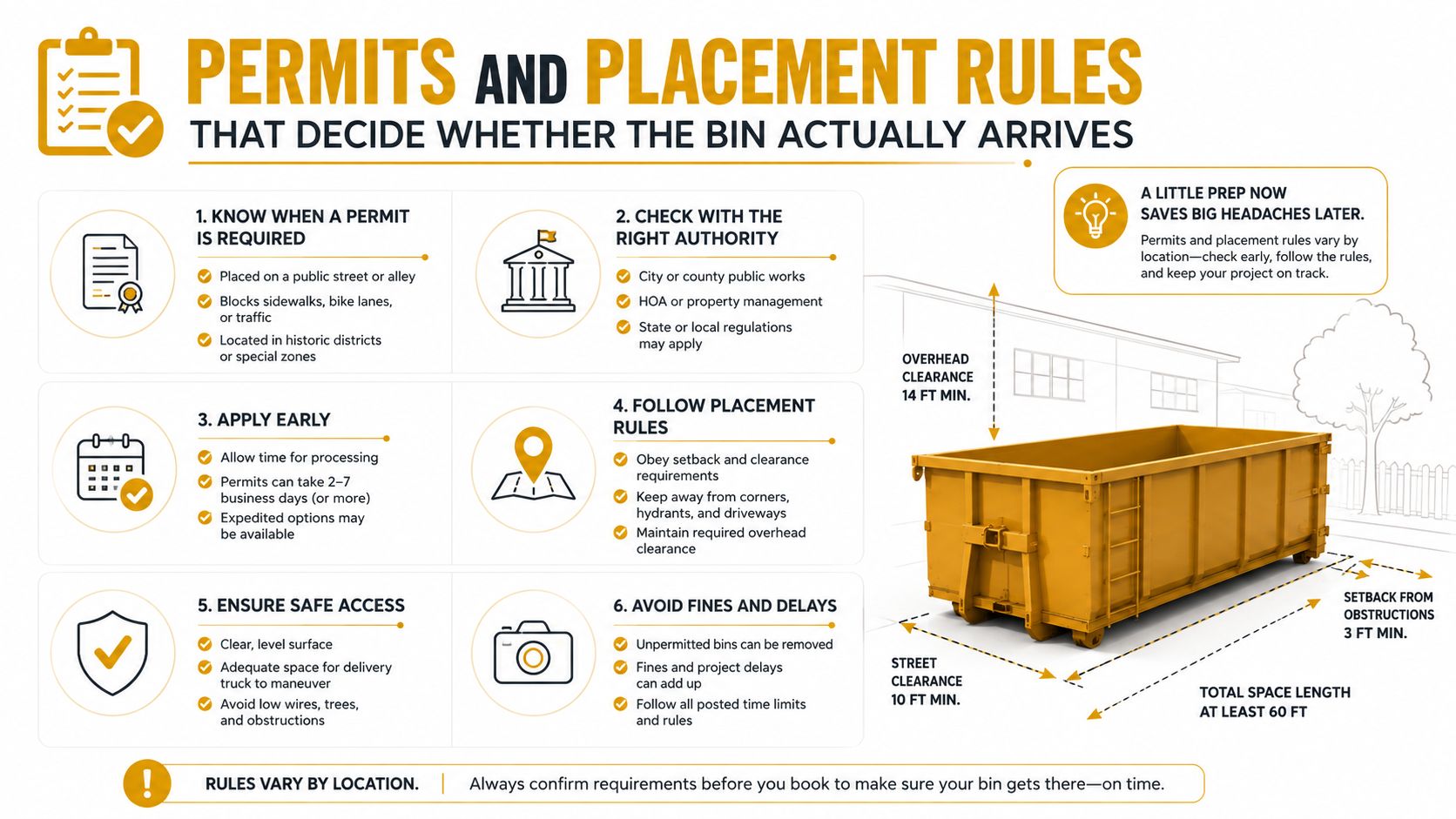
If an HOA governs the property, submit the exact placement location, container type, rental dates, and surface-protection plan before booking. A private driveway can solve the permit problem, but only if the bin fits legally and physically without blocking required access.
Compare Local Providers the Way a Pro Would
A professional shortlist starts with service capability, not the first sponsored map result. Scan providers that serve the address and ask where their trucks and containers are dispatched from. Depot distance can affect response time, but access, scheduling, and disposal arrangements matter more than a simple mileage comparison.
Use reviews as evidence of operating habits. Look for repeated complaints about:
- Weight disputes: Customers describe unclear allowances or unexpected scale charges.
- Pickup reliability: The provider misses the requested window or leaves a full bin on-site.
- Communication: The office doesn't return calls when access or material questions arise.
- Property damage: Customers report driveway, paver, asphalt, or landscaping problems.
- Booking accuracy: The delivered container differs from the quoted size or type.
Then put every quote into the same comparison sheet. Record the delivered price, rental period, included tonnage, overage rate, extension terms, swap-out policy, disposal restrictions, permit handling, and cancellation conditions.
The quote you want is the one that explains what happens when the job changes.
Complete the pre-book check
Confirm the hauler's license and insurance requirements for your project. If a general contractor or property owner needs a certificate of insurance, request the COI before delivery day. Put the placement spot on a site drawing and attach access photos to the booking.
Get the delivery window and pickup terms in writing. For specialized loads, ask directly whether the provider accepts concrete washout, wet slurry, contaminated soil, regulated debris, or mixed construction and demolition waste. If the answer is unclear, don't load the material until the provider confirms the rule.
A slightly farther company with clear terms and dependable scheduling can beat the nearest provider on total cost. Distance is only one input. The job succeeds when the right container arrives, sits legally, accepts the planned load, and leaves when promised.
Smarter Alternatives for Specialized Jobs Like Concrete Washout
A general roll-off isn't a universal waste container. Wet concrete, slurry, and paint-laden rinse water can create a different containment problem from dry construction debris. Many mixed construction-and-demolition containers reject these materials because liquids can leak, harden in the bin, damage equipment, or require separate handling.
Concrete washout deserves its own plan. A dedicated washout pan, a sealed container with suitable liquid containment, or a vacuum-truck service may be more appropriate than a standard roll-off. The right choice depends on the pour, available space, access, and the site's environmental controls.
Choose the service around the material
- Dry mixed debris: A conventional roll-off may fit if the material is accepted and the load stays within the weight allowance.
- Wet wash water or slurry: Use dedicated containment designed for liquid and cementitious waste.
- Suspected asbestos or lead-paint debris: Stop loading and contact a licensed abatement or specialty hauler. Don't mix suspected regulated material with ordinary renovation waste.
- Heavy roofing tear-offs: Ask about a shingle-only hauler, a smaller heavy-material container, or split loads when the expected weight approaches the provider's limit.
Reborn Rentals offers concrete washout containment rentals for crews that need a site-specific alternative to a general dumpster, with equipment, delivery details, and pricing confirmed during the booking process.

Use this decision rule
- If the material is wet, liquid, regulated, or chemically contaminated, skip the general dumpster until the hauler approves it.
- If the debris is dense and weight is the main risk, ask for a dedicated heavy-material plan.
- If the site needs controlled containment, call a specialty provider before paying a deposit.
That decision prevents rejected loads, failed pickups, and avoidable charges. A nearby dumpster is convenient only when it matches the waste stream.
For concrete work, Reborn Rentals provides purpose-built washout containment that helps crews plan placement and handle slurry separately from ordinary debris. Visit Reborn Rentals to review the available washout rental options and arrange the equipment your site requires.