
Concrete Washout for Sale vs Rent Smart Choice
The trucks are lined up, the pump is working, and the inspector has arrived just as the first driver asks where to rinse the chute. If the washout pan isn't already in place, the pour crew has a problem that can't be solved by pointing toward the nearest drain or bare patch of soil. That shortcut can create cleanup, scheduling, and compliance trouble before the concrete has even begun to set.
Choosing concrete washout for sale versus rental is therefore more than a comparison of purchase price and daily rate. The decision affects where the unit goes, how much slurry it can hold, who checks it, how it gets emptied, and what happens to the hardened residue afterward. Federal guidance calls for washout water and solids to be collected in leak-proof containment and recycled where possible, so the equipment choice becomes part of the site's stormwater control system. EPA construction stormwater guidance treats containment as a practical environmental control, not an optional housekeeping measure.
This guide is for general contractors, pumping and finishing crews, civil teams, facilities managers, and anyone responsible for SWPPP execution. Use the comparison below as a quick filter, then check capacity, placement, inspection duties, and end-of-life handling before committing to an owned pan or a delivered rental.
| Decision factor | Buying | Renting |
|---|---|---|
| Upfront commitment | Higher initial outlay | Pay for the period needed |
| Project flexibility | One owned size may not suit every pour | Capacity can be matched to the job |
| Storage | Requires yard or warehouse space | Returned after use |
| Maintenance | Your crew handles cleaning and condition | Service terms may cover support |
| Compliance workload | Your team documents condition and use | A supplier may simplify deployment, but site responsibility remains yours |
| Best operational fit | Frequent, repeated use at known locations | Short, seasonal, changing, or multi-site work |
Introduction Why Your Washout Decision Matters More Than Price
A washout decision usually gets made under pressure. The estimator sees a product listing, the superintendent wants something on site before the first truck, and purchasing asks whether a rental is really necessary for a container that may only be used for a day. That thinking misses the expensive part. The key question is whether your team can manage the entire containment cycle without interrupting the pour or creating a discharge risk.
An owned pan can make sense for a contractor that pours regularly from the same yard and has room to store, inspect, clean, and move it. It can also become a stranded asset when a project needs a different capacity, the unit sits at another site, or the crew has no practical plan for hardened residue. A rental avoids long-term storage, but it still requires accurate dates, access information, placement planning, and a clear understanding of who handles pumping, evaporation, and disposal.
Field rule: A washout unit isn't ready because it has arrived. It's ready when trucks can reach it safely, the unit has enough freeboard, the crew knows the procedure, and the SWPPP records match the setup.
The comparison should start with operational facts:
- Pour pattern: Is this a single placement, recurring work, or several active sites?
- Capacity demand: How many trucks, pumps, tools, or washout events will use the unit?
- Site conditions: Is there a stable location at least the applicable setback from drainage features?
- Support needs: Can your crew inspect, maintain, move, and empty the unit?
- End-of-life plan: Who handles liquid management and hardened concrete?
A rental provider such as Reborn Rentals can be relevant when a crew needs a delivered washout pan for a defined project window, but the same evaluation still applies to any supplier. The lowest sticker price doesn't necessarily produce the lowest lifecycle cost. The better choice is the one that controls the full jobsite responsibility from setup through final removal.
What Concrete Washout Containment Does on a Modern Jobsite
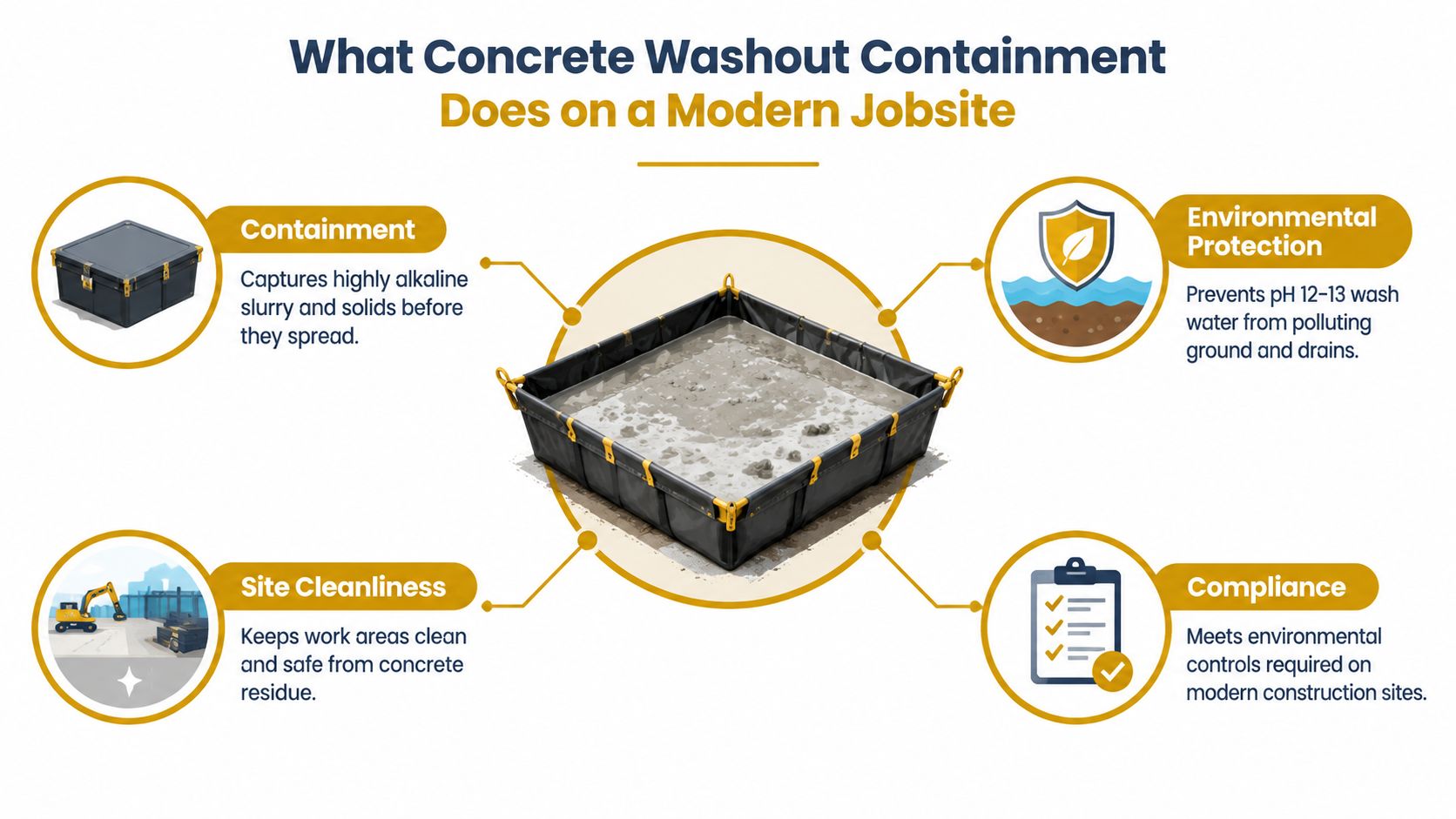
Concrete washout containment captures the water, cement particles, and solids produced when crews rinse truck chutes, pump equipment, hoppers, hand tools, or finishing tools. A washout pan or container is designed to keep that material from spreading across soil or entering stormwater infrastructure. It should be leak-proof, accessible to the crew, and positioned where ready-mix trucks can use it without creating a second safety or traffic problem.
The environmental issue is the chemistry. Concrete wash water is strongly alkaline, with guidance commonly placing it around pH 12 to 13, a level that can harm aquatic life, alter soil chemistry, and affect groundwater if it escapes containment. EPA guidance on concrete washout controls recommends collecting and retaining washout water and solids, then recycling the collected material so it doesn't reach soil, surface water, or groundwater.
The basic operating sequence
Set the containment area before the first truck arrives. Use a stable, reasonably level surface and make sure drivers can approach, rinse, and leave without crossing a drainage path. Keep the area visibly identified so a new driver or subcontractor doesn't choose an improvised location.
During the pour, direct every washout activity into the designated unit. That includes small tool rinses, not just truck chutes. A pan that catches the main discharge but allows hand tools to be washed on nearby soil isn't controlling the whole waste stream.
After the pour, inspect the container for tears, leaks, displacement, or signs of overflow. Keep the collected material contained while liquid evaporates or is otherwise managed through an approved process. Once the residue hardens, break it up where practical and arrange recycling or proper disposal. Public guidance on concrete washout best practices emphasizes containment, stable siting, regular inspection, worker training, and recycling when suitable facilities are available.
Why improvised pits often disappoint
An improvised pit may appear inexpensive, but it creates more variables. The liner can tear, the edges can collapse, trucks may track mud into the area, and the crew may not know how much freeboard remains. Portable pans and purpose-built containers make the control easier to identify and inspect, especially on compact sites where drainage routes are close by.
Containment also protects productivity. A clean, defined station reduces arguments between drivers, keeps residue away from access routes, and gives the superintendent one location to check. It doesn't remove the need for training or inspection, but it makes the correct action more obvious.
Buying vs Renting Concrete Washout Solutions Compared Directly
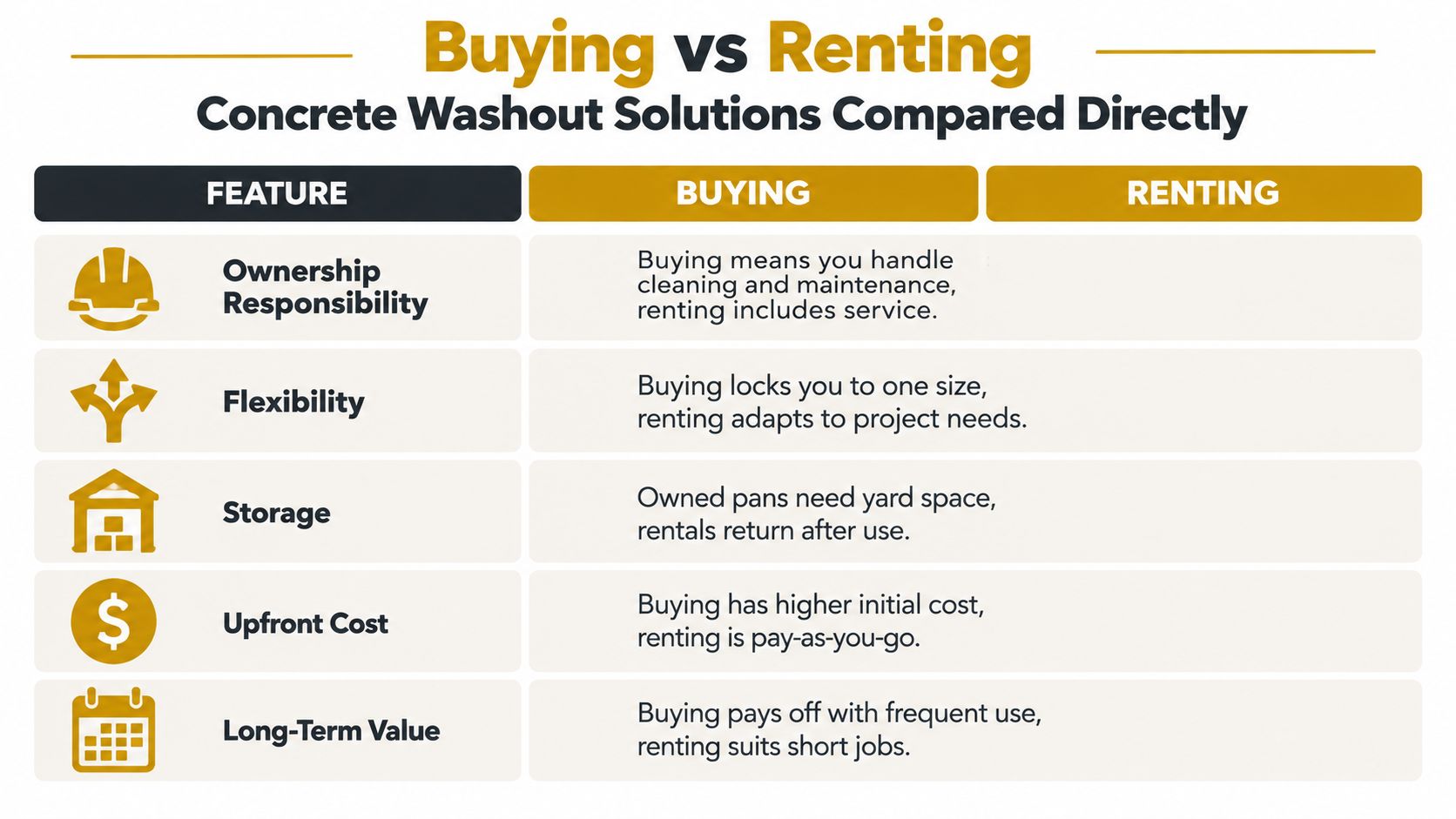
Buying and renting solve the same immediate problem, but they create different responsibilities after delivery. Ownership gives a contractor control over availability and placement. Rental gives a project team flexibility without leaving a pan in the yard after the job closes.
Responsibility and readiness
With a purchase, your team owns the condition of the unit. You need to check walls, seams, liners, fittings, and lifting points before use. You also need a plan for cleaning and storing it after the residue has been removed.
A rental may arrive ready for deployment, depending on the agreement. That can reduce preparation, but it doesn't transfer site compliance to the supplier. The contractor still selects the location, prevents misuse, monitors fill level, and documents the control in the SWPPP.
Renting removes ownership tasks. It doesn't remove superintendent tasks.
Flexibility across projects
An owned pan works well when your pours have a predictable pattern. It works less well when one project needs a shallow unit, another needs more liquid capacity, and a third has limited access for delivery or removal. Buying one size can force crews to adapt the project to the equipment.
Rental is more adaptable for short infrastructure work, seasonal placements, renovations, and contractors moving between multiple sites. The trade-off is coordination. If dates change or the site isn't ready for delivery, the rental schedule and transport plan can become the new constraint.
Storage, transport, and service
An owned unit needs a home between projects. It also needs a way to reach remote sites, plus equipment or labor for movement. A rental generally returns to the supplier, but delivery terms can include location restrictions, rough-terrain charges, or other logistics conditions.
The most reliable decision isn't “buy for long-term value” or “rent for convenience.” It's based on whether your company wants to operate a washout equipment program or deploy a compliant station for each project.
How to Choose Capacity and Specifications That Fit Your Pour
Capacity planning starts with the waste stream, not the physical footprint. Count the expected trucks, pump cleanouts, tool washing, and duration of the pour. A unit that looks large enough when empty may have too little usable working capacity once solids accumulate and freeboard is reserved.
Two listed pan configurations show why dimensions matter. A 72-foot by 72-foot by 24-foot unit is listed at approximately 441 gallons, while a 72-foot by 72-foot by 14-foot unit is listed at approximately 310 gallons. These figures come from Reborn Rentals' published washout equipment information, and they should be treated as product specifications to verify for the exact unit, not as a universal sizing formula.
| Pan Dimensions | Liquid Capacity | Best For | Key Consideration |
|---|---|---|---|
| 72' x 72' x 24' | Approximately 441 gallons | Larger pours, repeated truck access, or higher washout demand | Requires room for safe placement, access, and later handling |
| 72' x 72' x 14' | Approximately 310 gallons | Smaller pours, retrofit work, or sites with tighter height requirements | Reduced depth can leave less reserve when solids build up |
Use freeboard as working capacity
The container's rated capacity isn't the amount you should plan to fill. A widely used field benchmark is to pump out or allow evaporation before the unit exceeds 75% of capacity, because a full container has little protection against additional washwater, rain, displacement, or sloshing. EPA concrete washout guidance connects adequate freeboard with overflow prevention.
Calculate the operating point before the pour. For a unit listed at approximately 441 gallons, 75% of its listed liquid capacity is approximately 330.75 gallons. For a unit listed at approximately 310 gallons, the same benchmark is approximately 232.5 gallons. Those are planning values, not a license to ignore solids, rainfall, or the container's actual construction.
Check the site before choosing the pan
A large pan is useless if trucks can't reach it without crossing a drainage route. Confirm the turning path, ground stability, slope, overhead clearance, and removal route. Place the unit where it can be inspected and serviced, and cover it when conditions or site procedures call for protection from rain and debris.
If the pour will continue after the unit approaches the operating limit, arrange pumping, evaporation management, or a replacement unit in advance. Waiting until the container is visibly full creates an avoidable conflict between the next truck and the disposal plan.
Regulatory and SWPPP Realities Every Contractor Should Know
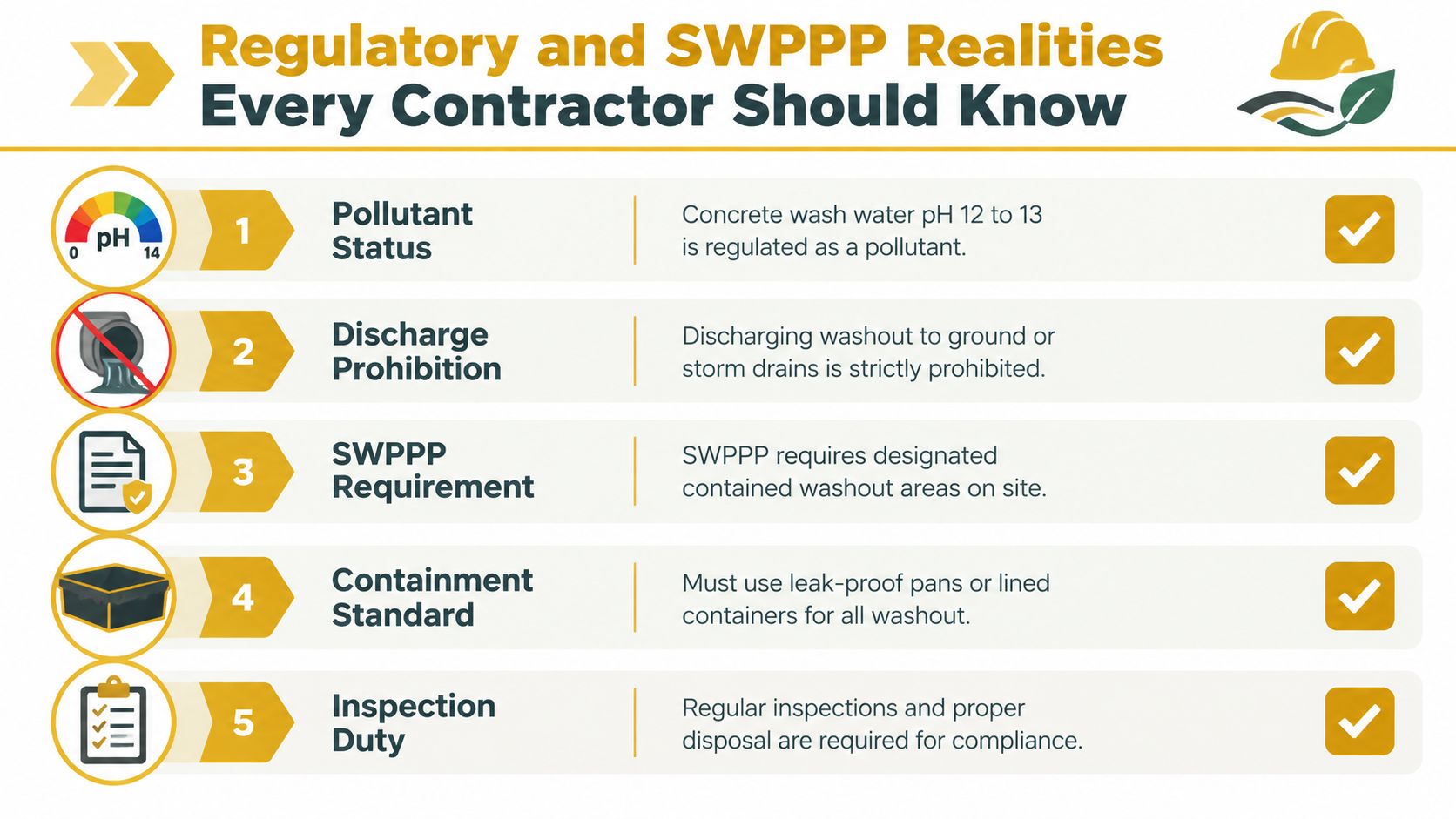
A chute washout beside the curb can send alkaline water and cementitious solids into the drainage system before the crew notices. Concrete washout is therefore a stormwater compliance issue, not just a housekeeping task. Federal guidance calls for collecting and retaining washout water and solids in leak-proof containers, then recycling the collected material so it does not reach soil, surface water, or groundwater. Construction stormwater rules also prohibit wastewater discharges unless an appropriate control manages them. EPA's construction stormwater material sets out that approach.
The superintendent must provide a designated control before work begins, communicate its location to drivers, and keep it functional through the pour. A purchase or rental decision affects lifecycle cost, but neither option transfers SWPPP responsibility away from the site team.
Placement and inspection thresholds
Keep the washout container or pit at least 50 feet from storm drains, open ditches, and waterbodies where site conditions and the applicable plan require that separation. Field compliance guidance on concrete washout containment explains how distance reduces the chance that slurry will clog drainage, contribute to flooding, or reach receiving waters.
Inspection schedules come from the permit and site conditions. For sites discharging to impaired or sensitive waters, commonly used requirements call for inspection every 7 calendar days and within 24 hours after a storm producing 0.25 inches or more of rain. Confirm those thresholds in the project's applicable permit and SWPPP, then record the unit's condition, fill level, location, damage, corrective actions, and relevant plan changes.
Capacity also affects compliance. A unit that reaches its operating limit during a pour can turn a properly selected control into an overflow risk. Set a response before that point, such as pumping, managing evaporation, or replacing the unit, and include end-of-life handling for hardened residue in the plan.
Ownership versus documented control
Rental may simplify deployment when the supplier provides a known unit, delivery, and product information. It does not confirm correct placement or complete SWPPP documentation. The site team still identifies the washout area, briefs truck drivers, inspects the container, and acts before overflow.
An owned pan requires the same records, plus internal maintenance. Track who inspected it, whether transport caused damage, and whether it remains fit for use after storage. Treat the pan as a listed BMP with an accountable owner, not as general site equipment.
True Cost Breakdown Beyond the Purchase Price
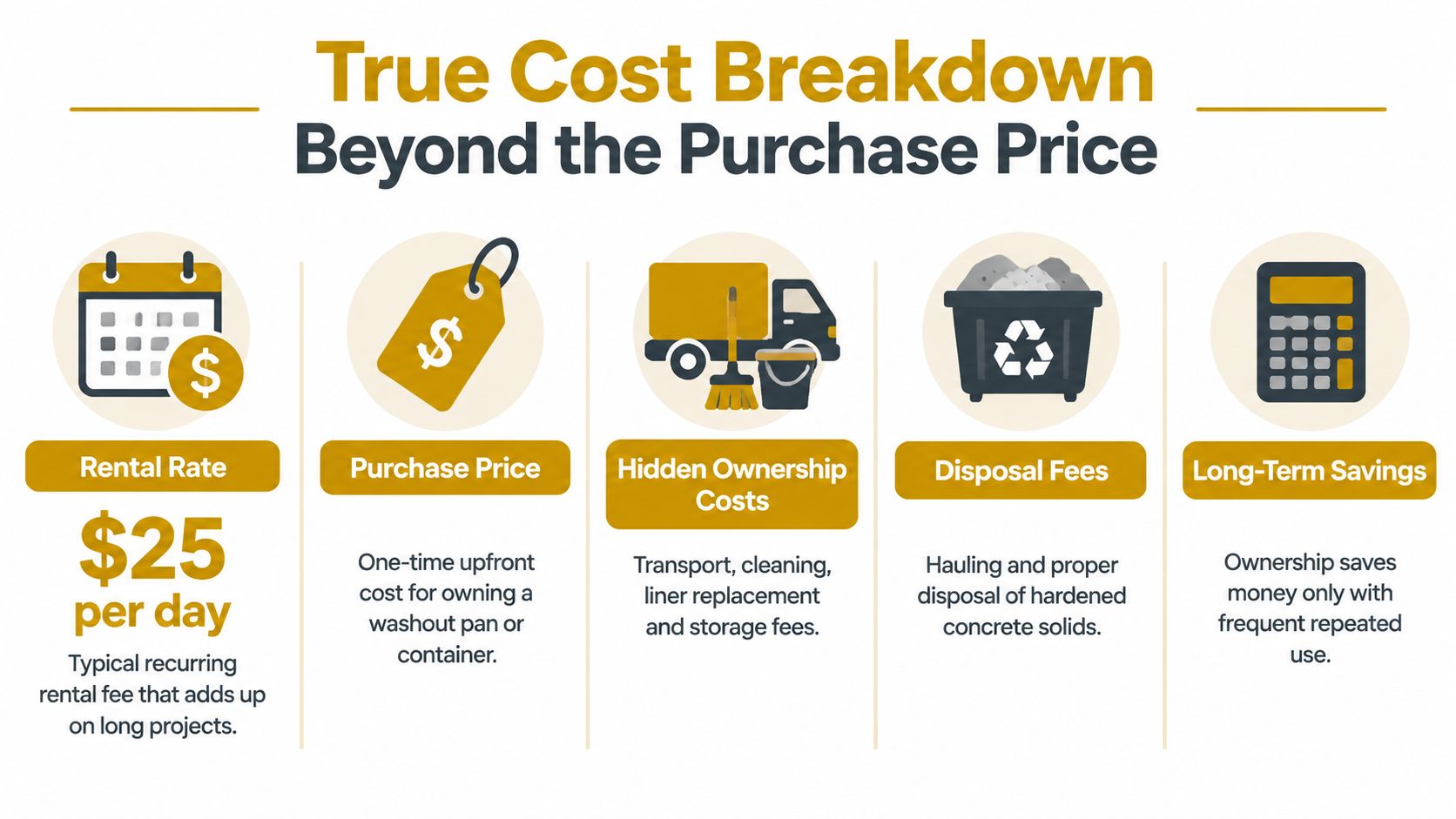
A pan that looks inexpensive in a sales listing can become costly once it reaches the jobsite. Concrete washout for sale pricing covers acquisition, not the full ownership cycle. Add storage, transport, cleaning, repairs, liner replacement where applicable, labor, hardened-residue handling, and eventual disposal. Capacity matters too. A smaller pan may require earlier pumping or replacement, creating extra trips and compliance exposure under the site's SWPPP.
Rental starts with a clear recurring charge. Reborn Rentals publishes daily pricing starting at $25 per day, with rental pricing and checkout information available for planning. Compare that rate with the period the unit occupies the site, then add delivery, removal, difficult access, express handling, and material disposal. The checkout price is only useful when those job-specific costs are included.
The ownership ledger
For a purchase, record each cost line before approving the equipment:
- Acquisition: Include the pan price, taxes, and accessories needed for compliant use. A sales quote should identify the unit's capacity and configuration, not just its shell price.
- Movement: Count loading, hauling, unloading, and equipment used to position the pan. A unit that cannot be moved easily between pours may need dedicated handling.
- Storage: Assign a value to yard space and account for access, weather protection, and the risk of obstructing other equipment.
- Condition: Budget for cleaning, repairs, liner work, inspections, and damage after transport or storage.
- Labor: Count time spent preparing, relocating, monitoring, emptying, and restoring the pan.
- Final material handling: Plan for breaking up hardened residue, hauling it, recycling it where possible, or sending it to an approved disposal facility.
The rental ledger
For rental, ask whether pumping, pickup, cleaning, damage assessment, and disposal are included or billed separately. Confirm delivery timing and access requirements before the pour, especially where the unit must remain at least 50 feet from a drain or receiving water and below the site's 75% operating limit.
The useful comparison is owned equipment cost over its service life versus rental cost for each actual deployment. Include labor, logistics, capacity limits, and end-of-life handling on both sides.
A low-cost owned pan sitting unusable in a yard produces no value during a pour. A rental arriving late can create overflow pressure and SWPPP risk.
Frequent pours at one predictable location may support buying. Sporadic work, changing sites, limited storage, and uncertain duration usually strengthen the rental case. Use your own schedule, transport requirements, labor assumptions, and disposal process rather than relying on a generic break-even promise.
Which Option Fits Your Project and What to Do Next
A general contractor with occasional pours and several active sites will often value flexibility more than ownership. Renting avoids keeping a pan at every yard and allows the team to match the unit to the project. A pumping company or finishing contractor that handles washout almost every working day may have a stronger reason to own, provided it has transport, storage, inspection, and residue-management systems.
Civil and infrastructure teams need to examine duration and access. A short project with difficult terrain may favor a rental arranged around the pour schedule, while a long-running site with a stable staging area may justify an owned unit. Facilities and property managers handling small retrofits should focus on delivery timing, footprint, and whether the unit can be removed without disrupting occupied areas.
Use this decision matrix:
- Frequent pours, one main yard, storage available: Buying may fit if the pan's capacity and dimensions suit the recurring work.
- Short job, uncertain schedule, or limited storage: Renting reduces idle equipment and storage responsibility.
- Multiple sites with different pour sizes: Renting provides more practical capacity flexibility.
- Strong internal compliance team and transport capability: Ownership becomes easier to manage.
- Limited SWPPP support or no disposal process: Choose the option that includes clear supplier guidance, then assign site responsibility before delivery.
For a unit offered for sale, inspect the floor, seams, walls, lifting points, drain fittings, and any liner or protective surface. Confirm the actual dimensions, liquid capacity, condition, freeboard expectations, delivery method, and how hardened material will be removed. Don't buy a pan until you know where it will live between projects.
For a rental, provide the supplier with project dates, exact location, access restrictions, terrain information, desired capacity, and the planned removal or service date. Confirm the daily rate, delivery terms, possible surcharges, condition requirements, and what documentation or product details your SWPPP file needs. Book early enough to place and inspect the unit before the first washout, not after the trucks are already waiting.
If you need a ready-to-deploy washout pan with delivery and clear daily pricing, review the available options through Reborn Rentals. Confirm the capacity, dates, location, access conditions, and removal plan before your next pour so the containment decision supports both production and SWPPP compliance.