
Portable Spill Containment for Concrete Sites
The next truck is waiting, the chute needs rinsing, and rain is moving toward the site. Your washout pan still has room below the rim, but nobody has checked whether it has enough room for the remaining washout and the weather. That's when portable spill containment stops being an equipment order and becomes a pour-management problem.
What Goes Wrong When Washout Goes Off-Script
Consider a familiar pour-day setup: trucks arrive close together, the crew is focused on placement, and drivers rinse into the nearest designated tub. The container looked generous when it was empty. Now slurry covers the bottom, the liquid level is rising, and the person who arranged pickup isn't available.
This is an illustrative scenario, not a documented incident. The operational problem is straightforward: the crew has accepted more washout without checking how much working capacity remains.
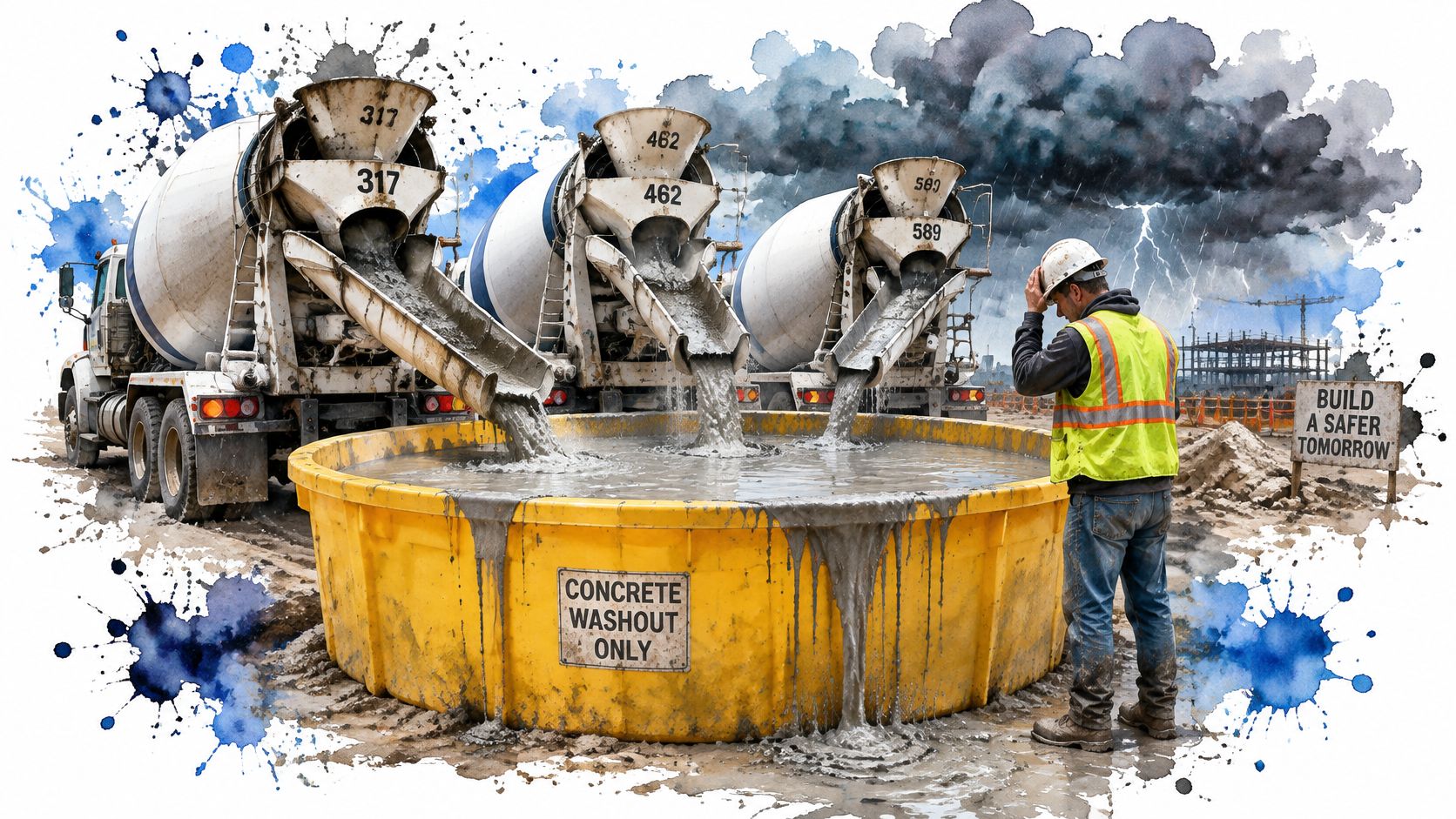
The tempting response is to keep using the pan because the liquid hasn't reached the top. That treats the rim as the operating limit. It also assumes the next rinse, incoming rain, and service delay won't matter.
A container can have space remaining and still be operationally full. The useful question isn't whether another chute rinse will fit. It's whether the site can retain everything arriving before the container is serviced.
Recognize the decision before it becomes urgent
Watch for these planning failures rather than waiting for visible overflow:
- Unassigned monitoring: Everyone knows where the pan is, but nobody owns the decision to stop using it.
- Unconfirmed servicing: Pickup is expected, not booked against the pour schedule.
- Uncontrolled inflow: Drivers rinse without anyone accounting for what's already accumulated.
- No alternate destination: The crew has no approved place to redirect washout when the working limit is reached.
Practical rule: Arrange the next containment option while the current unit is still usable, not when the crew has nowhere else to rinse.
Good portable spill containment connects the container, crew, weather plan, and service arrangement. Buying or renting a pan addresses only the equipment part.
Portable Spill Containment and Why It Matters
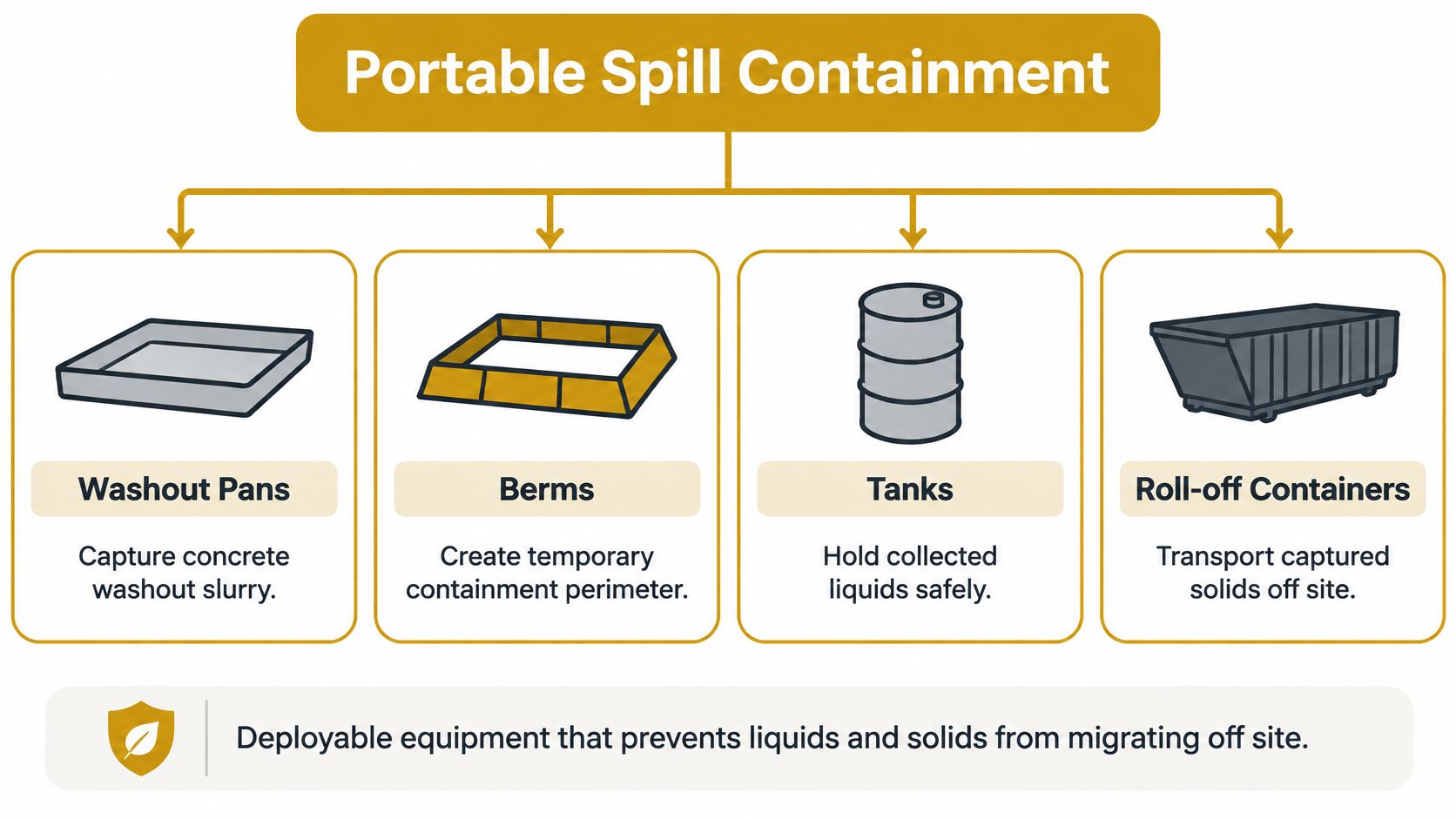
Portable spill containment is deployable equipment that keeps washwater, slurry, and solids inside a controlled boundary until they can be removed. On concrete work that usually means washout pans, lined berms where the full build suits the material, holding tanks, and liquid-tight roll-off containers.
EPA recommends retaining concrete washwater and cementitious solids in leak-proof containers so highly alkaline material stays off soil and out of groundwater and surface water, as described in its concrete washout management guidance.
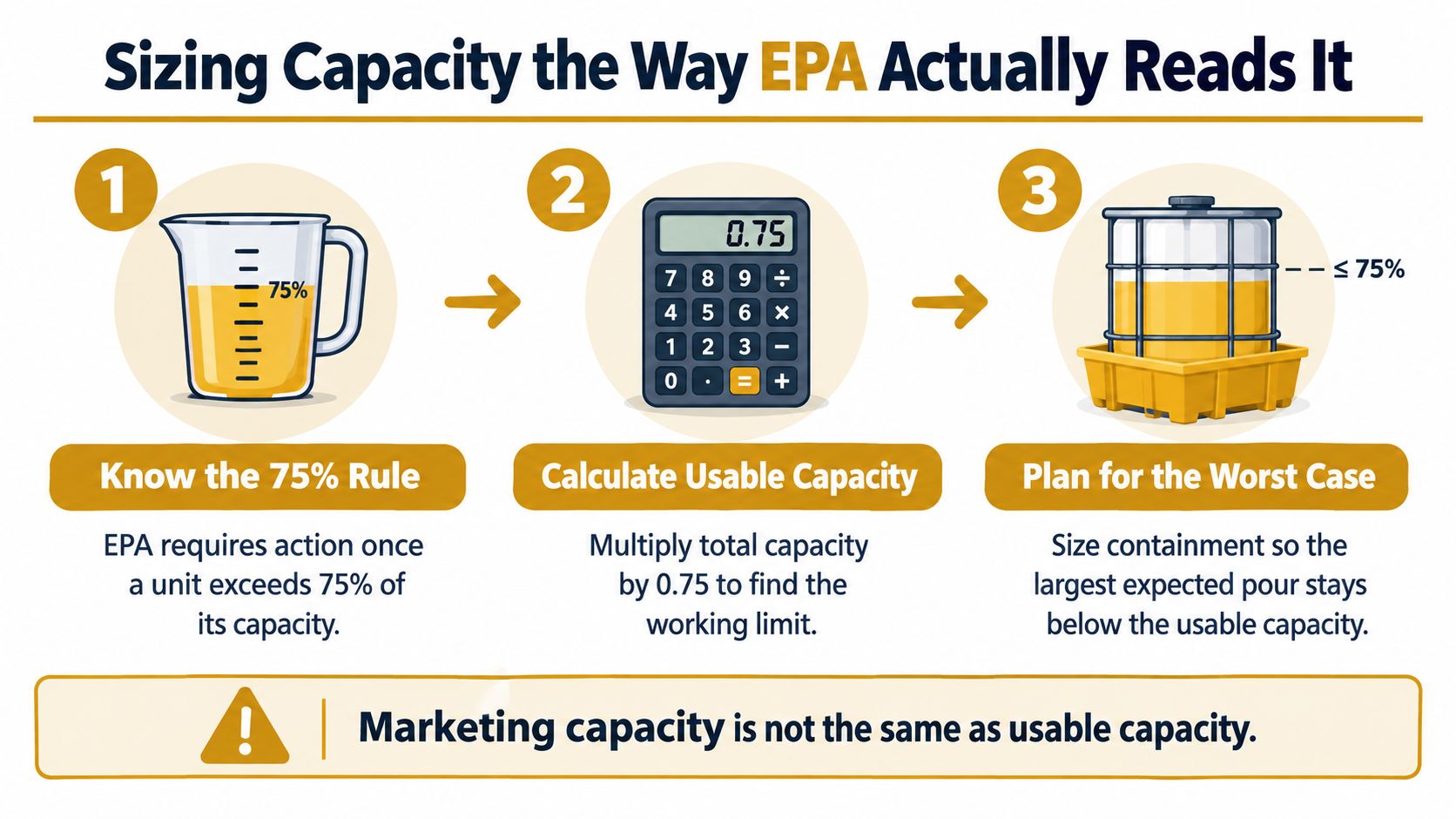
The nameplate rating is only the start. Nominal capacity assumes level placement, no rain, no splash loss, and service before the next truck arrives. A wet lot changes that math. As a planning example, treat 75% of the stated volume as the working limit and leave the rest as freeboard for rainfall, chute surge, and material that settles faster than the service window closes.
Match the equipment to the failure mode
The base has to hold liquid, the walls and seams have to stay intact through the pour, the discharge point has to take the chute without tearing liner or bending a rim, and removal has to cover both water and hardened cake. A general-purpose dumpster needs confirmation before anyone treats it as liquid-tight. A flexible barrier needs the same check before cementitious slurry goes inside it.
Access decides more than catalog height. Set a pan at grade so the chute reaches it easily, and after the last truck it can sit too low for the vacuum hose to pull the far corner without moving the unit.
Choose the complete workflow first; the shape of the box follows from it.
The Regulatory Backbone Behind a Portable Pan
A state inspector walks the lot after a rain event and asks one question: which permit governs that pan? The answer splits into two categories that crews routinely merge. Oil-storage secondary containment sits under EPA's SPCC program. Concrete washout sits under the site's construction-stormwater permit and its pollution-prevention arrangements. The math behind each is different, and satisfying one framework does not discharge the other.
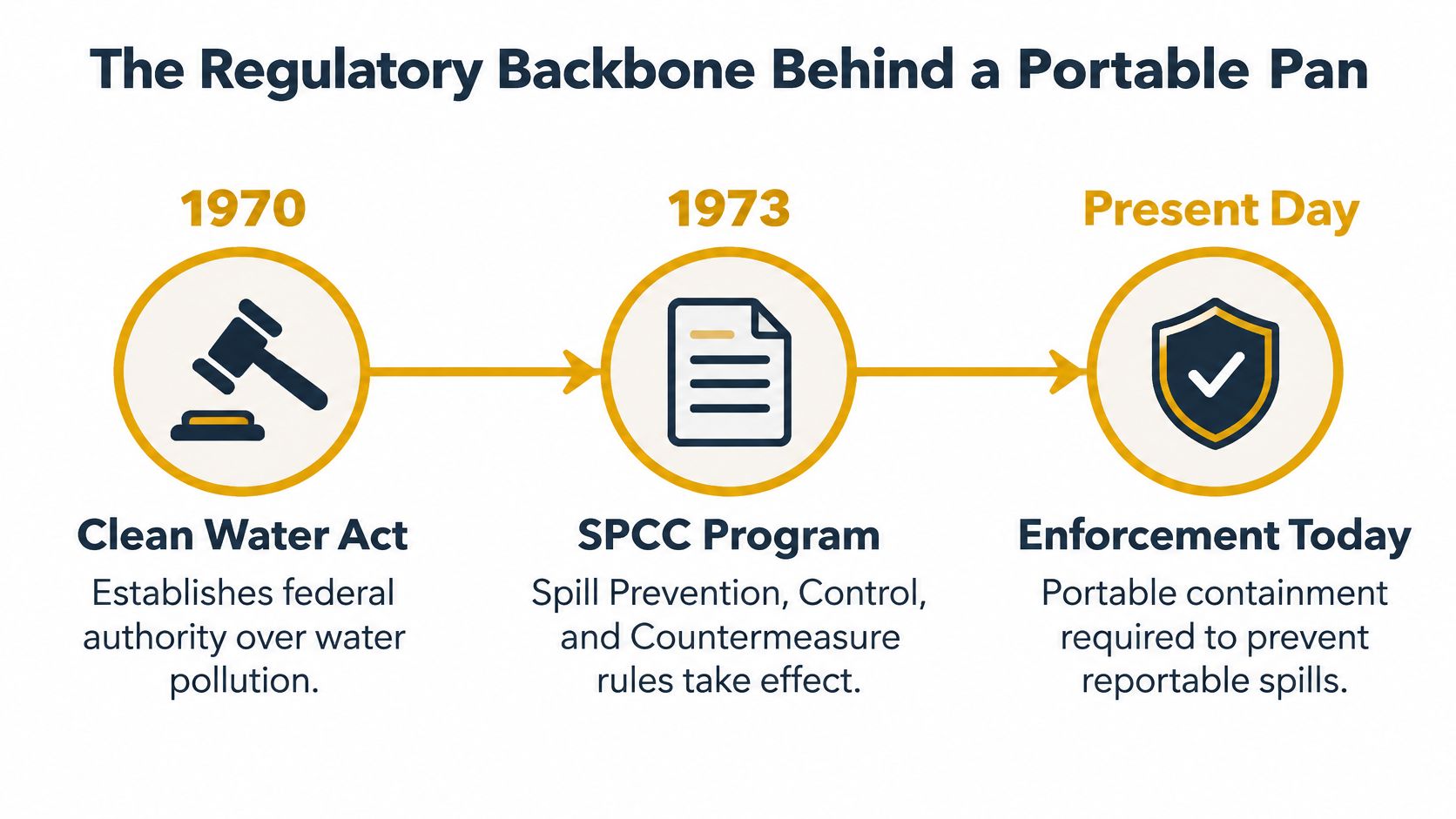
The SPCC side has a long paper trail. Federal legislation arrived in 1970, EPA's SPCC regulations followed in 1973, and the Clean Water Act's Section 311 authority was enacted in 1972. Applicability kicks in above 1,320 gallons of aboveground oil storage or more than 42,000 gallons of completely buried storage, together with a reasonable expectation of discharge to protected waters, as summarized in EPA's SPCC program overview. That same document sets the sizing principle for portable and mobile oil containers: hold the largest single compartment or container, plus enough freeboard for precipitation.
That freeboard clause deserves attention. Federal sizing logic has always treated stated capacity as something you derate for weather, which is the same reasoning behind planning a washout pan to roughly three-quarters of its nameplate volume before rain and chute surge eat the margin.
What enforcement looks like on a construction site
For washout work, the stormwater permit is the document that matters, and EPA's enforcement record shows how quickly it gets tested. Nationwide permitting expanded from sites larger than five acres in 1993 to sites between one and five acres in 2003, and an Idaho campaign produced five expedited settlements in 2005 with penalties ranging from $4,550 to $6,100 for failures involving erosion controls, inspections, maintenance, debris, and pollutant prevention, according to EPA's Idaho construction-site enforcement announcement.
Read the violation list closely. Most citations there involve housekeeping and paperwork as much as hardware. A pan can meet every capacity figure on its spec sheet and still sit inside a failed inspection if the logs, servicing records, or site arrangement don't match the permit plan.
On the ground, that translates to three checks: the responsible environmental lead identifies the permit conditions governing the site, the washout specification records what the setup must retain and how it gets serviced, and someone confirms the delivered unit and field arrangement match that plan before the first truck backs in. Renting the right equipment supports compliance. It does not create it.
Matching the Right Unit to the Right Pour
The second truck is the test. If the first washout leaves a rigid pan close to its working level and rain is forecast overnight, a bigger nameplate volume will not help unless the crew can still receive chute discharge, keep freeboard, and get the unit serviced before the next load. Selection starts with pour rhythm: how often trucks arrive, how much water each washout sends over, where solids accumulate, and who can move or pump the unit once it is holding weight.
Choose the receiving point before the container. A renovation with one mixer and tight access may favor a rigid pan at a controlled edge. A commercial slab with steady truck rotation needs a liquid-tight roll-off or tank positioned for exchange without stopping the pour. Flexible lined berms fit temporary pads when liner protection and traffic control are realistic; they become a maintenance problem when reinforcement traffic crosses the sidewalls all day. For portable spill containment, the format has to survive the route trucks take.
Then judge usable room, not advertised room. Freeboard disappears through rainfall, accumulated solids, splash, and the space a pump hose or chute needs at the edge. A unit can look half empty and still sit near its action level once hardened material reduces liquid volume. Leave margin for the service interval you can depend on, and treat receiving height, turning room, and removal access as part of capacity.
Three questions settle most choices. Can the crew keep discharge inside the liner when the chute moves? Can the unit be inspected without climbing into the splash zone? Can it be swapped, pumped, or hauled while loaded under site rules? If any answer is no, the format is wrong even if the brochure volume looks generous.
Small pours reward simplicity. Long pours reward continuity. The better unit is the one that keeps the washout path boring when weather, traffic, and timing stop cooperating.
Sizing Capacity the Way EPA Actually Reads It
Nominal capacity is not the working allowance. EPA's concrete washout guidance identifies overflow risk when a container exceeds 75% of capacity and recommends removing liquid or allowing evaporation before hardened solids are removed; it also recommends lowering liquid levels or covering the container before forecast rain, as explained in its concrete washout best-management-practice guidance.
Treat that guidance as an intervention threshold, not permission to operate right up to it. Also distinguish EPA recommendations from enforceable conditions in the applicable permit. The infographic's use of “requires” shouldn't replace that site-specific determination.
Calculate through the next dependable service
Use a planning relationship that includes what's already inside:
Projected contents at service = existing contents + expected washout + rainfall entering the unit + other incoming water.
Compare that projection with your operating action level, while preserving the required freeboard. Existing contents must include accumulated solids as well as liquid. An apparently shallow liquid layer doesn't tell you how much storage remains beneath it.
For expected washout, use observations from comparable work or a conservative estimate agreed with the concrete contractor. Multiply the expected washout per truck by the trucks that will use that container before service, then account separately for pump or tool cleaning.
Rainfall planning should use the exposed opening, forecast depth, and consistent units. Confirm usable dimensions and rated capacity with the supplier rather than assuming external dimensions describe the internal liquid volume.
Don't count on evaporation to create room before a service appointment unless you can verify that room actually exists.
Make the decision before accepting more washout
| Field condition | Planning response |
|---|---|
| Remaining inflow fits comfortably below the action level | Continue with assigned monitoring |
| Forecast rain consumes the remaining allowance | Lower the liquid level or arrange a suitable cover before weather arrives |
| Service timing is uncertain | Plan additional containment instead of assuming an early arrival |
| The projected contents reach the operating limit | Redirect washout to a prepared unit |
Keep the forecast, starting condition, volume assumptions, service commitment, and responsible person together in the site record. A larger unit or an additional receiving point is a scheduling decision as much as a capacity decision. Compare its quoted cost with the disruption and uncertainty of emergency service.
Where You Put the Pan Is Half the Performance
A leak-proof unit can still be part of a discharge pathway if the crew puts it where traffic damages it or flowing water enters it. Placement deserves a field walk, not a pin dropped on a delivery map.
EPA field guidance recommends locating concrete washout facilities at least 50 feet (15 meters) from storm drains and receiving waters, away from construction traffic, with a structurally sound, leak-free surface and sufficient storage for the anticipated waste, as described in its construction-site best-management-practices field manual. Treat that as guidance to incorporate into the site plan, not a substitute for checking applicable permit requirements.
Walk the water route and the vehicle route
Look upslope first. Ask where runoff will come from during rain and whether the proposed position sits in a drainage swale. Then look downslope toward drains, low spots, and receiving waters.
The traffic review is different. A location may be convenient for the first delivery yet conflict with later material handling, pump movements, or collection access.
- Supporting ground: Check for settlement, sharp debris, uneven bearing, and conditions that could compromise the unit.
- Run-on control: Keep surrounding runoff from becoming an unplanned addition to stored waste.
- Impact protection: Establish separation from reversing vehicles and moving equipment.
- Service access: Preserve the approach needed to remove liquid or exchange the container.
Record why the location works
A defensible placement record can be simple: mark the unit on the site plan, identify nearby drainage features, photograph the setup, and note the service route. Record any protective measures and the person responsible for keeping access clear.
Inspect the condition daily and after heavy rain. Add checks after relocation, equipment contact, or severe weather as practical operating controls, because a previously acceptable setup may have changed.
Don't inspect only the pan. Check the ground, access, surrounding drainage, and evidence of material outside the receiving area. A signed form is useful only when someone has looked at the conditions it describes.
Renting Versus Buying for Most Contractors
For contractors who manage washout intermittently, rental is a sensible starting point, not an automatic financial winner. It lets the equipment arrangement follow the job rather than forcing every pour to suit a container the company already owns.
Ownership can make sense for a specialist with steady utilization, suitable transport, storage space, and a maintained service routine. The comparison changes when equipment sits idle between scattered projects or requires a dedicated trip to move.
Compare the complete job cost
Ask for a written rental quote that identifies delivery, collection, cleaning, waste handling, site-access conditions, and any expedited-service charges. Confirm what's included rather than assuming that collection also includes every disposal task.
For ownership, account for the work your team must perform:
- Transport and handling: Who moves the unit, and what equipment must be available?
- Storage and maintenance: Where does it go between jobs, and who checks its condition?
- Waste management: Who arranges liquid removal and solids handling?
- Availability: Can the same unit realistically support overlapping work?
Rental doesn't transfer the site's monitoring responsibility. Ownership doesn't guarantee readiness. Either approach fails if the container arrives damaged, can't be reached for service, or isn't available when the pour changes.
Buying test: Consider ownership when you can identify a repeatable workload and a complete handling routine, not just an attractive purchase price.
Before booking, use the supplier's published contact channel to confirm specifications, availability, delivery access, and pickup conditions. Ask specifically what happens if the pour moves, weather intervenes, or the unit needs servicing sooner than expected.
Choose the commercial arrangement that supports the operating plan. Don't choose the operating plan around an incomplete quote.
Field Checklist and Questions Crews Should Expect
Give the foreman a short handoff that identifies decisions, not just equipment. The most useful document tells the crew what to check and who can authorize the next move.
Pre-pour field checklist
- Capacity: Confirm the supplier's usable-volume information and record the planned action level.
- Incoming material: Account for the remaining washout, existing contents, and forecast weather through service.
- Placement: Verify the selected location against the drainage plan and traffic arrangement.
- Condition: Check the receiving area, base, walls, seams, and any liner.
- Service: Confirm access, timing, and the alternate receiving arrangement.
- Responsibility: Name the monitor and backup, and keep inspection notes and service records accessible.
Questions from the crew or inspector
How close can the pan sit to a storm drain?
Use the setback guidance discussed above and check the applicable permit and site plan. If the proposed location can't meet the planned separation, refer the decision to the responsible environmental lead rather than moving it casually.
What happens if rain starts during placement?
Reassess remaining working capacity immediately. Use the prearranged covered or alternate receiving option, or obtain service before accepting more material than the setup can retain.
Who owns monitoring?
Assign a named person with authority to redirect washout and contact the service provider. A backup matters when that person is pulled into another task.
When is another unit preferable to a larger one?
Consider another unit when separate work areas, service interruptions, or changing access make a single receiving point unreliable. Consider a larger unit when receiving can remain centralized and servicing is dependable.
The handoff is complete when the crew knows where washout goes next if the current unit becomes unavailable.
Reborn Rentals offers portable concrete washout pans for construction and renovation projects. Before your next pour, visit Reborn Rentals to discuss container specifications, availability, and delivery logistics against your expected washout and weather allowance.