
Construction Site Rentals Explained for Contractors
The concrete trucks are already on the schedule, the pump crew has a narrow access window, and someone still needs to decide where the slurry will go when the chute gets rinsed. That's where construction site rentals either make the pour feel controlled or turn a straightforward morning into a chain of delays, extra charges, and cleanup problems.
The rental itself is rarely the difficult part. The trouble starts when the team overlooks delivery timing, pickup terms, equipment capacity, site access, or the difference between a low day rate and a predictable all-in cost. Concrete washout containment makes those gaps obvious because the rental has to support production while also preventing caustic wash water and solids from reaching soil, drains, or nearby water.
A Day on Site When Rentals Go Right
By the time the first crew walks through the gate, the washout pan is already sitting on stable ground away from the drainage path. It was placed the evening before, so nobody is trying to find a location while the concrete pump is being assembled. The hose bridge is across the pedestrian gate, the access lane is clear, and the superintendent has the dispatcher's number open on the radio.
The roll-off arrives at 6:15. The driver gets a clean signal from the spotter, backs into position, and leaves the route open for the pump truck. A few minutes later, the pump truck eases against the curb cut. Rebar and formwork are already in place, so the concrete crew can focus on the pour instead of moving rented equipment out of the way.
The first trucks cycle smoothly. The washout pan catches the chute rinse, and the crew keeps the washout tools beside it rather than across the site. When one truck idles longer than expected, the superintendent radios the dispatcher instead of letting the delay spread through the delivery sequence.
Practical rule: A rental plan has to account for the people, trucks, and access routes using the site at the same time.
The only scramble comes late in the pour. The pan is undersized for the final two loads, and the superintendent has to confirm whether a replacement or supplemental container can arrive before the last washout. That moment exposes the difference between ordering “a washout pan” and ordering containment based on actual pour volume, weather exposure, and concurrent truck activity.
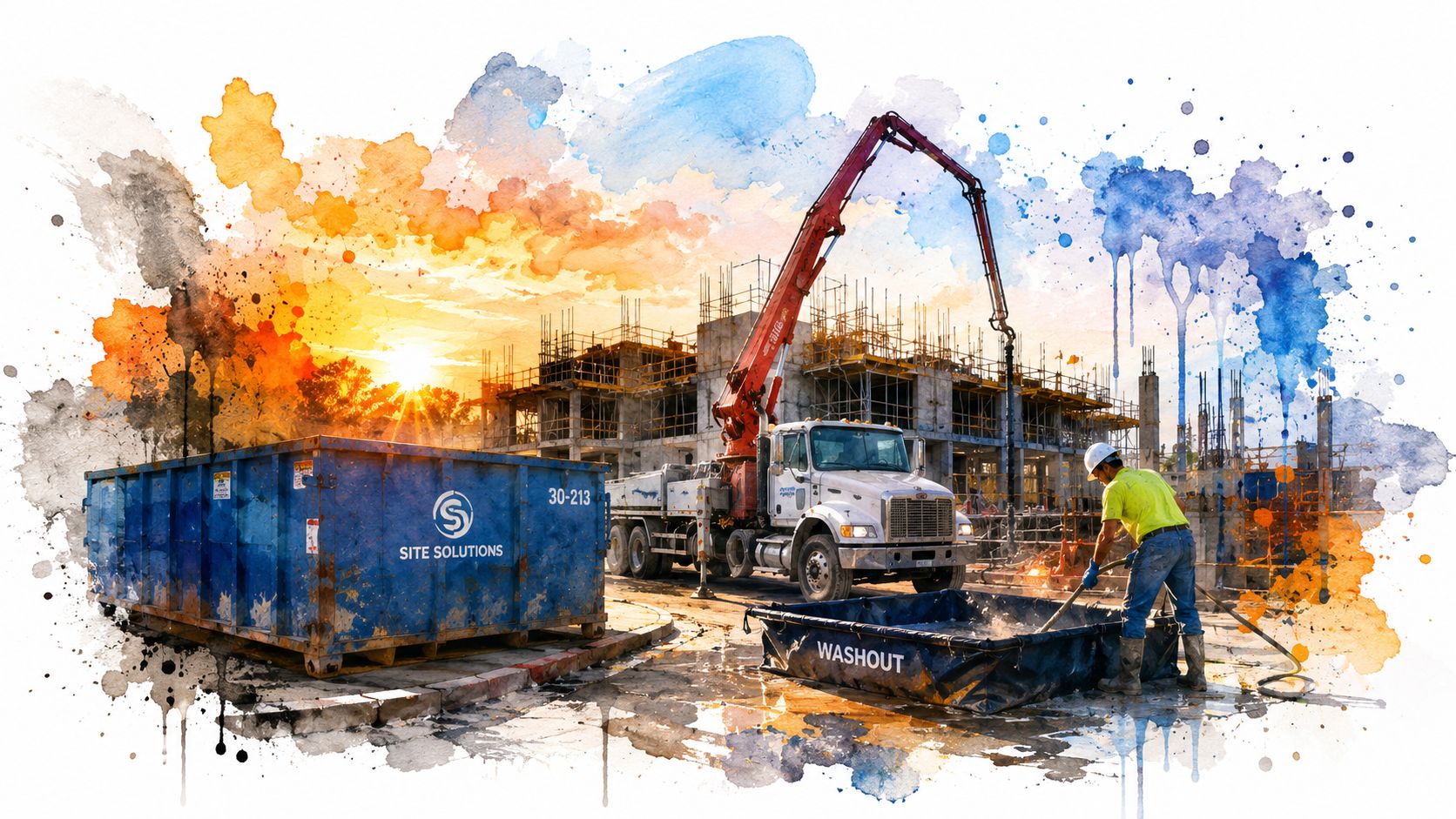
The final bucket rinses clean. The pump crew packs up, the roll-off leaves without blocking the gate, and the washout area remains contained. No one has to explain an overflow, chase a missing pickup, or discover that the rental agreement treats a filled pan as a separate service event. That quiet ending is what a well-orchestrated rental setup delivers.
What Construction Site Rentals Actually Include
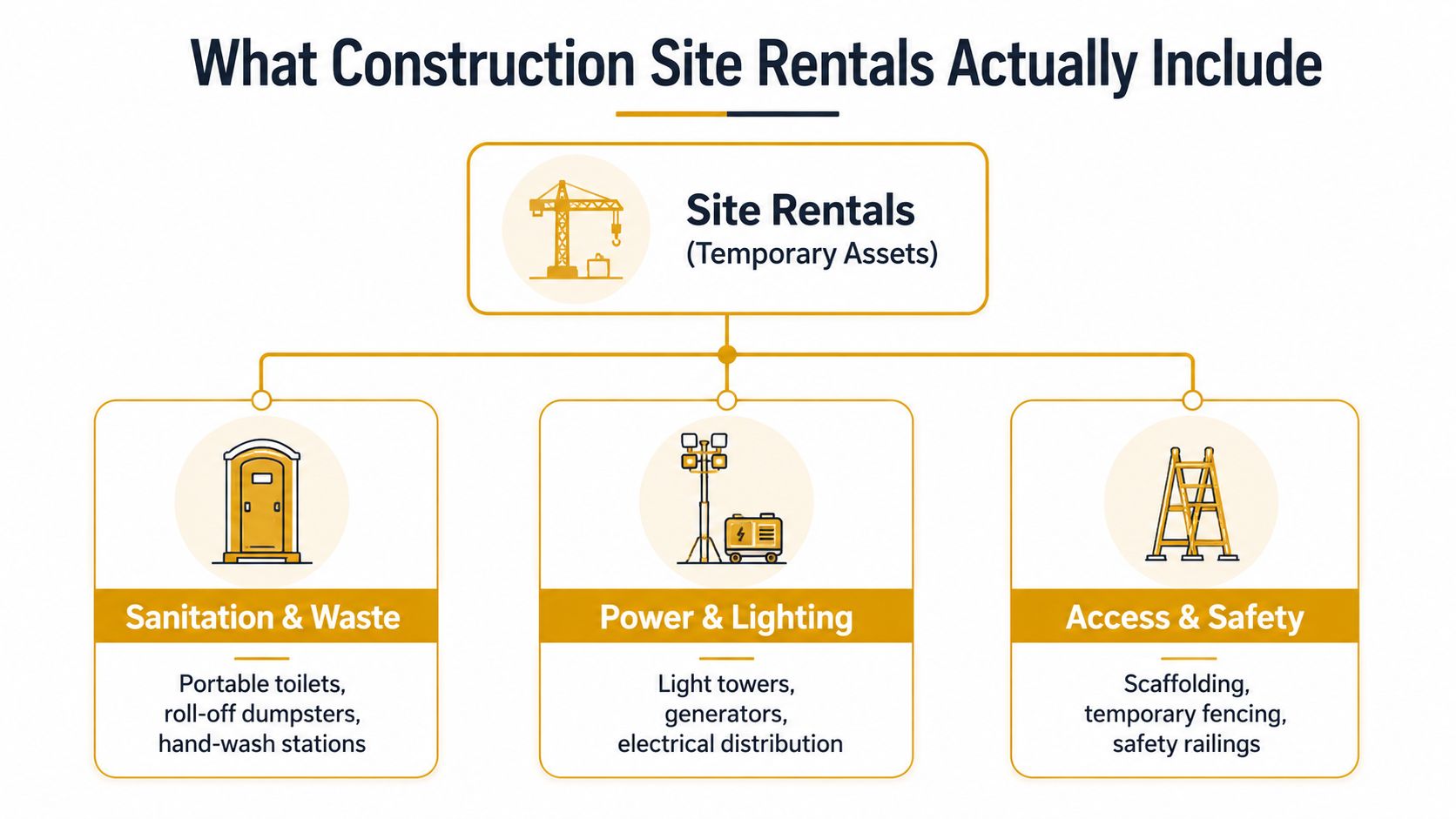
Construction site rentals are temporary assets brought to a project and removed when the work or phase closes. The category includes portable toilets, hand-wash stations, roll-off dumpsters, temporary fencing, light towers, generators, electrical distribution, scaffolding, safety railings, boom lifts, scissor lifts, telehandlers, and concrete washout pans.
A washout pan is a useful anchor because it sits at the intersection of equipment, compliance, logistics, and waste handling. The crew needs it before concrete arrives, the superintendent has to place it where runoff can't reach a drain, and the rental company may need to retrieve, clean, exchange, or dispose of the contents after the pour.
How rental yards price temporary assets
Rental yards commonly price equipment by day, week, or month. The invoice may use a calendar-day rule, a usage-day rule, or a defined rental period that doesn't line up neatly with the pour schedule. A unit returned dirty may incur a cleaning charge, while a container that still holds hardened residue can require additional handling.
Delivery and pickup aren't administrative details. They determine whether the equipment reaches the site when the crew needs it and whether the contractor pays for time when the item is waiting for removal.
Bundling related items with one dispatcher can reduce coordination mistakes. A concrete contractor might arrange a washout pan, lid, delivery, and pickup through one contact, while the general contractor separately coordinates sanitation, fencing, lighting, and waste removal.
Keep ownership categories separate
Owned equipment belongs in a different cost discussion from rentals. A leased unit has its own term and payment obligations, while subcontractor-supplied gear may be included in a subcontract price or carried as a pass-through cost. Rental equipment is temporary access, usually tied to a defined period and subject to return, damage, cleaning, and extension terms.
That distinction matters during job-cost review. If a crew treats every temporary asset as a simple day-rate purchase, it can miss service charges, standby exposure, and responsibility for disposal.
Day Rates, Delivery Fees, and Surcharges Explained
A 10-yard pour can finish on schedule and still produce an inflated rental invoice. The base rate may cover possession of the equipment, while delivery, pickup, fuel, environmental handling, cleaning, damage protection, rough-terrain access, and late-return extensions appear elsewhere.
EquipmentWatch reported higher weekly rental rates in several core categories in the first quarter of 2025, including telehandlers, which reached $2,103 after a 12.43% increase. The EquipmentWorld report on EquipmentWatch rental rates reinforces a practical rule: treat the quoted rate as one budget input, not the final cost.
Read the invoice by trigger, not just by item
A day rate may follow a 24-hour clock, a calendar day, or a weekly threshold. Pickup after the agreed window can create another rental day. Powered equipment may carry a fuel surcharge, while waste and washout contents may trigger environmental or handling fees.
Read damage-waiver language line by line. A waiver may reduce selected liabilities without covering misuse, theft, unauthorized movement, or damage from overloaded or contaminated equipment. Cleaning terms can be more direct. A pan returned with hardened concrete may cost more than one returned empty and rinsed.
Use this budgeting formula before comparing vendors:
Total rental cost = base rental charges + delivery + pickup + service fees + surcharges + taxes + extension or damage charges.
Contract language controls the result, so check the trigger for every accessorial charge. Ask whether the rental clock starts at delivery, whether a failed pickup extends billing, and whether a filled container is priced by handling, disposal, or both.
Build a sample invoice from verified terms
For a 10-yard pour using a washout pan, roll-off, and light tower over three days, the vendor must supply the actual rates. Assigning unsupported dollar amounts would make the estimate look precise without making it reliable.
| Line Item | Day Rate | Quantity/Days | Subtotal |
|---|---|---|---|
| Washout pan | Vendor quote | 3 days | Day rate × 3 |
| Roll-off | Vendor quote | 3 days | Day rate × 3 |
| Light tower | Vendor quote | 3 days | Day rate × 3 |
| Delivery | Quoted fee | 1 | Quoted fee |
| Pickup | Quoted fee | 1 | Quoted fee |
| Cleaning or washout handling | Contract term | As triggered | Contract amount |
| Fuel, environmental, or access surcharge | Contract term | As triggered | Contract amount |
| Estimated total | Add all line items |
Reject a quote that hides every accessorial inside an unexplained “service” amount. Ask which charges are fixed, which depend on time or site conditions, and which change if access becomes difficult.
Ask before signing: “What exact event creates another charge?” The answer should cover late pickup, rain rescheduling, filled containers, cleaning, fuel, rough terrain, and replacement equipment.
The American Rental Association projected U.S. construction and general tool rental revenue of $87.5 billion in 2025, as reported in the EquipmentWorld coverage. A large rental market does not remove contract risk. It gives contractors more reason to compare the complete invoice, including every condition that can change the final bill.
Scheduling Delivery, Pickup, and Crew Coordination
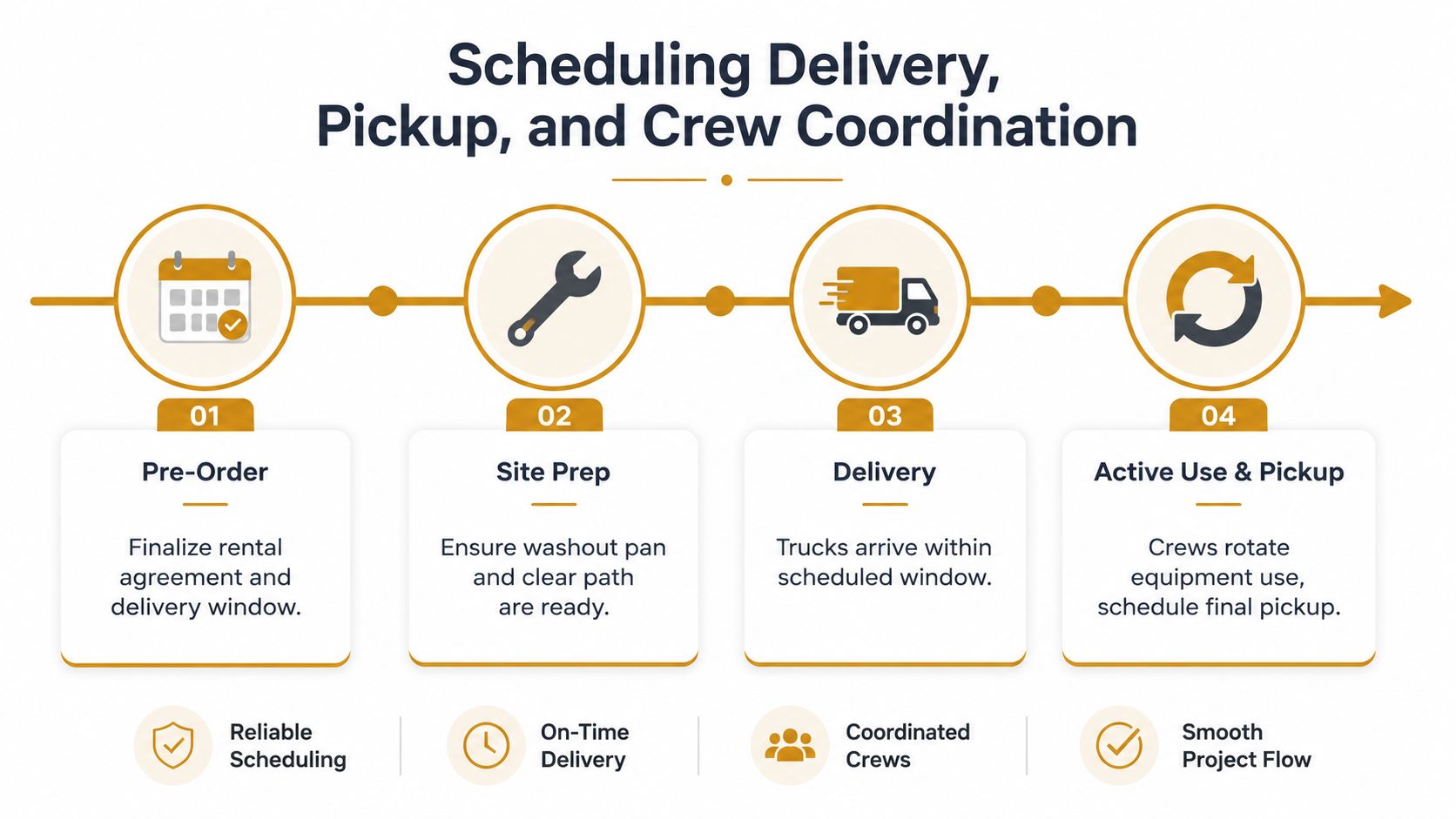
Treat the rental order as part of the pour ticket, not as a separate office task. The delivery window has to match the concrete sequence, the pump setup, the crew briefing, and the site's available access.
Build the order around the pour
Start with the delivery address, gate instructions, turning limits, curb cuts, overhead obstructions, and the named on-site contact. Tell the rental desk whether the truck needs a liftgate, whether the ground is rough, and whether a spotter will be available.
Confirm how the rental clock starts. Some agreements count calendar days, while others use usage periods or defined pickup windows. A pan delivered too early may begin billing before the pour, but a pan delivered too late can leave the crew improvising containment.
Staging the pan the evening before usually removes a common failure point. The superintendent can verify the placement, check that the unit is stable, and confirm that the crew can reach it without crossing active truck paths.
Coordinate the moving parts
Concrete trucks, the pump truck, rebar deliveries, formwork deliveries, dumpsters, and pedestrian traffic all compete for space. Put the washout area where the chute and pump lines can reach it, but don't place it in a travel lane or beside a drain solely because that spot is convenient.
Use a short dispatch plan:
- Before delivery: Reconfirm the address, gate, contact, equipment, and arrival window.
- Before the pour: Inspect the route and stage the washout equipment.
- During the pour: Keep the pan accessible and watch the fill level.
- Before departure: Confirm the final washout and release the pickup request.
Weather creates a separate scheduling problem. A rain delay can move the pour while the rental clock continues, depending on the agreement. Ask about rescheduling fees, cancellation cutoffs, and whether the supplier can hold the equipment without starting a new charge.
Pickup needs the same discipline as delivery. Tell the dispatcher when the unit will be empty, where the driver should park, and whether the site will remain open after the crew leaves. A “best-effort” pickup window gives the supplier flexibility, but it can expose the contractor to another rental period if the equipment stays on site.
Compliance and Washout Containment Rules That Shape Rentals
Concrete washout is a stormwater-control issue, not just a housekeeping task. Wash water and slurry can be caustic and can carry solids into soil, groundwater, storm drains, and receiving waters. The EPA concrete washout guidance says crews should collect and retain washout water and solids in leak-proof containers so the material can't migrate into the environment.
That requirement changes what a contractor should order. A thin, improvised area beside the curb isn't equivalent to a managed containment system. The rental needs to be leak-proof or properly lined, accessible to the crew, sized for the work, and positioned so rainfall and repeated washout cycles don't push material over the edge.
Placement is a field decision
State and municipal best management practices commonly use a setback of about 50 feet from storm drains, open ditches, or water bodies where space allows, as summarized in the EPA-referenced guidance. That distance isn't a substitute for local review, but it gives the superintendent a practical starting point when laying out the site.
Inspectors and site auditors will look at the condition of the containment, the route between the truck and washout area, signs of leakage, accumulated solids, and whether the setup can handle the planned work. They may also review the project's stormwater pollution prevention plan and local requirements.
Size for the pour and the rain
A municipal concrete-waste standard uses approximately 6 cubic feet of containment per 10 cubic yards of concrete poured, and it also requires the design to prevent overflow from inadequate capacity or precipitation. The City of Denton concrete waste management standard provides that sizing reference.
The practical calculation starts with the planned placement, not the pan's footprint. Add the expected chute and pump washout, account for multiple truck cycles, preserve usable freeboard, and protect the unit from rain with a suitable cover. If the pan is full before the final truck arrives, the crew has lost its compliant control at the moment it needs it most.
Local jurisdictions can add requirements beyond the federal baseline. Before ordering, confirm whether the project requires a specific washout design, discharge authorization, inspection log, or off-site washout service. If a site cannot safely contain the material, an off-site service may be more practical than trying to force a small pan into a constrained location.
Comparing Washout Pan Sizes for Different Pours
A residential footing pour and a commercial slab may use the same type of washout equipment, but they don't create the same operational demand. The footing crew may have fewer truck cycles and a shorter washout path. A commercial slab may involve a pump, continuous truck rotation, more crew movement, and a greater chance that several pieces of equipment need cleaning during the same period.
The right comparison isn't "small versus large." Look at liquid capacity, usable freeboard, footprint, sidewall height, load rating, forklift access, cover compatibility, and the path the chute must travel.
Side-by-side rental decision
| Feature | Standard Pan (Residential) | Heavy-Duty Pan (Commercial) |
|---|---|---|
| Best fit | Smaller footing, repair, or renovation pour | Larger slab, repeated truck cycles, or pump-supported placement |
| Footprint | Easier to place in a constrained area | Requires more deliberate access and staging |
| Capacity | Suited to lower concurrent washout demand | Provides more working room and reserve capacity |
| Load rating | Appropriate when heavy equipment won't enter the pan | Better where loading, handling, or repeated service demands are higher |
| Deck height | May simplify chute access at a smaller setup | May provide stronger containment geometry but needs access planning |
| Forklift pockets | Useful for relocation when site conditions permit | Important for moving a heavier unit safely |
| Construction | Steel or heavy-duty poly, depending on supplier | Reinforced steel or heavy-duty construction, depending on supplier |
| Main risk | Filling too quickly during an unexpectedly busy pour | Paying for capacity and handling that a small job doesn't need |
Calculate the working demand
Begin with the planned concrete volume and the expected washout behavior. Estimate residual material from the chute and pump, then account for the number of trucks that may wash out before service or pickup. The municipal benchmark of 6 cubic feet per 10 cubic yards is a useful reference point, but the site still needs a margin for rain, repeated rinsing, solids accumulation, and imperfect crew behavior. That benchmark is documented in the Denton concrete-waste standard, which has already been cited above.
Don't choose by gallon capacity alone. A tall pan may hold more liquid but create a difficult chute angle. A low pan may be easy for the crew to use but fill sooner. Forklift pockets can help with placement, yet they also require a route, equipment, and a trained operator.
Steel generally tolerates rough handling and heavy service, while heavy-duty poly can be easier to handle in some applications and may resist certain forms of corrosion. The cheaper day rate stops being cheap if the pan overfills, requires an emergency swap, or generates a cleaning and disposal dispute.
Best Practices Contractors Use Before Signing a Rental
The rental desk can give you a quick price. The superintendent has to live with the equipment after it arrives, so the contract review should focus on what happens when the job changes, the pan fills, or the driver can't access the site.
The morning-of-delivery routine
Use this checklist before the truck leaves the rental yard:
- Verify contract line items: Confirm liability for damage, cleaning fees, filled-pan overage, delivery, pickup, environmental fees, and extension charges.
- Confirm the delivery time: Reconfirm the arrival window and the dispatcher's direct contact.
- Inspect site access: Walk the route, check the gate and ground conditions, and remove obstructions before the driver arrives.
- Assign a crew contact: Name the person who will direct placement, document condition, and approve pickup.
- Stage ancillary items: Have covers, washout tools, hoses, barriers, and any required access equipment ready.
Photograph the rental from several angles at delivery. Capture existing dents, bent frames, damaged covers, stains, missing accessories, and the placement area. Those images won't resolve every dispute, but they create a clear record of the unit's condition before use.
Questions that expose the real cost
Ask the rental company who handles washout disposal, what triggers environmental or cleaning charges, and whether the price changes when hardened concrete remains in the pan. Confirm the unit's load rating and liquid capacity against the pour schedule, not merely against the contractor's first estimate.
Also ask what happens if the unit fills before pickup. A reliable answer covers replacement availability, response timing, transport charges, and whether the exchange starts a new rental period. The contract should state whether pickup is guaranteed or best effort, and what happens when weather moves the pour.
A low day rate can be the right choice for a short, simple job. All-in pricing may be safer when access is difficult, the schedule is tight, or the rental company charges separately for delivery, rough terrain, express orders, cleaning, and disposal. The difference between a modest line item and a much larger surprise usually comes from these terms, not from the equipment sitting in the yard.
One option for contractors needing dedicated concrete washout containment is Reborn Rentals, which provides washout pans and containers for construction and renovation projects with delivery arrangements and daily pricing shown through its rental process. Confirm the selected unit's capacity, placement requirements, delivery conditions, and pickup terms before the pour.
Before your next concrete delivery, match the washout containment to the full pour schedule, confirm every accessorial charge in writing, and walk the delivery route with the crew. Visit Reborn Rentals to review available concrete washout rental options, set project dates and location details, and arrange delivery for a contained, better-organized pour.