
Fuel Tank Secondary Containment Requirements: A 2026 Guide
Under the EPA SPCC framework, secondary containment for a regulated bulk aboveground fuel tank must hold the full capacity of the largest tank plus freeboard for rainfall, using the 25-year, 24-hour storm as an appropriate design benchmark. A blanket 110% capacity allowance isn't proof that the installation meets that requirement.
The shortcut fails when contractors treat containment as a purchase specification rather than an operating system. A basin can have enough advertised capacity and still fail because a pipe penetration leaks, a drain stays open, or accumulated rainwater occupies the space reserved for a spill.
Fuel tank secondary containment requirements are best managed as a performance record. Keep the calculation, material specifications, installation checks, inspection results, and corrective actions together. An inspector should be able to match those records to the equipment standing on site.
Fuel Tank Secondary Containment Requirements at a Glance
For regulated bulk storage, the controlling question is whether the installation provides usable spill capacity and precipitation allowance, not whether every tank has its own berm. The Congressional Research Service's overview of oil-spill prevention describes the SPCC framework, originally promulgated in 1973 under 40 CFR Part 112, and its application to certain non-transportation-related facilities that could reasonably discharge oil into navigable waters or adjoining shorelines.
That distinction matters on construction sites. A temporary installation doesn't become exempt just because the contractor intends to remove it when the project ends. Establish applicability from the facility and discharge conditions, then identify the containment duty for each operation.
Containment requirements by tank setup
| Setup | Containment volume | Freeboard | Governing rule |
|---|---|---|---|
| Single aboveground bulk fuel tank under SPCC | Full tank capacity | Precipitation allowance | SPCC bulk-storage requirements |
| Several tanks in one common area | Largest tank, with connected tanks evaluated together | Rainfall over the common containment area | SPCC shared containment |
| Tank under a state or local program | Capacity specified by the applicable program | Confirm whether precipitation is separately addressed | State or local environmental and fire rules |
| Container over 55 gallons | Appropriate containment after confirming regulatory applicability | Evaluate exposure and the applicable storage requirement | EPA secondary-containment guidance and applicable rules |
| New field-constructed underground tank | Secondary wall or equivalent containment barrier | Atmospheric rainfall allowance isn't the sizing basis | Federal underground-storage-tank program |
| Indoor flammable-liquid tank | Enclosure meeting the applicable installation provisions | Assess liquid accumulation rather than outdoor rainfall alone | OSHA flammable-liquid requirements and applicable fire code |
| Fueling, transfer and loading area | General containment addressing transfer spills | Address outdoor exposure in the containment strategy | SPCC general secondary containment |
Sized bulk containment and general secondary containment are different duties. A tank basin addresses a storage failure. A fueling area also needs a defensible way to stop a hose leak, connection spill, or loading release before it leaves the controlled area.
A compliant tank enclosure doesn't automatically contain the spill that happens beside it.
For a shared basin, keep a current tank layout and identify which valves or piping connections could allow tanks to drain together. The inspector's practical question is whether the calculation represents the installed arrangement, not an earlier drawing.
Finally, identify who owns the compliance decision. Keep the applicable rule, plan-certification basis, and responsible person with the site records. A supplier's capacity label helps identify equipment, but it doesn't establish the facility's regulatory status or approve the installation.
How to Calculate Containment Volume and Freeboard
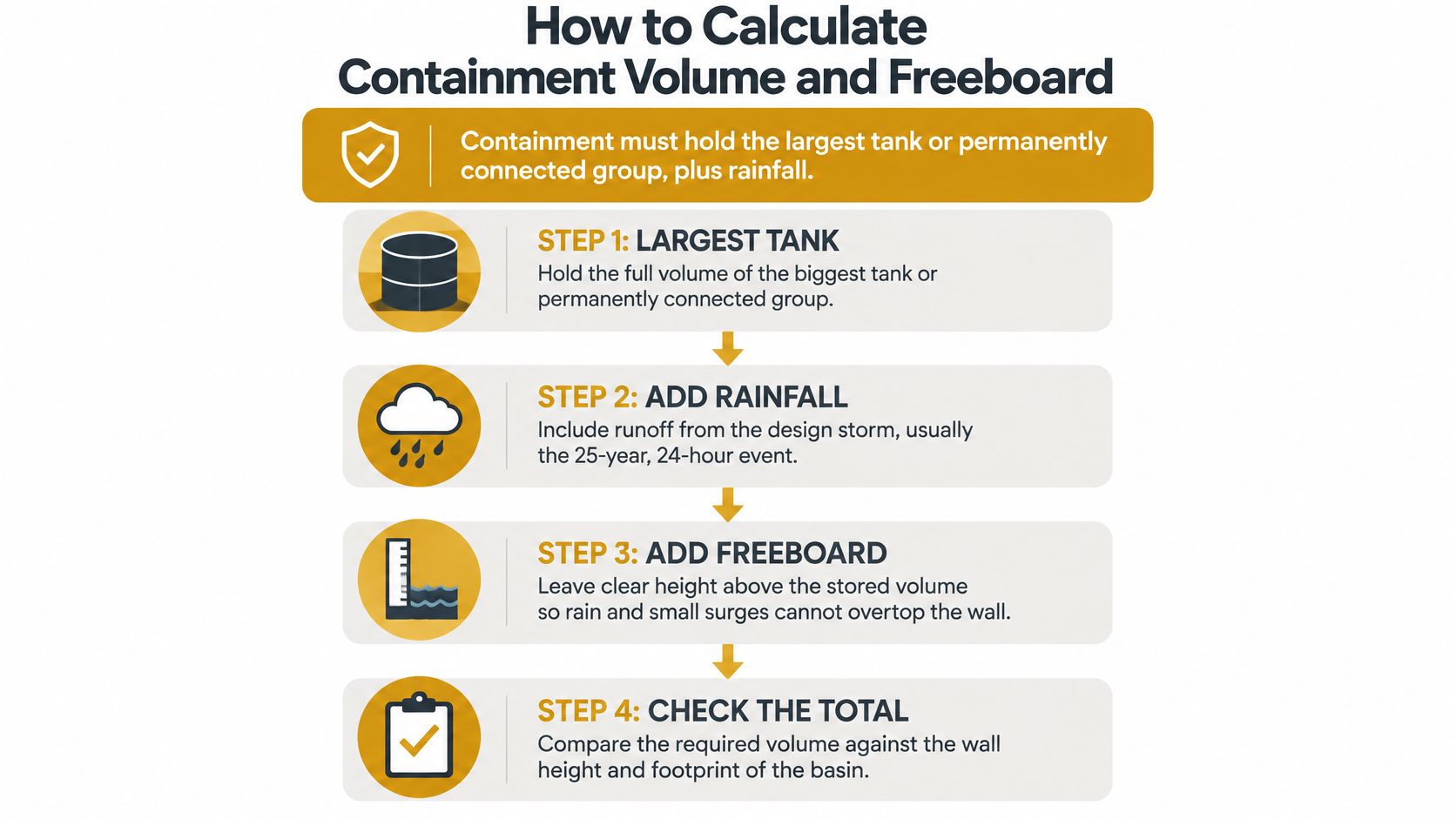
Calculate net usable capacity, not the volume inside an empty rectangle. The EPA's guidance on secondary containment for bulk-storage installations requires the largest container's full capacity plus sufficient precipitation freeboard and identifies the 25-year, 24-hour storm as an appropriate benchmark, rather than a universally mandated storm standard.
The rainfall allowance is part of freeboard. Don't count the same storm volume twice by adding it once as rainfall and again as a separate percentage reserve.
Build the calculation from field measurements
Identify the controlling release. List tank capacities and inspect permanent interconnections. Where a connected group could release together, have the plan preparer establish the appropriate combined release basis.
Use full capacity as the spill requirement. Don't substitute the normal delivery quantity or the level at which the crew usually refills. Operating habits aren't a physical limit on storage capacity.
Account for displacement. Supports, foundations, piping, and other occupied space below the design liquid level reduce basin capacity. Calculate gross basin volume minus displacement, or add displacement to the required gross volume, but don't apply both adjustments.
Calculate the rainfall allowance. Multiply the contributing catchment area by the selected storm depth, using consistent units. Check whether nearby grading or roof runoff sends additional water into the enclosure.
Check the actual retention level. Compare the required volume with surveyed floor elevations, the lowest wall crest, ramps, penetrations, and drain arrangement. Average wall height can conceal a low point that controls overflow.
Record the design basis. Attach the tank inventory, dimensions, displacement assumptions, storm basis, and calculation to the applicable plan. Date the field verification so the reviewer knows which arrangement was checked.
A hypothetical worked example
Assume a 10,000-gallon tank, a 1,000-square-foot catchment, and 3 inches of design rain for this example only. Those dimensions and rainfall are hypothetical inputs, not a site-specific storm recommendation.
The rain depth equals 0.25 feet, producing 250 cubic feet of water. Using approximately 7.48 gallons per cubic foot, the rainfall allowance is 1,870 gallons.
| Hypothetical condition | Gross basin capacity needed |
|---|---|
| No displacement deducted from the basin | 11,870 gallons |
| 500 gallons of occupied volume below the design liquid level | 12,370 gallons |
The distinction is important: the second basin needs more gross volume to deliver the same usable spill-and-rainfall capacity.
Common calculation failures are accepting a nominal percentage without checking rainfall, overlooking displacement, and measuring to a wall height the basin can't actually retain. An open drain creates a different failure altogether: the calculated capacity may exist on paper, but the liquid has an escape route.
Materials and Construction Options for Containment
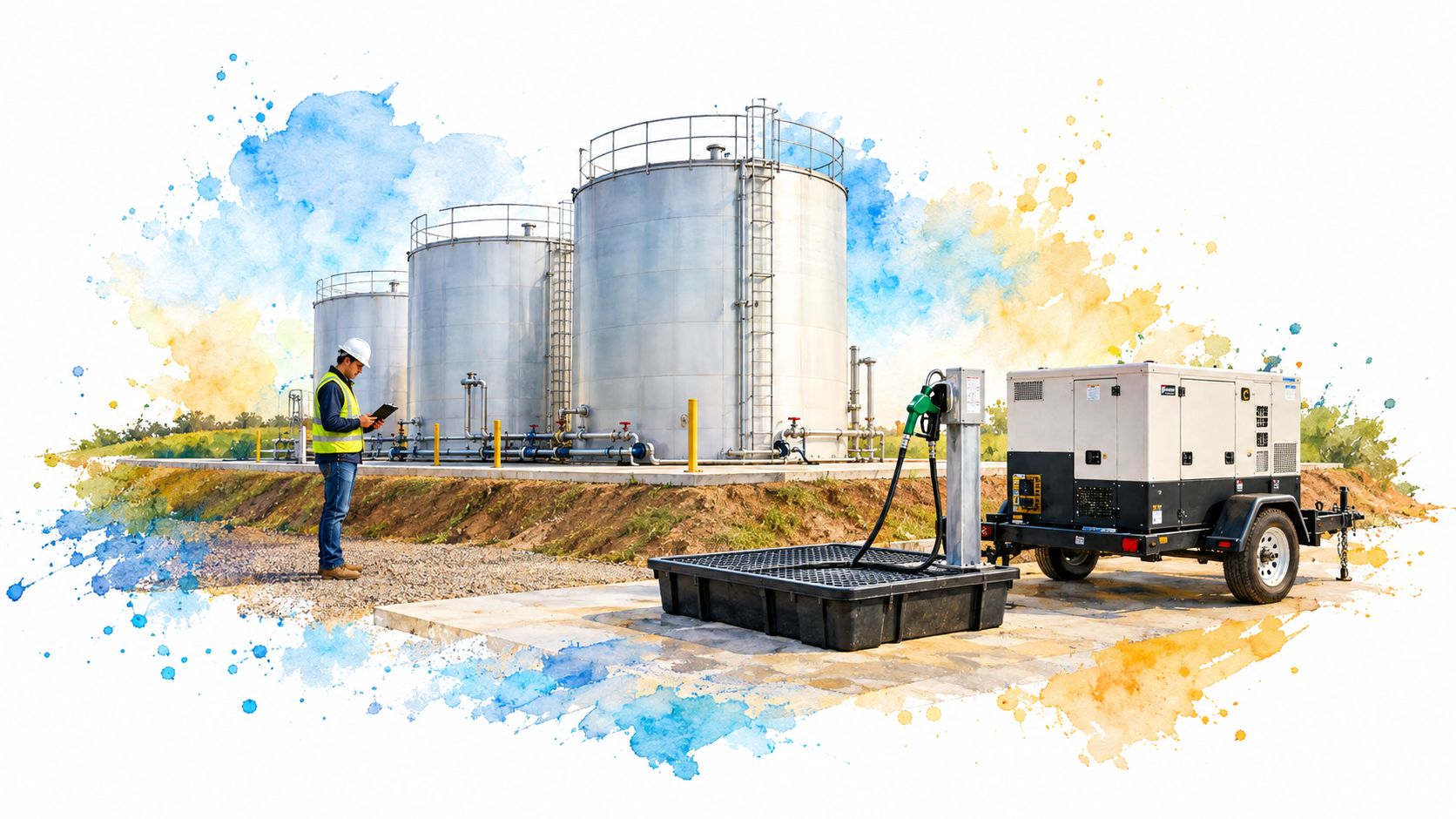
A permanent fuel farm, a temporary fueling pad, and a trailer-mounted generator need different containment details even when their spill volumes are similar. Choose the construction method around service life, movement, exposure, and fuel compatibility, then establish how the installation will be checked.
Containment build options compared
| Option | Best fit | Main limit | How to verify integrity |
|---|---|---|---|
| Concrete dike or berm | Permanent tanks and fuel farms | Cracks, joints, and penetrations need compatible sealing | Visual inspection and specified integrity testing |
| Earthen berm with synthetic liner | Temporary installations or large open sites | Punctures, settlement, and rainwater accumulation | Liner, seam, termination, and drain inspection |
| Steel containment pan or sump | Portable tanks and generators | Capacity limits and corrosion around seams | Inspect welds, seams, coating, and underside |
| Double-wall steel tank | Approved underground or sensitive aboveground applications | Monitoring access and sensor maintenance | Interstitial monitoring and prescribed testing |
| Polyethylene containment pan | Small mobile installations with verified fuel compatibility | Exposure resistance, deformation, and capacity | Visual inspection and manufacturer's integrity guidance |
| Single-wall factory containment system | Small aboveground installations | Product-specific fuel compatibility | Pre-service integrity testing where applicable |
Concrete offers a durable working surface, but the joints deserve as much attention as the wall. Inspect sealant adhesion, cracks around penetrations, and areas where equipment vibration or settlement can separate adjoining materials. A clean-looking slab isn't necessarily an oil-tight basin.
A lined earthen berm can accommodate a large footprint without extensive concrete work. Protect the liner from sharp aggregate, equipment traffic, and unsupported penetrations; leave seams accessible wherever practical. The weak point is often an installation detail rather than the liner sheet itself.
Match the proof to the construction
For steel pans, inspect places that collect water and hide corrosion, including beneath supports. For polyethylene, verify the exact fuel and exposure conditions against product documentation. A pan suitable for a small mobile tank isn't a substitute for an engineered storage-farm enclosure.
Underground installations require a different verification approach. The EPA's underground-storage-tank guidance describes secondary containment and continuous interstitial monitoring for new and replacement field-constructed tanks, using a second barrier to detect releases between containment layers.
Don't treat that outer wall as a replacement for corrosion protection, overfill prevention, or leak detection. Each safeguard addresses a different failure path.
Selection test: Before approving a material, decide how the operator will prove it still holds after weather exposure, maintenance work, and the next relocation.
Keep compatibility documentation and seam or weld test results with the equipment identifier. An inspector needs evidence for the installed material, not a brochure describing a similar product.
Fire-Code Rules and the Pre-Delivery Check
A berm that prevents soil contamination can still leave an unsafe fuel installation. Environmental containment approval doesn't settle fire safety, tank construction, venting, or access.
The OSHA flammable-liquids standard addresses noncombustible aboveground tank construction, pressure relief during fire exposure, and approval for the intended service, with recognized certification or engineering documentation such as UL, ASME, or API markings relevant to the equipment.
For certain indoor or specially configured installations, OSHA also specifies substantially liquid- and vapor-tight enclosures, reinforced-concrete construction provisions, and external means of removing accumulated liquid or vapor. Those provisions aren't a universal enclosure design for every outdoor diesel tank.
Resolve conflicts before the delivery truck arrives
Start with the stored product and tank configuration. Fuel classification, indoor placement, nearby structures, and access routes affect which provisions apply. Don't borrow separation distances from a different tank type or fuel service.
Keep approval documentation readable and traceable to the tank. A faded label, an unrecorded modification, or an unfamiliar fitting should trigger a document check before filling. A certification marking supports a particular equipment design; it doesn't approve every arrangement a contractor builds around it.
Emergency venting needs its own physical inspection. Check that protective covers, temporary weather protection, pipe extensions, or nearby construction haven't obstructed the intended discharge path. Don't alter a vent arrangement to make a delivery hose easier to reach.
Access is another practical trade-off. A tight enclosure saves space but can make valve operation, leak inspection, and emergency isolation difficult. Provide a safe inspection route without placing improvised steps or sharp supports where they can damage the liner.
Review environmental and fire requirements together. Meeting one obligation doesn't cancel another, and not every conflict can be solved by choosing a larger basin.
Keep concrete-washout equipment separate from fuel containment. Our rental terms prohibit using equipment to transport, store, use, or remove explosives or hazardous products or materials. Watertight construction for washout service isn't permission to store fuel.
Pre-delivery release checklist
Name the governing requirements. Record the applicable environmental, fire, worker-safety, and local provisions. Assign unresolved applicability questions to the plan preparer or reviewing authority.
Attach the sizing calculation. Identify the controlling tank arrangement, precipitation basis, and displacement assumptions. The reviewer should be able to reproduce the result without guessing at dimensions.
Verify the installed geometry. Measure the footprint and limiting retention height, then inspect drains and penetrations. Note any departure from the approved drawing.
Confirm chemical compatibility. Match the stored fuel, including its blend, to the liner, coating, sealant, and gasket documentation. Generic chemical-resistance language isn't enough to resolve an unspecified product.
Check tank approval and fire provisions. Record the tank identifier, approval evidence, venting, emergency relief, separation arrangements, and inspection access. Photograph markings before weather or equipment placement makes them difficult to read.
Close testing requirements. Obtain required integrity-test records and repair acceptance documents. Record the method, result, tester, and equipment tested.
Assign operating responsibility. Name the person who checks containment conditions and maintains the log. Include a backup for shift changes and absences.
Prepare for a spill. Stage compatible absorbents and drain protection where workers can reach them without entering a release. Post isolation instructions and emergency contacts.
Send the completed package, including photographs and unresolved exceptions, to the reviewing engineer or responsible qualified plan preparer before authorizing fuel delivery.
Inspection and Testing Schedules That Hold Up in an Audit
A volume calculation can establish design intent, but it can't prove present condition. Inspection records must show that the containment remains compatible, intact, monitored, and ready to retain a release.
The Florida secondary-containment rule illustrates the performance checks: resistance to the stored substance and environmental deterioration, strength under hydrostatic loading, direction of releases toward monitoring points, and pre-service integrity testing for applicable factory-made single-wall systems.
Inspection and testing schedule for fuel containment
The monthly entries below are recommended common-practice planning intervals, not universal federal inspection frequencies. Replace them with the applicable rule, approved plan, or manufacturer's schedule wherever that specifies a different obligation.
| Task | Typical frequency | Documented by | Extra check after |
|---|---|---|---|
| Tank shell, supports, and valves | Monthly as a site planning practice | Site operator | Leak, impact, or repair |
| Containment walls, seams, and liner | Monthly as a site planning practice | Site operator | Heavy storm, freeze-thaw damage, or vehicle impact |
| Rainwater and drain valve | Before every drain opening, with weather-triggered checks | Site operator | Sheen or unusual odor; keep the valve closed |
| Interstitial space or double-wall sensor | Continuous or logged checks under the applicable rule and equipment instructions | Operator or monitoring vendor | Alarm, power loss, or sensor fault |
| Containment integrity test | Before service where required, then at prescribed intervals | Qualified tester | Repair, relocation, or re-lining |
| SPCC plan and site configuration | On the governing review schedule and after relevant changes | Responsible plan preparer or certifying professional | Tank addition, movement, or reconfiguration |
Make each inspection actionable
A useful inspection identifies the component and its condition. Replace “berm checked” with a location-specific entry such as “sealant separating at the east pipe penetration,” supported by a photograph and an assigned repair.
For monitoring systems, distinguish no alarm from verified operation. A silent device with a failed power supply doesn't establish that the interstitial space is dry. Record faults, service work, and the functional checks specified for that equipment.
Rainwater management needs a decision record, not just a valve entry. Document the condition observed, whether discharge was authorized, and whether the valve was secured afterward. If contamination is suspected, arrange characterization and appropriate removal instead of assuming clear-looking water is acceptable.
An auditor should be able to follow a defect from discovery to closure:
- Identification: Date, inspector's name, equipment identifier, and defect location.
- Control: Temporary restrictions or isolation while the defect remains open.
- Correction: Repair method, responsible person, and completion date.
- Acceptance: Photograph, retest, or other evidence that the repair restored function.
Any change in tank count, location, connections, or drainage should trigger a fresh sizing and configuration check before the revised installation operates.
Spill Response When Containment Is Breached
A breached containment system is an incident, not a paperwork problem. Protect people and interrupt the release before attempting cleanup. Workers should respond only within their training, equipment, and the site's emergency procedures.

Act in order of urgency
Raise the alarm and stop the source if it's safe. Use accessible emergency shutdowns or isolation valves without entering pooled fuel or a vapor hazard. Don't operate electrical equipment inside a potentially flammable atmosphere.
Protect people. Move personnel to a safe location, keep others out, and account for workers near the release. Request emergency assistance when fire, vapor, exposure, or an uncontrolled discharge exceeds the site team's capabilities.
Block the escape route. Trained responders can deploy compatible absorbent booms, drain covers, or temporary barriers from a safe position. Keep containment drains closed and prioritize pathways toward storm drains, ditches, and surface water.
Hold accumulated water. Don't open a drain to recover storage capacity during a spill. Sheen or unusual odor is a reason to retain the liquid, but absence of those signs isn't proof that discharge is permissible.
Recover product and manage residue. Use compatible recovery equipment and suitable containers under the response plan. Segregate recovered fuel, contaminated water, absorbents, and damaged liner material for characterization and authorized disposal.
Make required notifications. Use the current emergency contact sheet to reach the appropriate federal, state, and local authorities. Don't delay a required report while trying to establish a perfect volume estimate; identify uncertainties and update the information.
Preserve the incident record. Record discovery time, release location, estimated amount, affected drainage routes, actions taken, and notifications. Photograph conditions only when doing so won't distract from safety or response duties.
Require a return-to-service decision
After recovery, determine why the liquid escaped. A split seam, failed penetration, eroded wall, and open drain need different corrective actions. Replacing absorbents without repairing the escape path doesn't restore containment.
Have the damaged system inspected, repaired, and tested as appropriate before returning the tank to service. Document who accepted the repair and what evidence supports that decision, then update operating instructions so the same failure isn't left for the next crew.
Reborn Rentals provides concrete washout containment rentals and washout disposal services for construction projects, separate from fuel-storage containment. Visit Reborn Rentals to reserve washout equipment and coordinate delivery while your project team arranges a fuel-rated containment system for the fueling area.