
Tank Containment Requirements: What Applies to Your Site
The diesel tank has arrived, the concrete crew wants a washout location, and rain is in the forecast. Someone points to the containment pan and asks whether that takes care of the environmental requirements for the whole site.
It doesn't. Fuel storage and concrete washout can sit beside each other while falling under different rules. The useful starting questions are what each container can hold, what it contains, and where a release could go, not whether you've already had a spill.
Which Containment Rules Apply to Your Tanks
Tank containment requirements start with capacity and discharge risk. A partly filled oil tank doesn't become a smaller tank for regulatory counting purposes, and a clean operating history doesn't remove the need to evaluate spill prevention.
The federal Spill Prevention, Control, and Countermeasure program, usually called SPCC, generally applies to non-transportation facilities where oil could reasonably reach navigable waters or adjoining shorelines. The EPA's SPCC applicability guidance identifies capacity thresholds exceeding 1,320 U.S. gallons aboveground or 42,000 gallons completely buried, generally counts containers of 55 gallons or more, and identifies exclusions including permanently closed, motive-power, and wastewater-treatment-only containers.
Think of capacity like the seats on a bus. The number of passengers aboard today doesn't change how many seats the bus has. Similarly, keeping a fuel tank nearly empty isn't a substitute for evaluating its maximum capacity.
Sort the site by activity
Don't put every container into the same regulatory bucket. Oil storage needs an SPCC applicability review; concrete washout needs a construction-stormwater review. Other chemicals and wastes may require additional evaluation.
Requirements by tank and site situation
| Situation | Governing rule | Trigger threshold | What it requires |
|---|---|---|---|
| Aboveground oil storage | SPCC | Aggregate aboveground capacity threshold and potential discharge pathway | SPCC Plan, applicable secondary containment, inspections, and response procedures |
| Completely buried oil storage | SPCC | Buried-storage capacity threshold and potential discharge pathway, subject to applicable exclusions | SPCC Plan addressing covered buried storage |
| Individual oil containers | SPCC counting rule | Qualifying container capacity and use | Include eligible containers in the inventory; document exclusions |
| Concrete, stucco, paint, or form-release oil washout on a construction site | NPDES construction stormwater permit | Covered land disturbance, including qualifying common-plan projects | No uncontrolled discharge of washout wastewater |
| Bulk storage secondary containment | EPA secondary containment guidance | Bulk storage requiring sized containment | Largest-container containment with sufficient precipitation freeboard |
| Washout at state-regulated sites | Applicable state stormwater permit | Permit coverage and operating conditions | Inspections, servicing, and overflow prevention under the state requirements |
Build an inventory before choosing containment
Run this practical check before ordering another tank or approving a washout location:
- List every container. Record its contents, maximum capacity, location, and use. Include waste oil and maintenance-area storage, not just the main diesel tank.
- Separate the storage totals. Add qualifying aboveground and completely buried capacities separately. Record why you excluded a container.
- Check construction activities. Review disturbed acreage, the larger development plan, and every activity that produces washout wastewater.
Then walk the drainage route. Look beyond the nearest patch of gravel to ditches, culverts, storm drains, and downstream water.
A site can trigger several requirements simultaneously. Read the table row by row rather than selecting whichever rule seems easiest to satisfy.
How Much Containment to Build
A bathtub needs room for the water you run and the splash you didn't plan for. Outdoor containment works on the same principle, except the extra water may arrive during a storm while nobody is watching.
For bulk oil storage, the sizing starting point is the largest container's full capacity plus sufficient room for precipitation. Freeboard is the reserved space that keeps the contents below the overflow level. It isn't spare production capacity.
The illustration uses a percentage-based shorthand, but that shorthand isn't a universal federal sizing rule. Don't accept it as a substitute for a documented calculation.
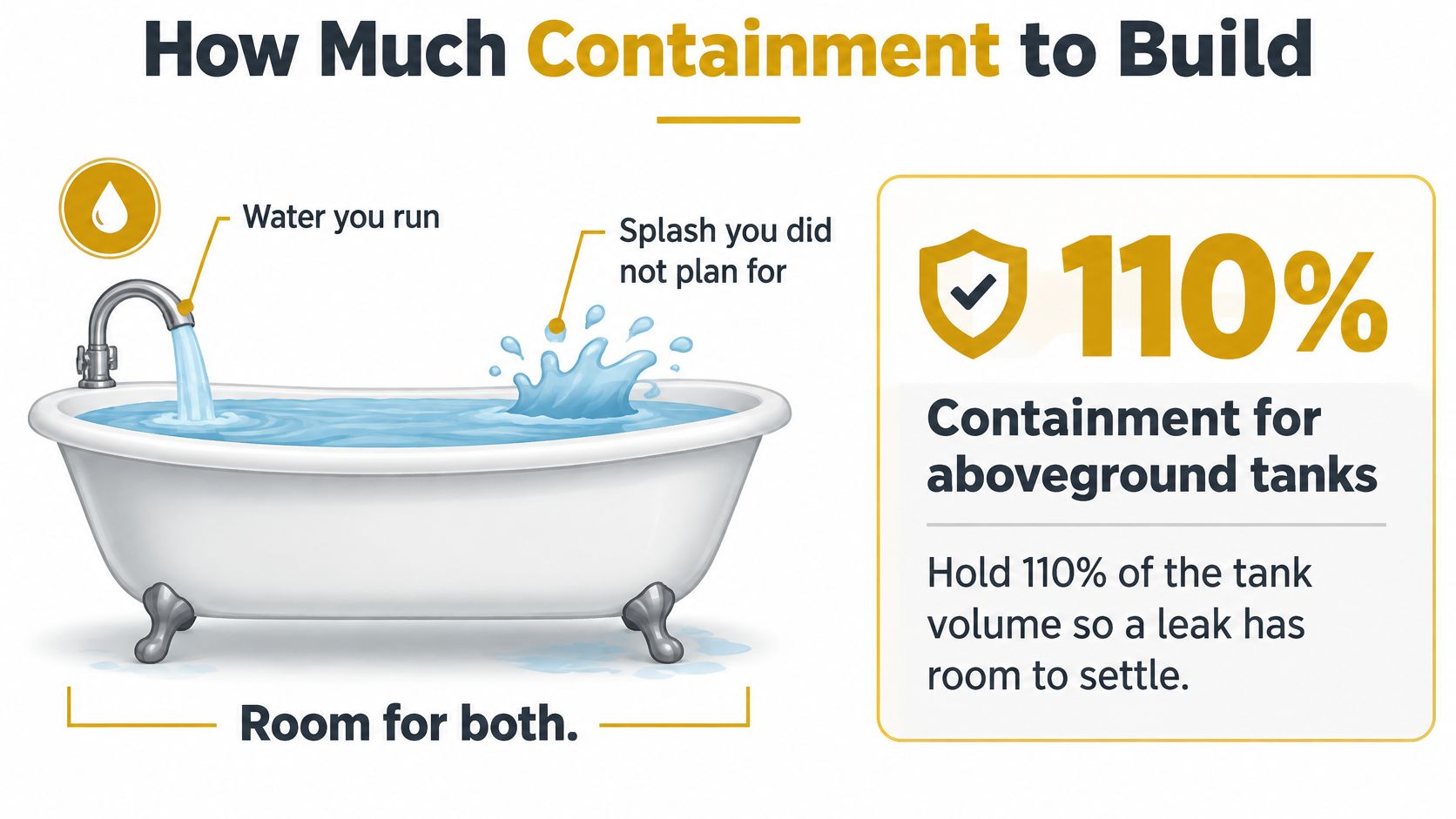
For bulk-storage secondary containment, EPA's guidance on sufficient freeboard identifies a 25-year, 24-hour storm event as a precipitation basis for evaluating sufficient freeboard. That's a bulk-storage design basis, not a universal washout-pan sizing requirement.
Calculate net capacity, not wall-to-wall volume
A containment enclosure can look generous while providing less usable space than its dimensions suggest. Tank bases, supports, grading, and other structures occupy space that spilled liquid would otherwise fill.
Measure to the lowest overflow point, not to the tallest wall. A low access opening or an uncontrolled drain can determine the effective containment height.
Containment sizing basis by setup
| Setup | Containment basis | Add for |
|---|---|---|
| Single aboveground tank | Full tank capacity plus documented precipitation allowance | Site-specific rainfall exposure and operating conditions |
| Multiple tanks in one bund | Largest container's capacity plus precipitation allowance | Displacement from other tanks, supports, and foundations |
| Concrete washout pan | Expected washout volume across the service interval | Rain, accumulated solids, and pickup delay |
| Bulk storage area | Documented release volume and design-storm freeboard | Rainfall across the contributing containment footprint |
Give washout its own calculation
Estimate washout demand from the equipment that is scheduled. A pump cleanup, chute rinse, and finishing-tool wash don't necessarily produce interchangeable volumes. Use the planned work sequence and expected cleanup method rather than assuming every washout is alike.
A useful planning relationship is:
Usable washout capacity = nominal capacity minus accumulated liquid, solids, and the reserve needed for rain and service delays.
Say a pan receives a pump washout, another cleanup before collection, and then overnight rain. Hardened residue remains on the bottom throughout. Even without an overflow, the pan may no longer have enough reserve for the next planned use.
Compare the calculation with the site plan before filling. Confirm the contributing drainage area, service access, overflow elevation, and collection arrangements match what the calculation assumes.
Materials and Design Criteria That Hold Up
Concrete washout containment is a leak-proof pollution-control system, not merely a convenient bin. A container that holds hardened concrete but allows wash water to seep into the ground hasn't done the job.
The EPA's concrete washout guidance identifies the objectives as retaining caustic wash water and cementitious solids so they cannot contact soil or migrate to surface water or groundwater, and recycling collected liquids and solids where practicable. Those objectives determine the barrier, location, and servicing arrangements you need.
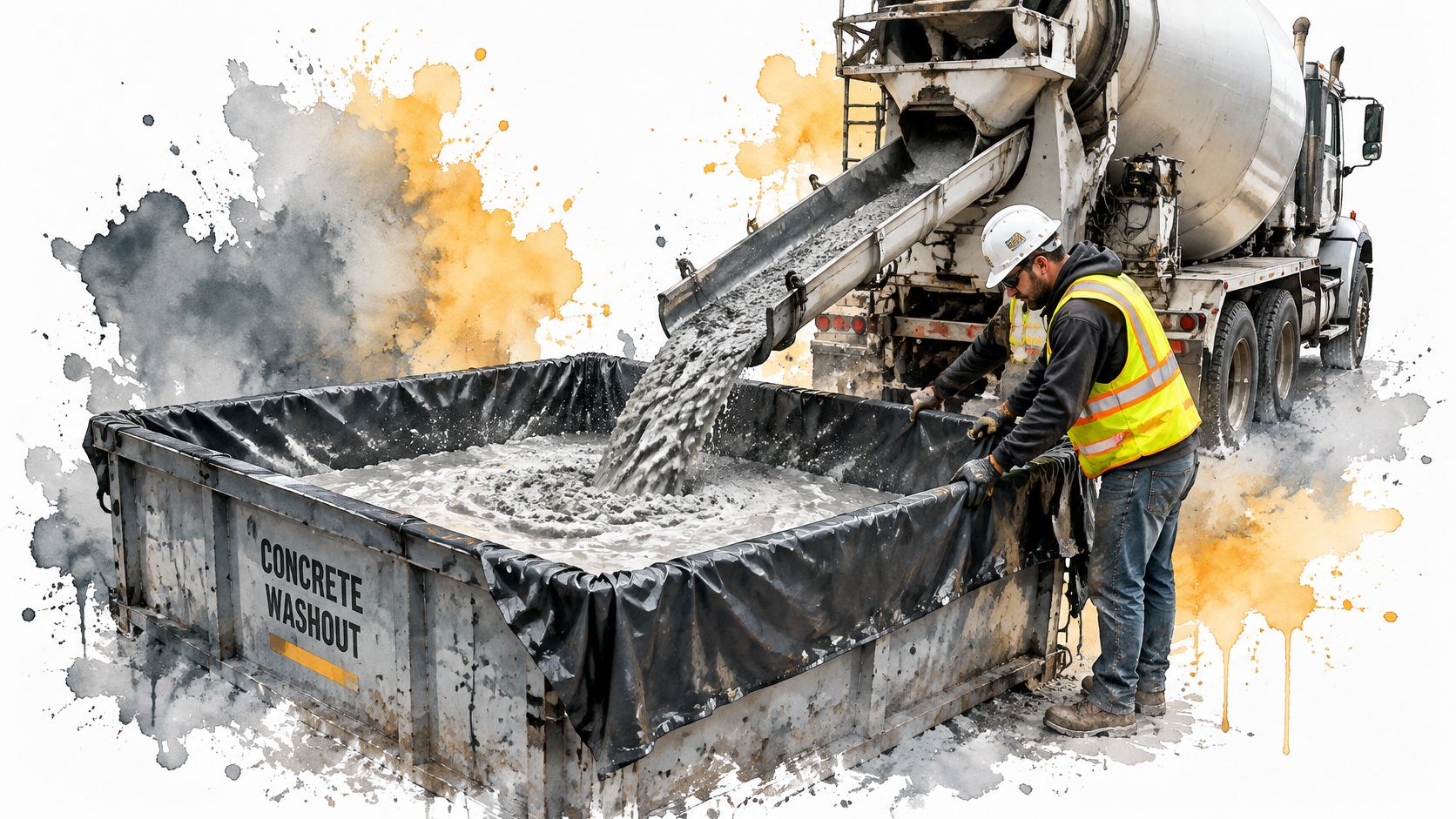
Match the barrier to the waste
Choose intact, chemically compatible liners or nonporous walls. Support the container on stable ground, protect its underside from sharp debris, and keep it away from storm-drain inlets, drainage ditches, and waterbodies.
Containment materials and their watch-outs
| Material | Typical use | Failure point to check |
|---|---|---|
| Steel tank or steel bund | Aboveground oil storage and compatible industrial liquids | Corrosion, weld defects, and damaged protective coatings |
| Polyethylene or HDPE pan or tank | Washout and compatible liquid containment | Chemical compatibility, sunlight exposure, impact damage, and distortion |
| Concrete sump or vault | Permanent containment installations | Cracks, construction joints, seals, and coating condition |
| Lined earthen dike | Large bulk-storage areas | Erosion, settlement, exposed seams, and liner punctures |
| Lined in-ground washout pit | Temporary washout where the permit and site conditions allow it | Aggregate or rebar punctures, damaged edges, and vehicle intrusion |
Material names alone don't establish suitability. Steel can corrode, concrete can crack, and a liner can fail at a seam even when the sheet material remains sound. Ask for compatibility information covering the actual waste and expected contact conditions.
Cement wash water is highly alkaline and carries suspended solids. A barrier suitable for diesel isn't automatically suitable for washout, just as a fuel hose isn't automatically the right hose for every industrial liquid.
Protect the installation during use
Keep sharp aggregate, protruding reinforcement, and equipment outriggers away from liners. For portable containers, inspect the support surface and loading arrangement so the unit won't tilt or overturn during use.
Make repairs with the liner or coating manufacturer's approved materials and procedures. A loose patch or general-purpose sealant may hide damage without restoring liquid tightness.
Before accepting the location, walk the vacuum-removal route. Check ground stability, hose access, overhead obstructions, and whether parked equipment could block collection. Also identify where hardened residue will go, so crews don't solve a full-pan problem by tipping material onto bare ground.
Inspections, Records and Pre-Fill Checks
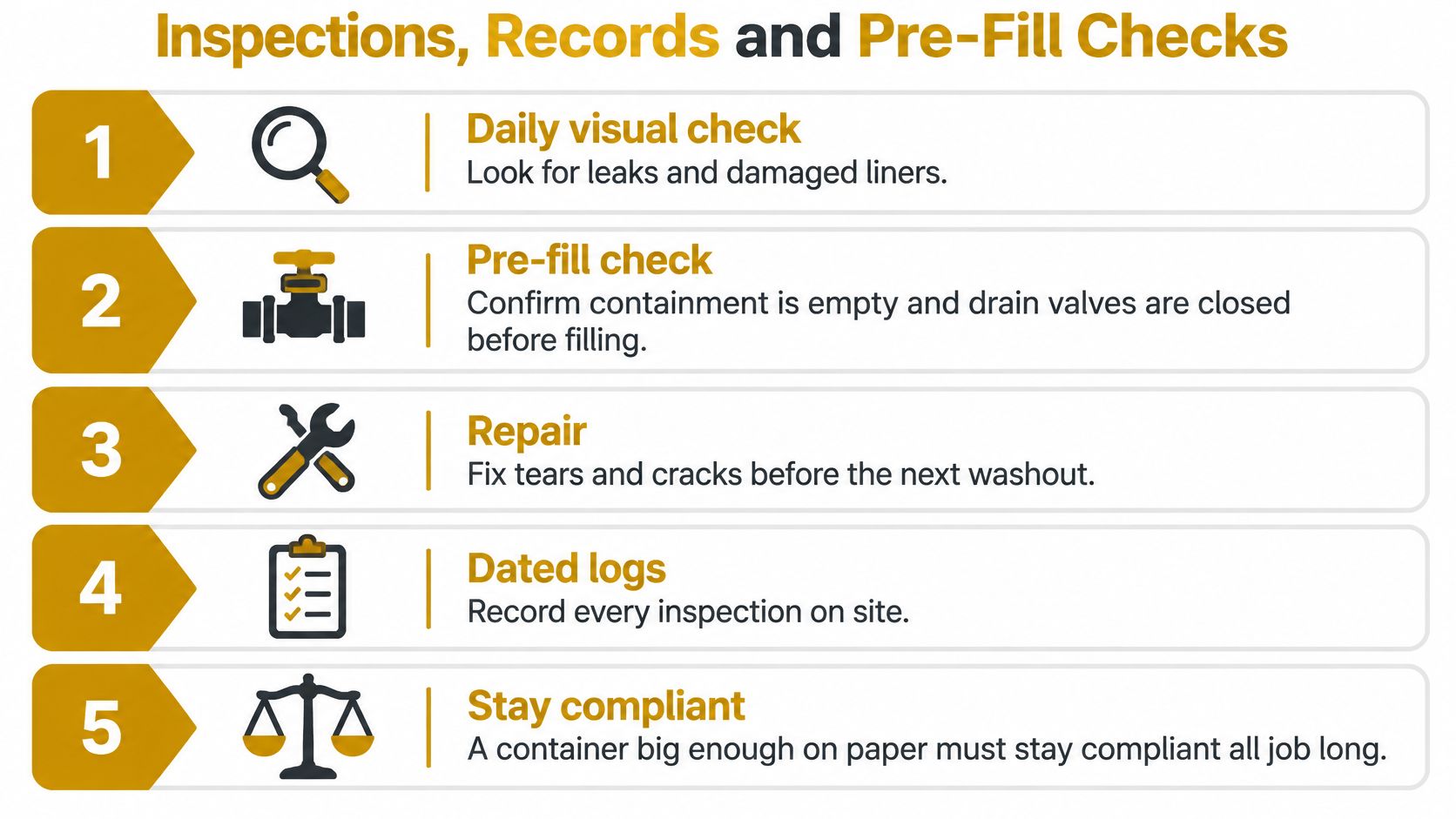
A container can pass its delivery inspection and become unsuitable before the next cleanup. Crews damage liners, concrete builds up around outlets, and equipment traffic shifts supports. The inspection routine needs to catch those changes before another load enters.
Use a field checklist tied to the governing plan, with a named person responsible for completing it:
- Look before use. Check for liquid outside the container, wet ground, damaged liners, distorted walls, and restricted access.
- Recheck after heavy rain. Inspect the liquid level, surrounding runoff routes, and any erosion beneath the unit.
- Arrange removal. Schedule liquid collection and solids handling around the work programme, not only around the rental end date.
- Act before reserve is exhausted. Stop adding waste when the approved operating limit or service trigger is reached.
Make the log useful to the next shift
Record the inspection date, inspector's name, observed condition, corrective action, and whether the container remains available for use. Attach collection or disposal tickets to the relevant entry. Keep records accessible for the period required by the applicable plan and permit.
Write observations that another person can act on. “Liner tear at truck-access corner, washout suspended, repair requested” is useful; “checked” isn't.
For oil storage, use the inspection and testing schedule in the SPCC Plan and the standards it adopts. Don't substitute an informal yard walk for a documented tank inspection, and don't assume a routine visual check replaces formal integrity assessment.
A completed checklist is evidence of an inspection only when someone actually checked the condition described.
Separate routine care from specialist repairs
The operator should keep access clear, remove debris that could damage the barrier, and check seams, supports, and visible surfaces. Follow the manufacturer's operation and maintenance manual. Welding, structural repairs, and major liner repairs need an appropriate procedure and competent personnel.
Our rental terms require customers to perform routine maintenance and cleaning at their expense and follow the manufacturer's preventative-maintenance guidance. That responsibility should be assigned before the equipment arrives, rather than left to whichever crew uses it last.
Our washout pans are NPDES, OSHA, EPA, and BMP compliant and load-tested to 36,000 lbs; the Small Concrete Washout Pan has a 310-gallon capacity. Those equipment credentials don't establish how much liquid a particular job can safely add or replace the site's inspection and servicing obligations.
Complete the pre-fill release
Before filling, confirm that the responsible inspector has signed the log and that any defect has been closed out. Check drain controls, available capacity, stable placement, and the receiving container's identity.
For construction work, keep the stormwater plan and designated washout location available to the crew. For covered oil storage, confirm the SPCC Plan reflects the installation and has the appropriate certification, whether engineer-certified or legitimately self-certified.
Finally, assign the post-storm check before the weather arrives. A named person with access to collection arrangements is more useful than a general instruction to “watch the level.”
Permits and Industry Standards to Know
The permit question and the equipment-standard question are different. A stormwater permit governs how the site manages discharges; a tank construction or inspection standard addresses a particular piece of equipment or inspection programme.
Under EPA's construction stormwater permitting guidance, NPDES permit coverage generally applies to construction disturbing at least 1 acre, including qualifying smaller projects within a larger common plan of development, and washout wastewater from concrete, stucco, paint, and form-release oils cannot be discharged without appropriate controls. A small subcontract area doesn't necessarily mean a small project for permitting purposes.
Request documents by their purpose
The stormwater pollution prevention plan, often called the SWPPP, should identify the washout arrangement and how crews will prevent uncontrolled releases. The oil-storage compliance package should address the facility inventory, containment, inspections, and response arrangements.
For SPCC, determine whether a professional engineer must certify the plan or whether the facility qualifies for self-certification. That decision changes who signs the document, not whether the physical installation needs to perform properly.
Permits and standards and who uses them
| Document | What it covers | Typically used by |
|---|---|---|
| SPCC rule, 40 CFR Part 112 | Oil spill prevention planning, containment, and inspections | Facility owners, operators, and certifying engineers |
| NPDES construction stormwater permit | Construction discharge controls and washout management | General contractors, SWPPP consultants, and site managers |
| UL 142 | Construction of steel aboveground tanks within its scope | Tank manufacturers, suppliers, and specification writers |
| API 650 | Welded steel storage tank construction | Tank designers, fabricators, and project engineers |
| API 653 | Tank inspection, repair, alteration, and reconstruction within its scope | Tank owners and qualified inspectors |
| STI SP001 | Inspection of aboveground storage tanks within its scope | Inspectors and facility maintenance teams |
| NFPA 30 | Flammable and combustible liquid storage and handling | Fire officials, designers, and facility safety managers |
These documents aren't interchangeable approvals. A construction standard doesn't demonstrate that a tank has adequate site containment, and an inspection standard doesn't grant permission to discharge wastewater.
Check the state and local layers
State permits can impose washout operating conditions beyond the federal baseline. Connecticut and North Carolina illustrate why the environmental consultant should check the actual jurisdiction rather than copying a neighbouring project's plan.
Local fire-code requirements may also affect fuel storage location, protection, and handling. Give the tank supplier, environmental consultant, and fire official the same layout so their reviews address the same installation.
Keep the resulting documents together. The field team should be able to identify which permit governs the work, which plan gives operating instructions, and which equipment records demonstrate suitability.
Edge Cases Where Requirements Change
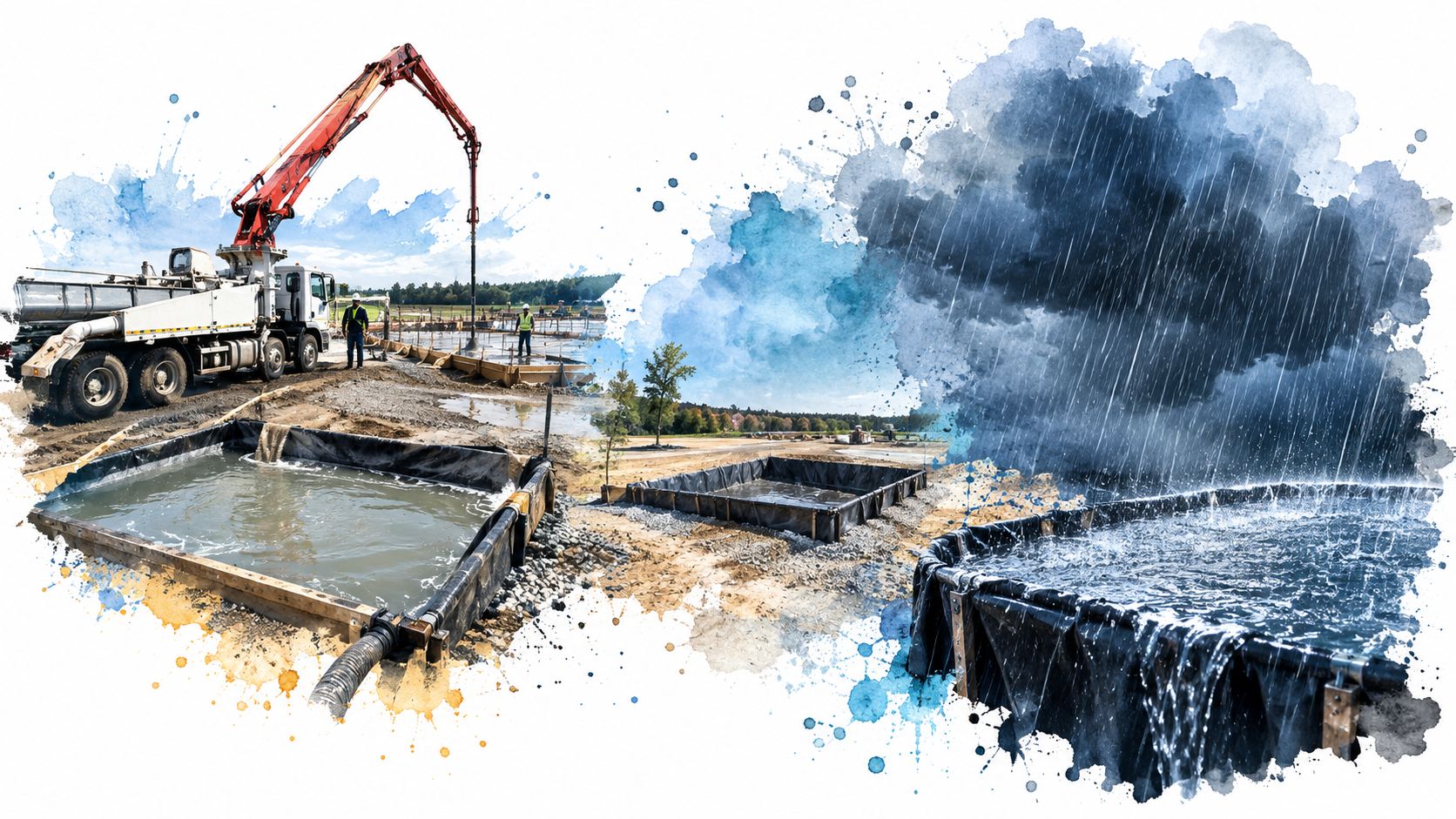
A pump crew washes out on Monday. Another cleanup follows on Wednesday, and a storm arrives Thursday night. Collection is booked for Friday, but the container now holds slurry, hardened residue, and rainwater.
No crack, no leak, nothing visibly wrong. The compliance problem is capacity: the required operating reserve has been consumed, and one more washout could mean an uncontrolled release. Sound steel alone doesn't keep the site compliant.
Set the service trigger before booking collection
Connecticut's 2025 concrete washout BMP guidance recommends daily and post-heavy-rain inspections and action when washout exceeds 75% capacity. Use that kind of operating trigger to schedule service while reserve remains, and confirm the threshold in the permit that governs your site.
The nominal rating is the container's stated volume. The usable operating capacity is smaller, because existing contents and required reserve both come off the top. The rating works like a fuel tank's total capacity: it describes the maximum the shell can hold, while the gauge shows what you can still add. A pan already three-quarters full has a quarter of its rating left, and a storm plus one more washout can consume that before the collection truck arrives. Waiting until liquid reaches the rim leaves no practical response time.
Planning rule: Book collection around the next expected washout and weather exposure. The rental end date alone is the wrong trigger.
Cold weather can slow evaporation, so don't make evaporation the only removal method. Remote infrastructure work and uncertain pickup timing call for additional reserve or a backup collection arrangement.
A cover changes the rain arithmetic. Reborn Rentals' pans take a 72-inch steel lid that seals stormwater out of the slurry, so a covered pan holds the same volume after a storm that it held before. An uncovered pan turns rainfall into capacity you must recover or dispose of.
Mixed waste needs separate attention. Paint residue or chemical slurry can change compatibility and disposal requirements, even when the container can physically hold it. The rental terms prohibit explosives and hazardous products or materials, so identify the waste stream before loading and never treat a concrete washout container as unrestricted chemical storage.
Correct the shortcuts
- A large pan is automatically compliant. Set a documented service trigger, check accumulated solids, and stop use before the operating reserve is lost.
- Rainwater can go into the storm drain. Many state permits prohibit pumping accumulated washout stormwater into drains or receiving waters, so keep a documented rain-management and lawful removal plan.
- A full pan can be dragged to a better spot. Equipment may be moved only with prior notice and consent, and it may leave the jobsite only with written approval, so confirm placement before the first washout, while the pan is still empty.
A workable containment plan tells the crew when to stop, who to call, and where the collected material will go.
Reborn Rentals provides concrete washout containment rentals and concrete waste haul-off and disposal for construction projects. Visit Reborn Rentals to reserve equipment and coordinate delivery and collection around your pour schedule, washout demand, and site access.