
SWPPP Requirements: A Practical Guide for Construction Sites
Rain is moving across the site, the access road is already soft, and a site superintendent is watching brown water head toward a catch basin. The permit binder is missing from the trailer, the concrete crew is asking where to wash out, and nobody can say who owns the next inspection. That's where SWPPP requirements stop being paperwork and become field decisions.
A Stormwater Pollution Prevention Plan must align with the site conditions, drainage patterns, work sequence, and the personnel managing the site. The federal baseline is established by the Clean Water Act's NPDES stormwater program, though state permits introduce their own specific requirements for filing, inspection, updates, and controls. A plan that seemed complete at the start of work can become outdated after a new outfall, haul route, subcontractor, or grading phase is introduced.
The practical standard is simple: identify where pollution can originate, keep it out of stormwater, inspect the controls, repair failures quickly, and preserve records that show what happened.
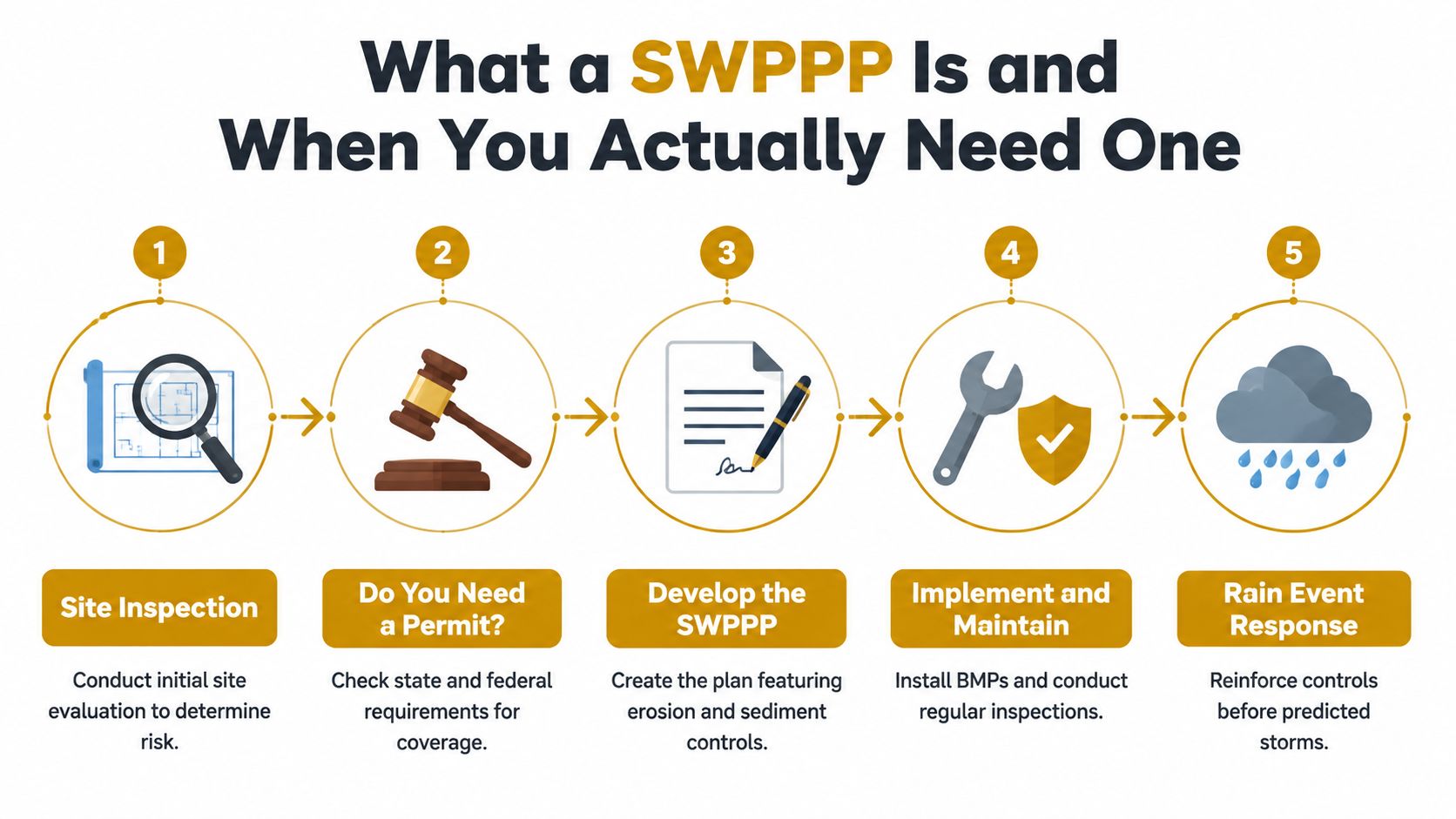
What a SWPPP Is and When You Actually Need One
The first question isn't whether someone has uploaded a template. It's whether the project will disturb enough soil, in the right regulatory context, to require permit coverage. Under EPA construction stormwater guidance, operators generally need NPDES coverage and a SWPPP when construction disturbs one acre or more, or when a smaller site belongs to a common plan of development exceeding one acre.
One acre equals 43,560 square feet, so the threshold catches far more than major subdivisions. Clearing, grading, excavation, utility trenching, stockpiling, road work, and building-pad preparation can all contribute to disturbance. The building footprint is only one part of the calculation. A project below the threshold can also become regulated when separate parcels or phases form one larger development plan.
Check the trigger before mobilization
Start with the site limits, not the permit binder.
- Map all disturbance: Include clearing, grading, cuts, fills, access routes, stockpiles, staging areas, and utility work.
- Check the common plan: Ask whether the parcel is part of a larger development, even if the current contract covers only a small section.
- Confirm the authority: Determine whether EPA or a state permitting agency administers the construction permit.
- File before work begins: EPA guidance states that the SWPPP must be prepared before the Notice of Intent is submitted and implemented from the start of construction through final stabilization.
- Keep the plan live: The document must identify pollution sources, describe controls, and support compliance with permit terms.
Some jurisdictions offer a waiver or alternate path for qualifying small-acreage work, often involving public notice. A fully interior operation or work on a fully paved site may qualify for a no-exposure exclusion, but that conclusion depends on the actual activity and exposure conditions. Don't assume a small footprint is exempt just because the finished building is small.
The cost of getting the determination wrong isn't limited to rewriting a plan. Uncontrolled discharge can lead to a Notice of Violation, corrective orders, project disruption, and penalties that overwhelm the cost of addressing stormwater controls during mobilization. The safest time to resolve coverage is before equipment starts turning soil.
The Required Elements Every SWPPP Must Include
EPA treats a SWPPP as a site-specific, engineering-based pollution prevention document, not a generic erosion-control binder. The EPA Construction General Permit materials describe the plan as a document prepared using good engineering practices, with pollution sources, control practices, and permit compliance procedures identified for the actual site.
A workable plan usually contains six connected pieces. Each one should help someone make a decision in the field.
Build the plan around the site
The site description and runoff map should show drainage areas, slopes, discharge points, receiving waters, and nearby impaired waters where relevant. A map that shows only property lines and a north arrow won't help an inspector understand where sediment will travel during a storm. Name receiving waters and mark storm drain inlets, ditches, stabilized entrances, washout areas, stockpiles, and BMP locations.
The BMP section should explain why selected erosion and sediment controls fit the soil, slope, phase, and drainage pattern. Vegetative stabilization, perimeter controls, inlet protection, sediment traps, slope protection, and flow diversion should appear where the site needs them, not where a template happens to place them.
Good housekeeping belongs in the same operating picture. Include concrete washout, fuel and chemical storage, spill response, portable toilets, waste handling, vehicle maintenance, and concrete curing materials. These sources can create pollution even when the soil controls are intact.
Make signatures and inspection procedures usable
Inspection and maintenance procedures need assigned responsibility, inspection triggers, documentation standards, and corrective-action steps. The delegation-of-authority page must be signed by the appropriate person, and the certification must use the required language and authorized signature. An unsigned delegation form or missing certification isn't a minor formatting defect when the permit is active.
| Required element | What inspectors look for |
|---|---|
| Site description and runoff map | Named receiving waters, drainage paths, slopes, outfalls, and current site features |
| Erosion and sediment controls | BMPs that match actual soil movement, grading, flow, and construction phases |
| Good housekeeping | Washout, fuels, chemicals, waste, toilets, and spill procedures shown in practical locations |
| Inspection and maintenance | Clear cadence, qualified responsibility, findings, repairs, and follow-up |
| Delegation of authority | Complete, signed authorization for assigned permit responsibilities |
| Certification | Required certification language and an authorized signatory |
Every map, narrative, inspection form, and signature creates an enforceable record. If the plan says the washout is on the east side but the crew uses a low point beside an inlet, the field condition wins during an inspection, and the team has to correct both the control and the plan.
Concrete Washout as a High-Risk BMP
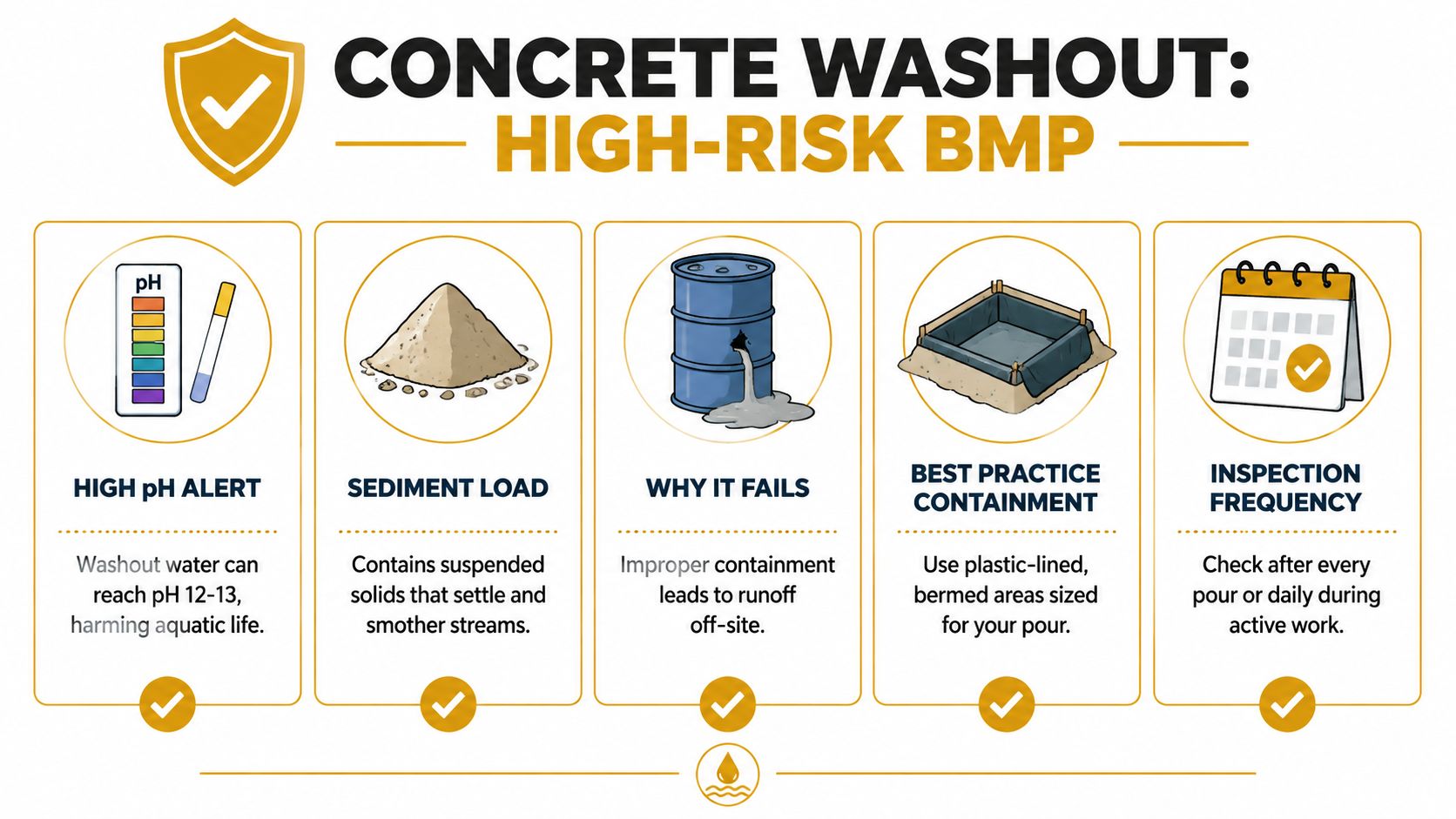
Concrete wash water deserves special attention because it combines alkaline liquid, cement solids, and an easy path to a storm drain. EPA construction SWPPP guidance directs operators to use designated washout areas with signage and containment, and to keep washout away from storm drain inlets, streets, gutters, uncontained ground, and streams.
The practical rule is containment plus location control. Use a leak-proof container, a properly lined pit, or a prefabricated washout system. Keep it away from inlets and waterbodies, and position it where ready-mix trucks can reach it without crossing a drainage path.
Choose containment that crews will use
Above-grade containers are easy to inspect and relocate as pours move. Lined pits can provide useful capacity, but they fail when the liner tears, the side slopes collapse, or groundwater and runoff enter the excavation. Prefabricated bags and bermed systems suit tighter sites when they're properly supported and protected from traffic.
State guidance commonly uses a setback benchmark of about 50 feet from storm drain inlets, open ditches, wetlands, and watercourses, as described in the EPA-hosted SWPPP guide. That same guidance gives examples of prefabricated and constructed washout dimensions, including a prefabricated unit measuring 4 feet by 4 feet by 1 foot with a 4-mil liner, and a constructed washout measuring 6 feet by 6 feet by 3 feet with a 10-mil liner and 2:1 side slopes. Those are examples from specific guidance, not a universal substitute for the controlling permit.
Field rule: If a truck can't reach the washout without backing across a drain path, the location is wrong even if the plan map looks tidy.
Size capacity for the expected pour and inspect the liner before use, after active work, and whenever equipment or debris could damage it. Don't route concrete waste through a sediment basin. Washout is liquid concrete waste, so arrange proper removal before solids harden where possible, and handle cured material according to the approved waste procedure.
Best-Practice BMPs That Hold Up on Real Sites
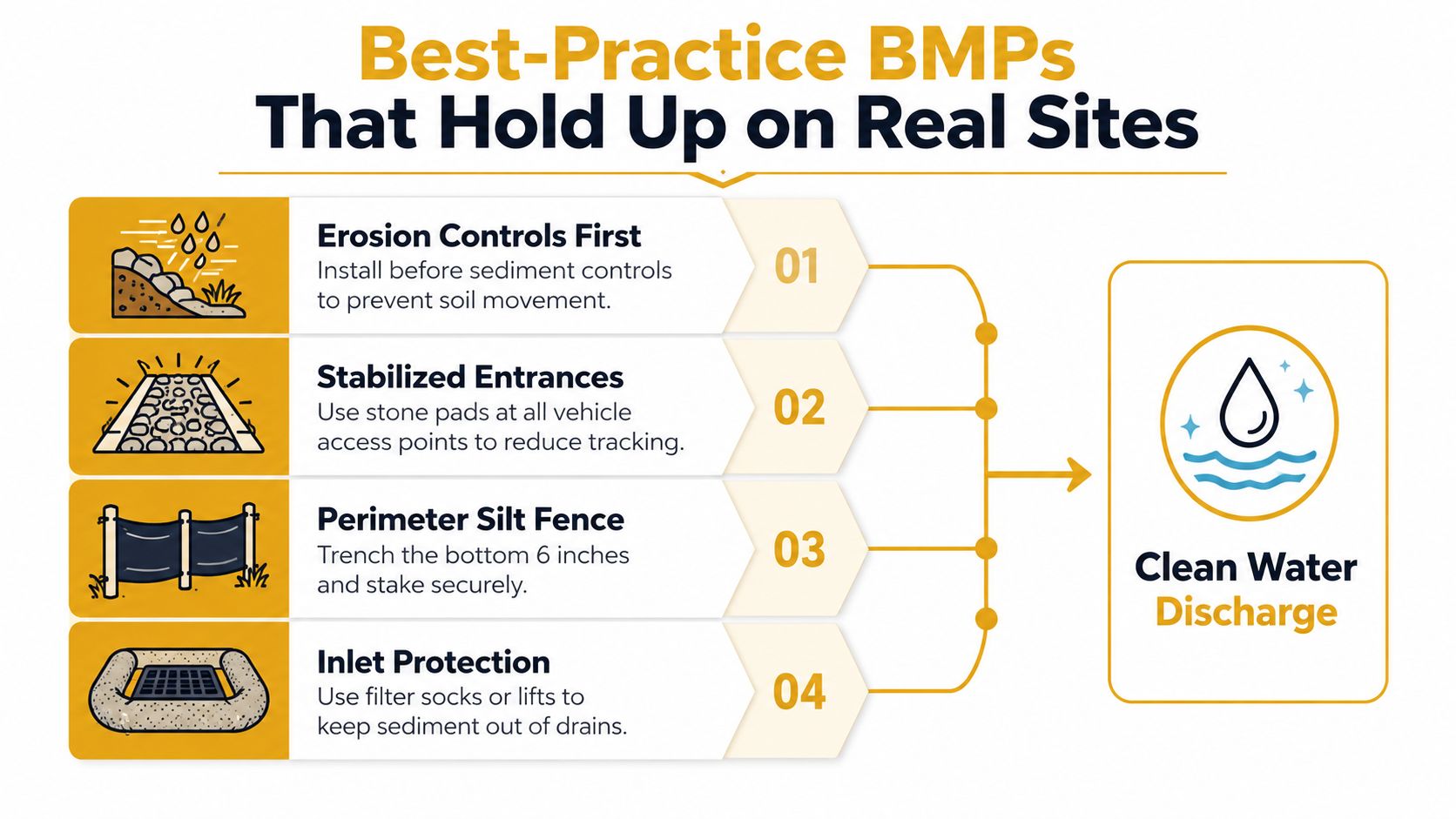
A durable BMP plan works in layers. Erosion controls prevent movement, sediment controls catch what moves, and housekeeping keeps unrelated pollutants from joining the runoff. Installing only the last layer, usually inlet protection, leaves the site dependent on a small device at the bottom of the drainage system.
Install controls before disturbance begins, then adjust them as grading advances. A stabilized entrance should use a rock pad suited to expected traffic and site conditions. Perimeter silt fence works when it follows the contour, is securely staked, and has its bottom trenched into the soil. A loose fabric edge lying on top of churned dirt isn't perimeter protection.
Match the control to the constraint
Tight infill sites force trade-offs. Straw wattles are quick to deploy but can move or flatten under concentrated flow. Compost socks conform well around irregular edges and can work where trenching is difficult, while sediment logs may provide a sturdier barrier in some applications but require proper anchoring and maintenance. The right choice depends on slope, flow, soil, access, and the permit detail.
A foreman's ten-minute briefing should cover:
- Erosion first: Stabilize exposed slopes, protect soil during pauses, and keep runoff from gaining speed.
- Sediment second: Place silt fence, socks, logs, traps, and inlet protection where they intercept the actual drainage path.
- Traffic control: Use one stabilized entrance route and repair tracking before it reaches public pavement.
- Housekeeping: Protect fuel, paint, fertilizer, curing compounds, waste, and equipment from rain and runoff.
- Phase control: Remove or relocate controls only when the drainage area is stabilized and the plan reflects the change.
Walk the perimeter regularly, including after active grading and weather. Repair a breached fence, buried inlet, displaced wattles, or rutted entrance as soon as it's found. A control that fails halfway through the project isn't a partial success. It is an open discharge route until someone fixes it.
Inspections, Maintenance, and Records That Survive an Audit
A SWPPP inspection is a field investigation, not a signature exercise. Under the 2022 Construction General Permit, the cadence is generally every 7 days and within 24 hours after rainfall of 0.5 inches or greater, as specified in the permit materials and applicable state administration. The inspection must be performed by qualified personnel who can recognize a failing BMP and recommend a workable repair.
The inspector should walk every relevant drainage path. Record the BMP location, current condition, visible discharge, maintenance need, corrective action, responsible person, and date. A photo helps establish what the inspector saw, but it doesn't replace a written finding.
Make corrective action traceable
A useful log tells the story from discovery to closure. If sediment has reached an inlet, record the inlet location, the condition of the upstream control, the immediate cleanup, the repair, and the follow-up check. If the drainage area becomes permanently stabilized, document why the associated temporary control can be removed.
Keep signed inspection reports for at least 3 years, with access available when the agency requests them. The exact retention and accessibility rules should be checked against the controlling permit, but a practical digital structure is consistent across projects:
- Permit and approvals: NOI, permit coverage, authorizations, and current SWPPP.
- Inspections: Date-named reports, signatures, weather notes, and photos.
- Corrective actions: Open items, assigned owners, repair evidence, and closure checks.
- Changes: Revised maps, new subcontractors, phase changes, and amended procedures.
- Storm response: Rain observations, discharge records, cleanup, and follow-up.
| Requirement | EPA Construction General Permit | Common state variation |
|---|---|---|
| Routine inspection | Permit-defined recurring inspection schedule | States may add stricter frequency or triggers |
| Rainfall response | Inspection after the permit's qualifying rainfall event | Some programs use different event thresholds or windows |
| Qualified personnel | Trained or otherwise qualified inspector | State programs may define credentials more specifically |
| Corrective action | Document findings, repairs, and follow-up | State forms and deadlines can differ |
| Record retention | Preserve signed reports for the required period | State permits may add electronic access or filing duties |
A complete log that records a breach and a timely repair is more defensible than a spotless log with unexplained gaps. Inspectors understand that active sites have failures. They question records that pretend otherwise.
Why SWPPP Requirements Differ From State to State
The federal Construction General Permit provides a baseline, not a universal operating manual. States with NPDES authority can add requirements covering electronic registration, inspection timing, reporting, updates, discharge limits, and post-construction controls. The EPA SWPPP development guidance is useful for the common framework, but it won't answer every state-specific filing question.
The drift is especially important for contractors working across state lines. Recent 2025 and 2026 permit developments described in the available EPA guidance include Connecticut electronic registration and reporting changes, Tennessee requirements for an updated SWPPP with NOI submission, Washington update deadlines for industrial stormwater plans, and frequent inspection expectations in some New York programs. These changes affect administrative work as much as field controls.
Verify the controlling authority
Don't copy yesterday's state checklist into a new project without checking the current permit.
| State or program example | Notable variation | Practical site impact |
|---|---|---|
| Connecticut | Electronic registration and reporting changes in the 2025 industrial permit | The team must plan for digital submissions and deadlines |
| Tennessee | Updated SWPPP required with NOI submission under the 2025 multi-sector permit | The plan has to be current when coverage is filed |
| Washington | 2025 ISGP update deadline for SWPPP changes | Plan revisions need deadline tracking, not informal edits |
| New York | Some programs use frequent inspection expectations | Staffing and field coverage may need adjustment |
Claims about California washout sizing, Washington turbidity benchmarks, and Florida inspection triggers require confirmation in the specific state permit before they're written into a project procedure. The safest workflow is to identify the state agency, permit type, receiving water, and project category first. Then confirm the current NOI process, update rules, inspection triggers, and record obligations before finalizing the SWPPP.
Common Violations and How to Prevent Them
Most enforcement problems begin with ordinary production pressure. A new subcontractor arrives, the grading plan changes, a pour gets moved, or a storm bypasses the forecast. The violation appears later as a missing control, an inaccurate map, a discharge, or a log that doesn't explain what the team did.
Fix the field failure, then fix the system
| Common violation | Root cause | Corrective action |
|---|---|---|
| SWPPP missing or outdated on site | The binder stayed in a remote office, or site changes never reached the plan | Keep the current plan accessible and revise maps, BMPs, and responsibilities when conditions change |
| Uncontrolled washout or slurry discharge | No pre-pour location, damaged liner, or truck access conflict | Stop the discharge, contain and remove waste, repair the washout, and brief the concrete crew before the next pour |
| Sediment plume leaving the property | Controls were installed after grading or a flow path bypassed them | Trace the discharge uphill, stabilize the source, reinforce perimeter and flow controls, and document the repair |
| Inlet protection missing or buried | Inlets appeared after the last plan update, or sediment accumulated unchecked | Mark every inlet during the walk, install the specified protection, and clean or replace it when capacity is reduced |
| Inspection logs incomplete | Whoever happened to walk the site signed without checking each BMP | Assign qualified personnel, use a location-based form, attach photos, and close corrective actions with dates |
| Disturbed soil left unstabilized | Grading phases outran the stabilization plan or weather delayed the work | Sequence stabilization with grading, protect exposed areas during pauses, and document the approved method and timing |
Weekly photo logs are useful because they connect the written inspection to the actual site. Photograph recurring risk points from consistent locations, especially outfalls, inlets, entrances, perimeter controls, washouts, and active slopes. Photos won't cure a discharge, but they expose deterioration before the next inspection.
Pre-pour planning prevents many washout failures. The concrete lead should know the designated location, access route, containment type, capacity, signage, and who will arrange removal. The same principle applies to grading. Before a new area opens, confirm the downstream controls are installed and the site map reflects the new drainage pattern.
Field-Ready SWPPP Checklist for Construction Teams
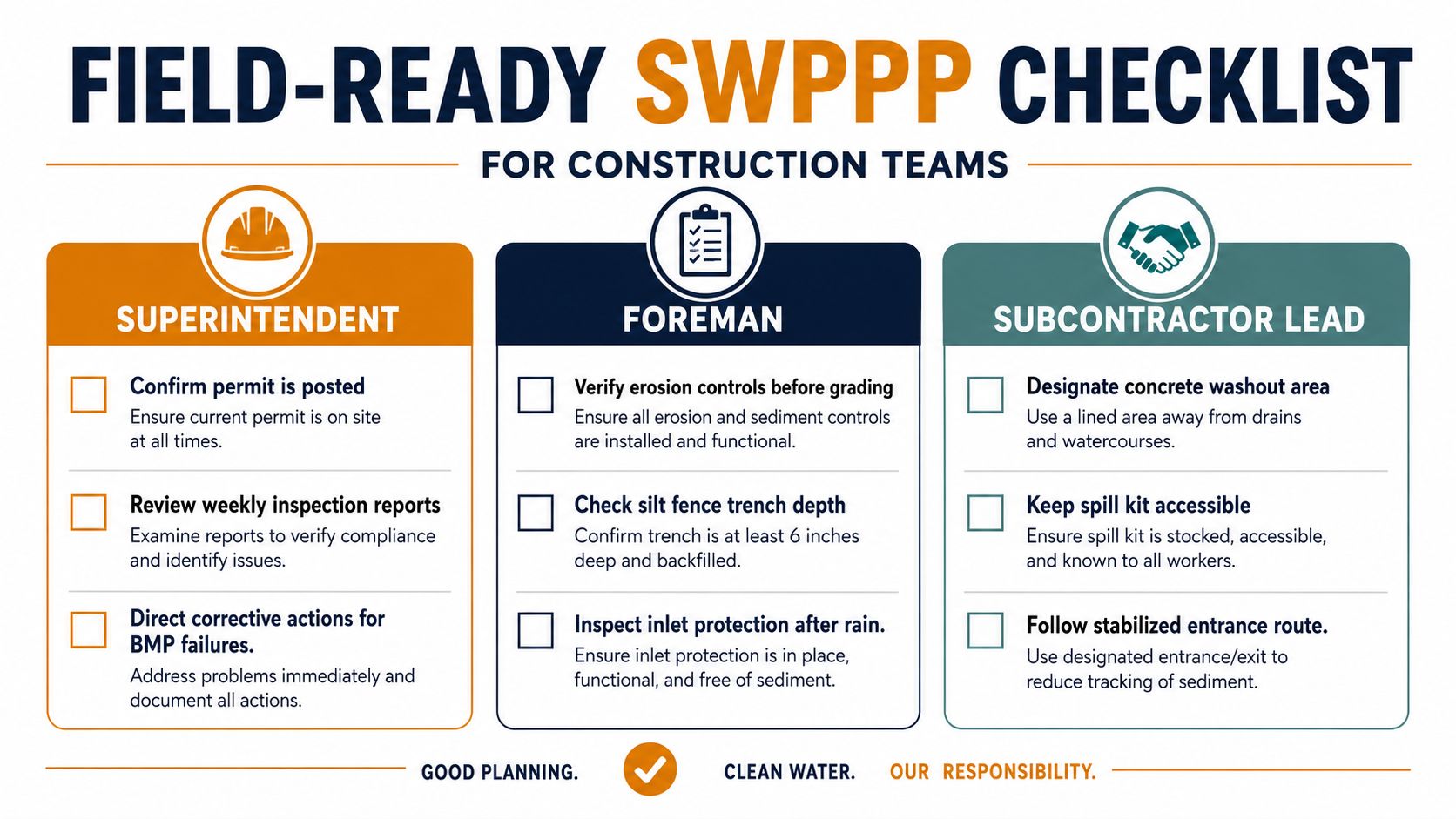
Tape this checklist inside the job trailer, then make the responsibilities explicit. A plan only works when the superintendent, foreman, and subcontractor lead know what they own before rain or concrete makes the decision for them.
Superintendent
- Confirm coverage: Verify the permit decision, NOI status, applicable fee or registration step, and current plan before disturbance.
- Control the document: Keep the SWPPP accessible, signed, current, and consistent with active grading, drainage, contractors, and BMP locations.
- Review inspections: Check reports, signatures, photographs, open corrective actions, and the next inspection date.
- Direct repairs: Assign owners and deadlines when a fence, inlet, entrance, washout, slope, or outfall fails.
- Escalate uncertainty: Call the SWPPP designer or permitting contact when the work expands, drainage changes, or a new discharge path appears.
Foreman
- Walk before work: Confirm erosion and sediment controls are installed before grading, excavation, stockpiling, or utility work.
- Check the perimeter: Look for undermined or torn silt fence, bypassed wattles, ruts, and sediment reaching the property edge.
- Inspect inlets: Check protection after rainfall, nearby grading, and heavy traffic. Remove accumulated sediment before flow bypasses the control.
- Manage access: Keep trucks on the stabilized entrance route and correct tracking before it reaches public roads.
- Report changes: Tell the superintendent when the field no longer matches the SWPPP map or BMP narrative.
Subcontractor lead
- Plan the pour: Confirm the designated washout area, containment, signage, access route, and responsible cleanup person before concrete arrives.
- Protect materials: Keep fuel, paint, curing compounds, waste, and spill kits away from runoff paths.
- Follow the route: Use the stabilized entrance and keep equipment out of washout and drainage areas.
- Stop and report: Halt work if slurry, sediment, or contaminated water is moving toward an inlet, ditch, or waterbody.
- Close the task: Leave the area clean, inspect the liner or container, and report capacity or damage before the next crew arrives.
At the end of each week, ask three questions: Does the site map still match the ground? Are any corrective actions open? When and who is performing the next inspection? That short review catches small omissions before they become enforcement evidence.
For concrete crews that need ready-to-deploy containment, Reborn Rentals offers washout pans and containers for short-term construction use, with listed options, delivery coordination, and upfront daily pricing available through Reborn Rentals. Check the required capacity, location, access, and permit conditions first, then arrange the containment before the pour rather than after slurry reaches a drain.